Mark Zuckerberg on Open Source
Mark Zuckerberg sees open source AI as the best way to spread capability widely, drive invention, and avoid concentrating power in one company or one model.
- He wants AI capabilities shared broadly, not concentrated in a few labs or one giant system.
- He argues open source speeds invention and lets more people and businesses build useful agents.
- He thinks safety comes from checks, balance of power, and widespread access, not only restriction.
- He still supports guardrails against clear harms like crime assistance and abuse.
- He believes open models can also be strong products, including freely available assistants.

“…the best antidote to someone having an AI that could potentially hack into systems is having everyone have access to an AI…”Huge Conversations with Cleo Abram, 2024 · 2:52
He treats openness as the default direction for AI
Zuckerberg’s basic stance is that important AI advances should be shared widely. He describes Meta’s orientation as broad distribution of what it invents, and he repeatedly presents open source as part of that philosophy rather than as a side tactic.1
That view connects to his belief that the next era of computing should favor an open ecosystem. He is not arguing only for publishing code; he is arguing for a technology landscape where capability is spread across many builders instead of locked inside a few companies.2
He does not want one giant AI to dominate everything
A central idea in Zuckerberg’s open source argument is that AI should be plural, not centralized. He says people should not interact with just one big AI, and he draws a parallel to how people use many different apps for different purposes rather than one universal destination.45
That leads to a world with many specialized agents: personal agents, creator agents, business agents, and tools adapted to local needs. Open models help that ecosystem form because they give more people a base they can customize instead of forcing everyone into the same product.678
His main reason is invention, not just automation
Zuckerberg frames AI’s biggest value as helping people create new things. He says the primary purpose of AI is invention rather than automation, which makes broad access especially important: if more people can use powerful tools, more ideas can turn into products, art, services, and discoveries.9
This is why open source matters so much in his worldview. If AI is mainly for invention, then limiting it to a small set of labs would limit who gets to create. He wants ordinary users, developers, creators, and businesses to be able to build agents for themselves and for their communities.87
He argues open source can improve safety through checks and balance
Zuckerberg’s safety argument is not that open source removes risk. It is that the safer long-run system comes from checks and balances and a wider distribution of capability, rather than concentrating power and hoping a few actors always make the right decisions.
He even extends that logic to offensive capabilities, arguing that broad access can be a defense against misuse by any one actor. In his framing, safety comes partly from balance of power: if powerful AI exists, the answer is often to make sure others have strong tools too.10
“…the best antidote to someone having an AI that could potentially hack into systems is having everyone have access to an AI…”Huge Conversations with Cleo Abram, 2024 · full transcript →
Open does not mean no guardrails
Although Zuckerberg is strongly pro open source, he is clear that some limits are necessary. He says AI systems should not help people commit crimes, and he describes danger largely as amplifying already known harms.1112
So his view is not openness at any cost. It is openness combined with practical restrictions on clearly harmful use, especially around abuse, crime, and other direct safety threats. He tends to separate those obvious harms from harder disputes where the right intervention is less clear.121113
He thinks open models can also win on product quality and adoption
Zuckerberg does not present open source as a sacrifice in capability. He argues that Meta’s assistant, powered by Llama 3, is a freely available system with very strong intelligence, and he ties open release directly to a broad developer and product strategy.14
He also talks about building enough computing capacity to pursue what is coming next, which fits his larger bet that open models can remain competitive as AI becomes more capable and more agentic. In his view, the future is not a single chatbot but a growing set of systems that can reason through multi-step goals and work on behalf of users and businesses.16177
Zuckerberg on open source, in his own words
“…the best antidote to someone having an AI that could potentially hack into systems is having everyone have access to an AI…”
“I am kind of hopeful that in the next generation of computing, we're gonna return to a zone where the open ecosystem wins…”
“…we don't have one app that we go to for everything. I don't think that we want one AI.”
Where to watch
 Mark Zuckerberg on Open Source AI: Why Every Business Needs an AI2024 · 59 min · full transcriptBest single overview of why he thinks open ecosystems, many agents, and business customization matter for AI.
 Mark Zuckerberg on Meta AI Agents: Muse, Privacy, and Open Source2024 · 70 min · full transcriptMost direct statement of his principles: invention over automation, broad distribution, and safety through checks and balances.
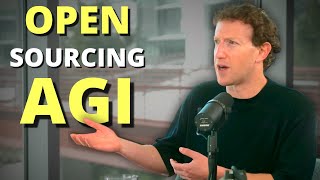 Mark Zuckerberg on Open Source AI: Llama 3, Scale, and Safety2024 · 79 min · full transcriptShows how he connects open source to product quality, Llama 3, and a freely available assistant.
 Mark Zuckerberg on AI Moderation: Open Models, Safety, and Speech2023 · 167 min · full transcriptBest for understanding how his support for openness coexists with safety limits and moderation rules.
 Mark Zuckerberg on Threads and Open Source AI: Building for Scale2024 · 69 min · full transcriptUseful for his argument against one universal AI and in favor of a wider ecosystem of specialized tools.
Questions people ask
Sources
Every quote above, word for word from the transcripts. Numbers match the text.
“…our ethos is that we want to share what’s invented broadly…”
“I am kind of hopeful that in the next generation of computing, we're gonna return to a zone where the open ecosystem wins…”
“…there shouldn't just be kind of one big AI that people interact with.”
“…we don't have one app that we go to for everything. I don't think that we want one AI.”
“…give every person in the world a very capable personal agent that can understand their goals…”
“I think in the future, every business is gonna have an AI agent that interfaces with their customers.”
“We wanna empower all the people who use our products to basically create agents for themselves.”
“…the primary purpose for AI is going to be invention of new things, not automation…”
“…the best antidote to someone having an AI that could potentially hack into systems is having everyone have access to an AI…”
“…you can't ask it to help you commit a crime…”
“…the danger is basically amplifying the kind of known set of harms…”
“…we want to allow people to express as much as possible…”
“…with Llama three, we now think that Meta AI is the most intelligent AI assistant that people can use that's freely available.”
“…we always wanna have enough capacity to build something that we can't quite see that were on the horizon yet.”
“Reasoning, I think, is another example. It's like, okay, yeah, maybe you want to chat with a creator or, you know, you're a business and you're trying to interact with a customer. You know, that interaction is not just like, okay, the person sends you a message and you just reply, right? It's like a multi step interaction where you're trying to think through how do I accomplish the person's goals. And, you know, a lot of times when a customer comes, they don't necessarily know exactly what they're looking for or how to ask their questions. So it's not really the job of the AI to just respond to the question. It's like you need to kind of think about it more holistically. It really becomes a reasoning problem. Right? So if someone else, you know, solves reasoning or makes good advances on reasoning and we're sitting here with a basic chatbot, then our product is lame compared to what other people are building.”
How this guide was made: drafted with AI from the full transcripts of the recordings cited, then checked: every quotation must match a transcript word for word and be the speaker's own words, and an independent review gates accuracy. Methodology and corrections.