The Price of Trust
Defaulting to truth makes society possible and makes deception possible.

“They just assume everyone's honest. Turns out that's a really good way to make a lot of money, right? The people who are sitting in their home like so paranoid that their money is under a mattress, those people don't make any money, right? So, it's like it's weirdly adaptive to be taken in by Madoff. It's, you know, it’s a sign that you are someone who's generally trusting. Mm-hmm. It's probably a positive thing.”92nd Street Y conversation, 2019 · 9:24
The lesson
Gladwell’s argument starts with a paradox: the same habit that makes social life work also makes deception possible. We usually begin by believing other people, not by interrogating them, and he treats that tendency as normal and useful rather than foolishness12. At the same time, this leaves us exposed to frauds, abusers, and liars who benefit from our willingness to trust3.
This matters because people are not nearly as good at reading strangers as they think. Across these conversations, Gladwell argues that we routinely misjudge faces, demeanor, and behavior, and that encounters go wrong when we place too much confidence in those quick interpretations45. His point is not simply that some people lie well; it is that the rest of us overestimate our ability to detect lies and hidden intentions in the first place63.
That is why deception often survives in plain sight. Gladwell emphasizes that modern secrets are not always hidden behind elaborate cover stories; sometimes they remain visible, but people fail to act on what they see because trust and denial are powerful defaults78. Cases like Madoff illustrate the logic: institutions and investors often prosper by assuming honesty, so the same trait that helps them function can also delay suspicion when suspicion would be costly or socially disruptive92.
The chapter also connects trust to tragic misunderstandings, not just long-running frauds. In Gladwell’s account of stranger encounters, especially policing, the danger comes when people make high-stakes judgments too quickly and with too much confidence1011. His practical lesson is not to eliminate trust altogether, which would carry its own severe cost, but to approach strangers with more caution, humility, and time so that fewer errors harden into disasters1213.
4 principles from Malcolm Gladwell
Treat default trust as adaptive, not naive
Gladwell’s point is that society depends on a baseline assumption that most people are telling the truth. In your own life, start by seeing trust as a functional social strategy, while remembering that its benefits come with real vulnerabilities.
“They just assume everyone's honest. Turns out that's a really good way to make a lot of money, right? The people who are sitting in their home like so paranoid that their money is under a mattress, those people don't make any money, right? So, it's like it's weirdly adaptive to be taken in by Madoff. It's, you know, it’s a sign that you are someone who's generally trusting. Mm-hmm. It's probably a positive thing.”
Do not overrate your lie-detection ability
We tend to think we can spot dishonesty from behavior, expression, or tone, but Gladwell argues that confidence here is misplaced. Apply this by being less certain that a person’s face or manner tells you what is true.
“…we should be good at that and we're not…”
Expect deception to hide in plain sight
The problem is often not total secrecy but our reluctance to reinterpret what is already visible. When something feels off, ask whether familiarity, reputation, or convenience is keeping you from seeing it clearly.
“…the way you hide secrets is in plain sight…”
Respond with caution and humility, not cynicism
Gladwell is not calling for universal suspicion; he is calling for less certainty about what we know from brief encounters. The practical stance is to remain open to being wrong and to design decisions accordingly.
“I want people to have, when I end, a call for caution and humility…”
In his own words
The quotes behind the lesson, word for word from the transcripts. Numbers match the lesson above.
“WE ARE CONDITIONED BY EVOLUTION TO BASICALLY ASSUME THAT EVERYONE IS TELLING THE TRUTH…”
“…the cost of that insight is too high…”
“…we are pretty bad at discerning when someone's trying to deceive us…”
“…we're not very good at talking to strangers…”
“YEAH. SO WHAT I WANTED TO DO WITH THE BOOK IS TO SYSTEMATICALLY BREAK DOWN THE FAULTY ASSUMPTIONS THAT LEAD ENCOUNTERS BETWEEN STRANGERS TO GO AWRY. SO I MEET YOU FOR THE FIRST TIME. ALL WE KNOW ABOUT EACH OTHER IS WHAT WE CAN SEE ABOUT EACH OTHER. WE START TO HAVE A CONVERSATION. SOMETIMES THAT GOES WELL. SOMETIMES IT GOES HORRIBLY WRONG. BUT WE'RE MAKING JUDGMENTS ALL THE TIME... THE WHOLE TIME. ...BASED ON OUR OWN UNCONSCIOUS BIASES AND CONSCIOUS, CORRECT? EXACTLY. I'LL GIVE YOU ONE OF THE ONES THAT I SPENT A LOT OF TIME ON, IS WHAT I CALL THE ASSUMPTION OF TRANSPARENCY, WHICH IS, WHEN I SEE YOU, I OBSERVE YOUR DEMEANOR, YOUR FACE, YOUR EXPRESSIONS, YOUR EMOTIONS, YOUR BODY LANGUAGE, AND I DRAW CONCLUSIONS ABOUT THAT.”
“…we should be good at that and we're not…”
“…the way you hide secrets is in plain sight…”
“Anyone who's in the gymnastics world of, of around Penn State knew Larry Nassar, but they didn't really know him. And Michigan State—yeah, Michigan State, man—they didn't really know him, and that, you know, partly because we have powerful mechanisms of denial, probably because, you know, if you are a pedophile, you spend a lot of time trying to obscure your behavior from people, but partly because what we're talking about, like people have many, many different dimensions and it takes—it took a very long time for some of those parents to come around to the idea that this man was—took actually finding 37,000 images on his hard drive for many of them to come around to the notion that he might.”
“They just assume everyone's honest. Turns out that's a really good way to make a lot of money, right? The people who are sitting in their home like so paranoid that their money is under a mattress, those people don't make any money, right? So, it's like it's weirdly adaptive to be taken in by Madoff. It's, you know, it’s a sign that you are someone who's generally trusting. Mm-hmm. It's probably a positive thing.”
“I wanted to write about because if you break that exchange down moment by moment, you see multiple failures of understanding…”
“WHEN YOU SENT THIS OFF TO YOUR PUBLISHER AND YOU HAD DONE THE FINAL PAGE AND BROUGHT US ALL THE WAY BACK AROUND TO SANDRA BLAND, YOUR DEEPEST HOPE FOR THE BOOK WAS... THAT WE WOULD ALL ACKNOWLEDGE OUR COMPLICITY IN THE DEATH OF SANDRA BLAND. THAT THAT WASN'T ABOUT A ROGUE COP AND A STUPID SMALL TOWN AND WHAT HAVE YOU. IT WAS ABOUT THAT WE HAVE INSTITUTIONALIZED WAYS OF DEALING WITH STRANGERS THAT MAKE NO SENSE. WE HAVE ASKED POLICE OFFICERS, REQUIRED THEM, FORCED THEM, PUSHED THEM TO MAKING JUDGMENTS ABOUT PEOPLE THAT SHOULDN'T BE MADE.”
“…what your job is is to add seconds into the encounter…”
“I want people to have, when I end, a call for caution and humility…”
Reflect
- Where in your work or life do you rely on default trust because it keeps things moving, and what specific risks come with that choice?
- Think of a time you felt sure you had read a stranger correctly from their expression or behavior. What evidence did you actually have, and what might you have missed?
- What is one high-stakes situation in which you should add time, questions, or de-escalation before making a judgment about someone?
Check your understanding
Go deeper
 Malcolm Gladwell on Truth and Deception: Why We Miss the Signs2019 · 71 min · full transcript
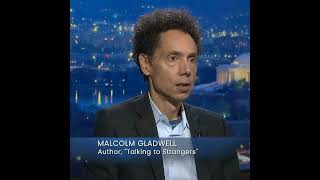 Malcolm Gladwell on Talking to Strangers: Trust, Error, and Tragedy2019 · 57 min · full transcript
 Malcolm Gladwell on Talking to Strangers: Why Trust Goes Wrong2019 · 42 min · full transcript
 Malcolm Gladwell on Trust and Strangers: Why We Misread People2019 · 88 min · full transcript
 Malcolm Gladwell on Talking to Strangers: Why Encounters Go Wrong2019 · 159 min · full transcript
- What did Malcolm Gladwell say about why people miss signs of abuse or deception?
- Why does Malcolm Gladwell think trust can be a good thing, even when it leads to fraud?
- What did Malcolm Gladwell say about spies and living undercover?
- What is Malcolm Gladwell's main idea in Talking to Strangers?
- Why does Malcolm Gladwell say people need to slow down when dealing with strangers?