Howard Marks on Second-Level Thinking
Marks says second-level thinking is the investor’s edge: not just having a view, but having a better-than-consensus view on value, price, risk, and psychology.
- Second-level thinking means going beyond the obvious and reaching a view that is better than consensus, not merely different.
- It starts with price versus intrinsic value, because a great asset can still be a bad investment if you pay too much.
- It requires humility about forecasting and a focus on preparing for a range of outcomes.
- It is inseparable from risk control, since success comes from upside with less-than-proportionate downside.
- It often means acting against crowd psychology when optimism or pessimism has become extreme.

“None of this is any good unless the person making the decision has superior judgment. And the first chapter of the book says the most important thing is second level thinking. Most people think on the first level. To be a superior investor, you must think on the second level. You have to think different from everybody else. But in being different, you have to be better. So the first level thinker is naive. He says, this is a great company, let's buy the stock. The second level thinker says it's a great company, but it's not as great as everybody thinks it is. We better sell the stock. That's the difference between being an average person and a person with superior insight.”Talks at Google, 2012 · 49:01
Second-level thinking means being different and more right
Marks treats second-level thinking as a basic requirement for superior investing, not a clever extra. The average investor stops at the obvious conclusion, while the better investor asks what is already priced in, what others believe, and whether that belief is too optimistic or too pessimistic. The point is not novelty for its own sake, but insight that is both different from consensus and better than consensus.12
That is why simply spotting a great company is not enough. If everyone already agrees it is great, the key question becomes whether expectations have gone too far. In Marks’s framing, the gap between average and superior results comes from thinking one step beyond the crowd’s first reaction.12
“None of this is any good unless the person making the decision has superior judgment. And the first chapter of the book says the most important thing is second level thinking. Most people think on the first level. To be a superior investor, you must think on the second level. You have to think different from everybody else. But in being different, you have to be better. So the first level thinker is naive. He says, this is a great company, let's buy the stock. The second level thinker says it's a great company, but it's not as great as everybody thinks it is. We better sell the stock. That's the difference between being an average person and a person with superior insight.”Talks at Google, 2012 · full transcript →
Price is the hinge: a good asset is not always a good investment
For Marks, second-level thinking is grounded in valuation. He repeatedly comes back to the idea that investment success depends less on what you buy than on what you pay, because price determines whether future outcomes are favorable or dangerous.34
That leads directly to intrinsic value. He defines value investing as estimating what something is worth from its cash-flow-generating ability and buying only when price is meaningfully below that value. Second-level thinking therefore asks not just whether something is good, but whether the current price already assumes too much goodness.5678
This is also why he resists rigid labels. If value comes from future cash flows, then the investor has to stay open-minded and judge each case on its merits rather than by style-box rules.910

“What I've put down here is, I think, a working definition of value investing. It consists of quantifying what something is worth intrinsically, based primarily on fundamental cash flow generating capabilities, and buying it if the price represents a meaningful discount from that value. I have firmly said that cash flow generating capabilities are what create value—that stocks, bonds, and buildings and companies have cash flow generating capabilities and can be.”Virtual Value Investing Conference keynote and Q&A, 2024 · full transcript →
Second-level thinkers respect uncertainty instead of pretending to predict
Marks does not tie superior investing to bold forecasts. He argues that the future is inherently uncertain, that randomness plays a large role, and that deviant forecasts are not consistently valuable. That pushes the investor away from confident prediction and toward judgment under uncertainty.111213
His alternative is preparation. Rather than pretending to know exactly what will happen, the investor should recognize that many things can happen and shape the portfolio to survive and prosper across a range of outcomes.14151617
This mindset also demands mental flexibility. Marks describes changing his mind only after challenging his mind, which captures the discipline of testing one’s own assumptions instead of falling in love with a thesis.18
The test of second-level thinking is risk-adjusted judgment
Marks ties second-level thinking closely to risk control. He says the real achievement in investing is not simply making money, but earning returns while taking less-than-proportionate risk. In his language, the goal is asymmetry: enough upside when things go well and less downside when they do not.192021
That view changes what good thinking looks like. A second-level thinker does not ask only how much can be made, but also what can go wrong, how permanent the loss could be, and whether the downside is survivable. For Marks, the most important risk is permanent loss of capital, and risk cannot be reduced to neat formulas in advance.222324
This is one reason he is drawn to approaches where avoiding mistakes matters enormously. His repeated idea that avoiding losers can be enough reflects a style of second-level thinking that is defensive, selective, and highly aware of bad outcomes before they happen.25262728
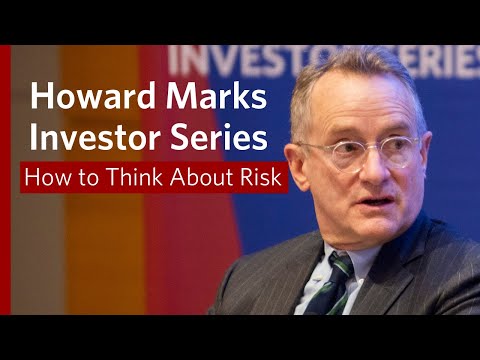
“So I start off by asking, what is risk? And I think, as I just said, it is the ultimate test of investor skill. It's not hard to achieve investment returns, as I said, especially when the market goes up, which it does almost all the time. And I think that the real achievement is achieved -- is getting return with -- while taking less than proportionate risk. And at many times throughout this presentation, I'll probably talk about something I call asymmetry. And this should be, in my opinion, your goal as an investor. Asymmetry, which means that in a certain favorable setting, you make a certain amount of money. In an analogous unfavorable setting, you lose less.”Wharton School Investor Series conversation, 2021 · full transcript →
Crowd psychology creates the opportunities second-level thinkers need
Marks believes markets are shaped by emotion as much as by fundamentals. Investors swing from greed to fear, and in their minds conditions move from nearly perfect to nearly hopeless. Those exaggerations create mispricings for anyone able to stay rational.293031
This is why second-level thinking is often contrarian in practice. When behavior becomes imprudent and expectations become too favorable, risk rises even if recent experience looks reassuring. And when others become excessively fearful, prices can become attractive.323334
But he is careful here: being right on value does not tell you when the market will agree. An overpriced asset does not have to fall tomorrow, and being early can look the same as being wrong. So second-level thinking requires patience, staying power, and the ability to look out of step for a long time.35363734
Marks on second-level thinking, in his own words
“None of this is any good unless the person making the decision has superior judgment. And the first chapter of the book says the most important thing is second level thinking. Most people think on the first level. To be a superior investor, you must think on the second level. You have to think different from everybody else. But in being different, you have to be better. So the first level thinker is naive. He says, this is a great company, let's buy the stock. The second level thinker says it's a great company, but it's not as great as everybody thinks it is. We better sell the stock. That's the difference between being an average person and a person with superior insight.”
“Superior performance does not come from being right but from being more right than the consensus.”
Where to watch
 Howard Marks on Truth About Investing: brutal lessons from markets2005 · 57 min · full transcriptBest single source for Marks’s direct explanation that superior performance comes from being more right than consensus, not just right.
 Howard Marks on Investing Philosophy: Origins and Inspirations2012 · 69 min · full transcriptShows how second-level thinking fits into his broader philosophy of judgment, humility, and avoiding losers.
 Howard Marks on Investing Risk: How to Think About It2021 · 86 min · full transcriptExplains why second-level thinking must be risk-aware, asymmetric, and humble about the unknowable future.
 Howard Marks on Market Cycles: Why Extremes Matter2017 · 49 min · full transcriptBest for seeing how second-level thinking works in real markets when psychology becomes extreme and timing is hard.
 Howard Marks on Value Investing: Rethinking Growth and Tech2024 · 59 min · full transcriptConnects second-level thinking to intrinsic value, cash flows, and avoiding simplistic labels like value versus growth.
Questions people ask
- What did Howard Marks mean by second-level thinking?
- What did Howard Marks say about asymmetry in investing?
- What did Howard Marks say about forecasting in investing?
- What did Howard Marks say about learning from bad investments?
- What did Howard Marks say about waiting for the bottom?
- What did Howard Marks say about being contrarian and second-level thinking?
Sources
Every quote above, word for word from the transcripts. Numbers match the text.
“None of this is any good unless the person making the decision has superior judgment. And the first chapter of the book says the most important thing is second level thinking. Most people think on the first level. To be a superior investor, you must think on the second level. You have to think different from everybody else. But in being different, you have to be better. So the first level thinker is naive. He says, this is a great company, let's buy the stock. The second level thinker says it's a great company, but it's not as great as everybody thinks it is. We better sell the stock. That's the difference between being an average person and a person with superior insight.”
“Superior performance does not come from being right but from being more right than the consensus.”
“It's not what you buy, it's what you pay that counts.”
“Investing is not a matter of what you buy, it's what you pay.”
“What I've put down here is, I think, a working definition of value investing. It consists of quantifying what something is worth intrinsically, based primarily on fundamental cash flow generating capabilities, and buying it if the price represents a meaningful discount from that value. I have firmly said that cash flow generating capabilities are what create value—that stocks, bonds, and buildings and companies have cash flow generating capabilities and can be.”
“It consists of quantifying what something is worth intrinsically…”
“…cash flow generating capabilities are what create value…”
“The fact that a security has a high P/E ratio doesn't mean it's overpriced.”
“There shouldn't be a big distinction between value and growth…”
“Um, let me see if there's anything else I want to say on that subject. Um, I think that—I think that, uh, you know, the whole thing is about open-mindedness and trying not to have, uh, things that strictly delimit what you will do. Have an open mind and, uh, you know, see if things can be—like, for example, a lot of people say we don't do technology, and is that appropriate? Is there no situation to which, uh, you know, that a value investor can invest, on a value basis, in a tech company? Uh, are they really?”
“The views of that forecaster would not be of any value to you unless he was right consistently. And nobody's right consistently in making deviant forecasts. So the bottom line for me is their forecasting is not valuable. And that's something that my experience has told me. So we don't know what's going to happen and randomness will play a big role in what happens. And randomness is, by definition, unpredictable.”
“We have two kinds of forecasters—the ones who don't know and the ones who don't know they don't know.”
“All the sophistication in the world will not change the fact that all your knowledge is about the past, and all your decisions are about the future.”
“You can predict you can't predict, you can prepare.”
“…risk means more things can happen than will happen…”
“Risk means more things can happen than will happen.”
“And he said in there -- I wanted to include these quotes in the new memo. He said in there essentially risk says we don't know what's going to happen. That's what risk is. We don't know what's going to happen in the future. We walk every moment into the unknown. There's a range of outcomes, and we don't know where the actual outcome is going to fall within the range. Often, we don't even know what the range is. You have to interiorize that until you have a real appreciation for risk. Now, we may -- If we're lucky, we get to enumerate the possible outcomes. If we're even luckier and smarter, we get to say which are more likely, which are less likely. Still doesn't tell us which is going to happen. This is an essential concept. You can understand the possibilities, probabilities.”
“I changed my mind, but first, I first I challenged my mind.”
“So I start off by asking, what is risk? And I think, as I just said, it is the ultimate test of investor skill. It's not hard to achieve investment returns, as I said, especially when the market goes up, which it does almost all the time. And I think that the real achievement is achieved -- is getting return with -- while taking less than proportionate risk. And at many times throughout this presentation, I'll probably talk about something I call asymmetry. And this should be, in my opinion, your goal as an investor. Asymmetry, which means that in a certain favorable setting, you make a certain amount of money. In an analogous unfavorable setting, you lose less.”
“…the most important thing in investing is controlling risk…”
“…the most important thing is risk…”
“The most important risk is the permanent loss of capital.”
“So the point is that volatility is measurable. It's just not right. And, you know, Einstein -- there's a great quote from Einstein, who said that not everything that counts can be counted, and not everything that can be counted counts. And it's one of the things that guides me, and I hope it'll guide you. And so, as I say here in bold, volatility can be an indicator of the presence of risk. Sometimes things fluctuate, because they are inherently risky, a symptom that is, but volatility is not risk itself. So what is risk? If you think about it, what is the lay definition of risk? It's the probability of a bad event. So the -- I think the most important risk is the permanent loss of capital. Now, permanent is an important word, because things fluctuate. And a downward fluctuation, by definition, is temporary.”
“If you think about it, as I described it, secular trend, oscillation around the trend, in general, each high is higher than the preceding high. So if you buy at a high, you may feel badly when it hits a low, but when it returns, when it recovers, as historically, it always has, you feel okay. You're ahead. That's -- so buying high and seeing a decline is not the worst thing in the world. Selling low and missing the rise, I think, is the cardinal sin of investing, because it takes you out of the game at a time when you don't want to be out of the game. Now, let's think a little more theoretically. An important thing for you to note, I think, is that risk is unquantifiable in advance.”
“…if we avoid the losers, the winners take care of themselves…”
“…avoiding the losers is good enough.”
“I just don't have to hit any losers. So Charlie Ellis took this idea to investing. Should you go for winners or should you try to avoid hitting losers? And that appealed to me. And, given my chicken nature, I said, well, I can win by not hitting losers. And so, now, Oaktree, my company, invests primarily in credit. You make a bunch of loans. If you can make a bunch of loans without having any that default, you'll get the return you were after. So that's a good formula in credit, or in fixed income, or in debt, or bonds, whatever you want to call it. It's not a good formula in venture capital or even in equities-- or maybe in real estate.”
“Well, this is what we call a postmortem, which is what you do with stiffs in the morgue. You figure out why you went bad. And, again, since you can't quantify risk after the fact, you look at a failure, you can't be -- necessarily be so sure you know why it failed. Could be a variety of reasons. But you can enumerate them, attach possibilities, and learn from them. That's the key with past investments is learning from them. Especially failures. Andrew, one of the things he developed for his fund, is what he calls a pre-mortem. Rather than figure out why something died after it died, figure out why it could die before it dies.”
“…the human brain's ability to reject information which is at odds with its predisposition…”
“…in real life, things fluctuate between pretty good and not so hot. But in the minds of investors, they go from flawless to hopeless.”
“Excesses and corrections, excesses and corrections.”
“When behavior is imprudent, then asset prices go too high based on favorable expectations, and the world becomes a risky place.”
“…too much money chasing too few deals…”
“Now, everybody says, "Well yes, I am anti-cyclical, I am contrarian, I'm a second-level thinker, I reach conclusions which are different from others and better." But if you are those things, you have to do things which diverge from the consensus. You know, if you like, if you buy the things that the consensus thinks are great, you're unlikely to find a great bargain. Everybody else likes it too. So you have to buy the things that they don't like, which means that you will look like you're out of step. And, you know, you have to be able to live with that for a long time, even with the pressure that comes from clients and and…”
“…being too far ahead of your time is indistinguishable from being wrong…”
“…overpriced and going down tomorrow are not synonymous…”
“One of my favorite sayings is never forget the six foot tall man who drowned crossing the stream that was five feet deep on average. We can't live by the averages. We can't say, well, I'm happy to survive on average. We got to survive on the bad days. And if you're a decision maker, you have to survive long enough for the correctness of your decision to become evidence. And you can't count on it happening right away. I always remind people overpriced is not the same as going down tomorrow. And if you bear that simple truth in mind, I think it helps.”
How this guide was made: drafted with AI from the full transcripts of the recordings cited, then checked: every quotation must match a transcript word for word and be the speaker's own words, and an independent review gates accuracy. Methodology and corrections.


