What did Howard Marks say about learning from bad investments?
Howard Marks says you should do a postmortem after a bad investment, but you can never be completely sure whether the loss came from bad judgment or bad luck. The best you can do is enumerate the possible reasons, assign probabilities, and learn from them. He also recommends a pre-mortem: think about how an investment could fail before you make it.
“Well, this is what we call a postmortem, which is what you do with stiffs in the morgue. You figure out why you went bad. And, again, since you can't quantify risk after the fact, you look at a failure, you can't be -- necessarily be so sure you know why it failed. Could be a variety of reasons. But you can enumerate them, attach possibilities, and learn from them. That's the key with past investments is learning from them. Especially failures. Andrew, one of the things he developed for his fund, is what he calls a pre-mortem. Rather than figure out why something died after it died, figure out why it could die before it dies.”
Key takeaways
- Review failures systematically instead of guessing one cause
- List possible reasons for a loss and learn from each
- Use a pre-mortem to identify risks before investing
Context
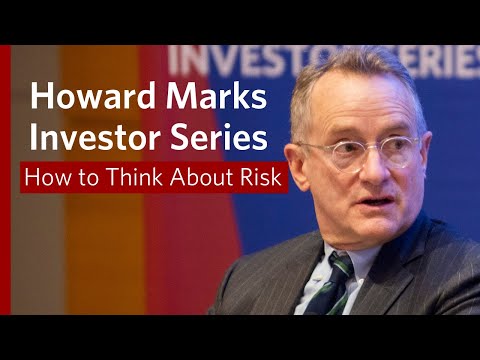
At a 2021 Wharton School Investor Series conversation, Marks was answering a student question about how to learn from negative investment outcomes. The quote above is taken word for word from the recording's transcript.
In the transcript
…so much for coming. My name is [UNINTEL]. And my question was, I'm curious, I was very intrigued to hear that probability distributions are not very quantifiable. So given like a negative outcome in the present, how do you know if your strategy was inefficient, or how do you -- or if you were just unlucky? How do you derive learnings from a negative outcome and sort of correct forward?
Well, this is what we call a postmortem, which is what you do with stiffs in the morgue. You figure out why you went bad. And, again, since you can't quantify risk after the fact, you look at a failure, you can't be -- necessarily be so sure you know why it failed. Could be a variety of reasons. But you can enumerate them, attach possibilities, and learn from them. That's the key with past investments is learning from them. Especially failures. Andrew, one of the things he developed for his fund, is what he calls a pre-mortem. Rather than figure out why something died after it died, figure out why it could die before it dies.
And you know, if the possibility of death is high, because there are lots of things that could kill it, maybe you don't do it. Or maybe you take some steps to remediate that. But, you know, I think that the post mortem is very important. And since the markets are always evolving, you have to learn as you go. You know, if I was still doing the things I…
Read the full transcript of Wharton School Investor Series conversation, 2021
Topics
What others said about decision making
More questions about Howard Marks
- What did Howard Marks say about asymmetry in investing?
- What did Howard Marks say about volatility and risk?
- What did Howard Marks say about selling at the bottom?
- What did Howard Marks say about the future and uncertainty?
- What did Howard Marks say about the difference between stocks and bonds?
- What did Howard Marks say about macro forecasting and investing?
How this answer was made: the quote is checked word for word against the transcript of the recording and confirmed as the speaker's own words; the summary above it was drafted with AI from that transcript and quality-checked. Methodology and corrections.