Howard Marks on Investing Risk: How to Think About It

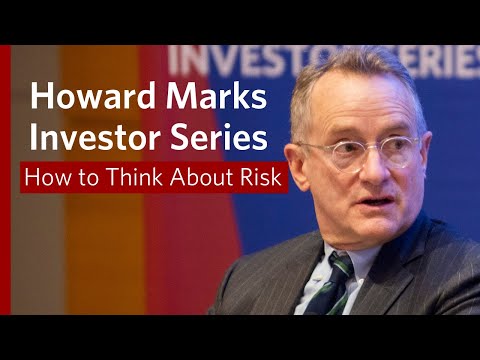
What Marks talks about
Howard Marks gave this Wharton School Investor Series talk in 2021, reflecting on investing risk, market cycles, investor behavior, and the limits of quantifying uncertainty.
Also known as: Investing Risk – Wharton School Investor Series; Wharton School Investor Series conversation on investing risk.
Howard Marks argues that risk is the central challenge in investing, but that it is often misunderstood as volatility. He says the real test is whether an investor can achieve asymmetry: good upside participation with limited downside.
He explains that risk is subjective, forward-looking, and impossible to quantify precisely in advance or even after the fact. Instead of relying on models, he says investors should use judgment to assess ranges of outcomes, probabilities, and the possibility of unfavorable surprises.
Marks also emphasizes that risk comes from behavior and psychology, not from the asset itself. Markets, leverage, forced selling, and false confidence can turn seemingly safe situations dangerous, while cheap assets can be relatively safe if priced well.
Erika James and Chris Geczy introduce and moderate; an audience member asks a question near the end.
In his words
“Volatility is not risk itself.”
“The most important risk is the permanent loss of capital.”
“Risk means more things can happen than will happen.”
“All the sophistication in the world will not change the fact that all your knowledge is about the past, and all your decisions are about the future.”
“It's only when the tide goes out that we find out who's been swimming naked”
Key points
- Volatility is measurable, but it is not the same as risk.
- The most important form of risk is permanent loss of capital.
- Missing out on gains and being forced to sell at the bottom are also major risks.
- Risk is subjective and cannot be quantified reliably in advance or in hindsight.
- Good investing is about buying things well, not just buying good things.
- Risk comes from investor behavior, leverage, and complacency as much as from the asset itself.
- An investor should aim for asymmetry: more upside than downside.
Full transcript: Howard Marks, Wharton School Investor Series talk on investing risk (2021)
Erika James: All right. All right, well welcome everyone to the Howard Marks Investor Series. And thank you all for joining us today. I am so pleased to have this opportunity to welcome back to campus an alum whose dedication as a benefactor and supporter of this lecture series has delivered invaluable advice and thought leadership to thousands of students over its eight years in existence. I feel like I see you, Howard, more than almost any other person who's coming back to visit. So thank you for making this such a frequent stop for you. So as you all know, Howard Marks is the co- chairman of the Oaktree Capital Management. Since the formation of Oaktree in 1995, he has been responsible for ensuring the firm's adherence to its core investment philosophy, communicating closely with clients concerning products and strategies, and contributing his experience to big picture decisions relating to investments and corporate direction. Previously, Howard was the -- was with the TCW Group, where he was Chief Investment Officer for the domestic fixed income, and with Citicorp Investment Management, where he progressed from Equity Research Analyst to Director of Research and then Vice President and Senior Portfolio Manager. Howard holds a bachelor's degree in economics with a major in finance from Wharton, and an MBA from the Booth School at the University of Chicago. He's the author of several books, including The Most Important Thing, Uncommon Sense For The Thoughtful Investor, and Mastering The Market Cycle: Getting The Odds On Your Side.
He is a Professor of Practice at Kings Business School in London, and serves on the Shanghai International Financial Advisory Council, and the advisory board of Duke Kunshan University. A long standing partner to Wharton and the University of Pennsylvania, he is an emeritus trustee of the university, and chaired Penn's investment board from 2000 to 2010. His support led to the establishment of the Howard Marks Endowed Professorship at Wharton, the Howard Marks Professorship for Faculty in Economic History, and the Howard Marks Endowed Scholarship for Undergraduate Students. He also endowed the Marks Family Center for Excellence in Writing at Penn Arts and Sciences, and established this lecture series, the Howard Marks Investor Series, with his gift to Wharton in 2014. I am also delighted to introduce today's event, who will be moderated by Professor Chris Geczy. Chris is an Adjunct Professor of Finance as well as the Academic Director of the Wharton Wealth Management Initiative, and the Jacob Levy's Equity Management Center for Quantitative Financial Research at Wharton. Would you all please join me in a warm welcome to Howard Marks and Chris Geczy.
Chris Geczy: Thank you, Dean James. It's great to see you for perhaps among the first times without a mask. It's great, we're getting through it. As far as masks go, for folks in the room, what Howard has asked is that between the sessions, or as the session is, if you'd be so kind to put on your mask, but until then masks are optional for you who are in the room, and obviously for those of you who are coming in remotely. So thanks again for everyone who has joined us today. As our Dean said, Howard and his family have been friends and supporters and graduates of Penn and Wharton for a number of decades. Among a number of truly impactful initiatives they have motivated, we are grateful for the generous gift that established this speaker series, which has brought many prominent names in investing to campus to share their thoughts as well as literally thousands of students and observers. The former group includes people like Stan Druckenmiller, Bruce Karsch, Seth Klarman, Steve Schwarzman, and of course, perhaps most notably, Howard himself. I'm sure many of you are familiar with Howard and with Oaktree Capital Management as the most well known manager of distressed debt in the world, but also as a leader more generally in credit, in private equity, real assets and in listed equities. You also probably know of Oaktree Memos, which I encourage you to explore in depth if you haven't already. In my view, they are required reading, and as some of you know, if you take my investments class or other classes that I teach, they're nothing less than required reading. I learned earlier today
that the memos now go out to more than 100,000 recipients, many of whom, of course, then pass them on to others. Howard, that would be impressive enough if we're a Twitter or a TikTok account, much less something as deep and important as your memos. Howard will be speaking with us today about the important topic of risk, and he'll cover several sub topics and important points relevant for defining risk, for thinking about from where it comes, whether we can measure it, how to measure it, if so, what it means for investors, and the potential relationship between risk and reward. I hope you all had a chance to read Howard's memo related to this presentation, which is called "Risk Revisited." Again, it's a classic. If you haven't, a link to it's available on the Mark Series website. Howard describes it as containing everything I know about risk, and is replete with wisdom appropriate for the generations, and for better or for worse, quite naturally for today. Now, before we get started, I hope it's clear that we collectively truly appreciate all the ways in which Howard shares his expertise and his presence with the next generation of Wharton and Penn students. Just last month, he served as one of the keynote speakers at the inaugural Women -- Working Women In Investing Conference. And since Howard joined that event virtually, I'd like to invite the conference co-chairs, Bonnie Wang and Sophia Kim, up to give him a token of the group's appreciation. Howard, thank you so much for your presence in the conference.
Howard Marks: Thank you. Thank you. It's not necessary, but I appreciate it. Nice to meet you. Speaker: Thank you so much. - Thank you Bonnie and Sophia. And thank you, Howard once again. And now let's turn it over to Howard. Once again, Howard Marks. - Thank you, Chris. Thank you all for turning out. And that includes the people who are on virtually. As Chris said, I'm talking about risk today, I'll -- let me say this. In the past, I brought down some of my friends for interviews. And now that COVID is I think over we will get back to that. But today you're stuck with me. I've done the last couple of sessions, just Q&A. But today, I thought I would share with you one of my presentations on the subject of risk. I do believe that risk is extremely important for practitioners, and is in many ways is the most interesting aspect of investing.
To the point where -- well, you know, my first book was called The Most Important Thing. It consists of 21 chapters, each one of which says the most important thing is, and then it's a different thing. Because there are so many things in investing that are the most important thing. But I did dedicate three chapters to risk of the 21. The most important thing is understanding risk, recognizing risk, and controlling risk. Likewise, I've written in the -- in the years I've been writing the memos, three memos on risk. "Risk in '06", "Risk Revisited in '14", and "Risk Revisited Again in '16." And as Chris says, I'm very happy with the one on the latter of those, the "Risk Revisited Again."
And, you know, I think that investing essentially consists of trying to make money and trying to control risk. And making money is easy. It's especially easy when the market goes up. And the market goes up seven or eight years out of every 10. And over the last 90 years, the S&P 500 has increased at an average rate of 10.5% a year for 90 years. Which basically means that if you put a dollar into the S&P 500 in '29, today you, I think, have $81,000, if I'm not mistaken. So all you had to do was put it in 90 years ago and and then live 90 years. But -- so, and I do believe that making money is easy. The market has a natural up slant, what we'd call a secular growth trend, that stems from the natural secular growth trend in the economy and in corporate profits, which of course when you invest certainly in stocks, you're buying a piece of corporate profits. And -- but I think that, as I say, risk is somewhat -- sometimes overlooked, but extremely important. And that's why I'll be talking about that with you today. So the presentation is entitled, "How To Think About Risk." It's not a how-to book. It's not an algorithm. It's how to think.
And your job when you're here at Wharton is to learn how to think. Not what to think, how to think. And you should learn the things here that you won't learn in the real world. In fact, you'll learn some stuff here that may not be directly applicable in the real world. Some will have to be modified. The question is, how do you adapt it for the real world? So I start off by asking, what is risk? And I think, as I just said, it is the ultimate test of investor skill. It's not hard to achieve investment returns, as I said, especially when the market goes up, which it does almost all the time. And I think that the real achievement is achieved -- is getting return with -- while taking less than proportionate risk. And at many times throughout this presentation, I'll probably talk about something I call asymmetry. And this should be, in my opinion, your goal as an investor. Asymmetry, which means that in a certain favorable setting, you make a certain amount of money. In an analogous unfavorable setting, you lose less. Now, you can accomplish an asymmetry by being a defensive investor who does much better than most people in bad times, but participates in most of the gains in good times. Or you can appropriate a an outsize percentage of the gains in the good times and lose only a little in the bad times. So you can be aggressive and superior
or defensive and superior. But I think that that's -- that asymmetry holds the key. How do you advance the slide? I think I do but it's not clicking. Okay, right. Okay, fine. Okay, now, that's the hard part. So as I just said, achieving an average return, an above average return with average risk, is a great accomplishment. I believe that achieving an average return with below average risk is an equally significant accomplishment but easily overlooked, because only the risk is evident. Only the return is evident. You know, at the end of the year, there's a tabulation in the paper, who made what. There's no tabulation of how much risk they took, or who had the best risk adjusted return, or who had the least risk. Only the return is obvious. The risk control can be -- can be obscured. So what are we talking about here? Take a look at the first bullet point. And I say these are managers who don't add any value. If the market's up 10%, Manager A is up 10%. And if the market's down 10%, Manager A is down 10%. Clearly just giving you market type returns, no, what we call alpha,
no value added. What about Investor B? When the market's up 10, she makes 20. But when the market's down 10, she loses 20. Again, no value added, just a beta of two, if you will, a market sensitivity of two. You take the market result, you multiply by two, and that's what she gets. So clearly, she's not adding anything through personal skill. She's just aggressive. Take Investor C. The market's up 10, he's up five. Market's down 10, he's down five. Again, no value added, no asymmetry. He's just an investor with a beta of a half. No alpha, no personal skill. So all three of those didn't add any value.
But this one does. When the market's up 10, he's up 15. When the market's down 10, he's down 10. That's asymmetry. That's an aggressive manager who has an asymmetry, who participates in the gains to a greater extent than he participates in the losses. What about Investor E? Market's up 10, he's up 10. Market's down 10, he's down five. Again, value added asymmetry. And this is -- so there are different ways to add value. And -- but they're all -- any time somebody can consistently achieve an asymmetry, I think that's significant. Now as you can tell from this discussion, and from the review of those numbers, risk is an essential consideration in assessing investment performance. The return tells you only so much.
The key question is how much was the return and how much risk was taken to get it. That tells you the story. And what you look at are reserves. So you look at somebody who is up 29% last year, Mark was up 27. Somebody who was up 29. How did they do it? Was it a safe portfolio that outperformed because of the way it was constructed? Or was it a fair weather portfolio? And if the market would have been down, it would have been down greatly? How much skill was brought to bear? How much would it -- how would it have held up in a hostile environment? Now you don't get to know. But that's the important question to ask. How would it have done under different circumstances? Now, I think that one of the things you're taught here is that volatility is a measure of risk. Volatility is risk. You look at the volatility of a stream, whether it be the performance of a stock or the performance of the portfolio, and that -- you can use that number, the standard deviation of the return, say, two as a proxy, a measure for the risk. I believe that academics developing the investment theory, which you're being taught today, and which I was taught at University of Chicago in the late '60s, adopted volatility as the measure of risk, largely because it is quantifiable. You can look at history, and you can say, what has been the volatility of the results? However, there's only one problem with that, is that that's a number. It's measurable. It ain't risk. Risk is other things that I'll define
for you in a moment. Risk is also something that people, when the market is functioning rationally, demand compensation for bearing. So, you know, what we say as practitioners is, well, I can make 10% a year in that. If I consider this, which is riskier, I have to believe I could make 15. So we compare expected return with expected risk. And that risk premium has to be there if we're going to bear -- make it a riskier investment. Nobody, believe me, nobody sits around and says, you know, I'm not going to be -- I'm not going to buy it because it could be volatile. Or I'm not going to -- I'm going to demand a high risk premium, because it might be volatile. They say, I need risk compensation if I could lose money, for example.
So the point is that volatility is measurable. It's just not right. And, you know, Einstein -- there's a great quote from Einstein, who said that not everything that counts can be counted, and not everything that can be counted counts. And it's one of the things that guides me, and I hope it'll guide you. And so, as I say here in bold, volatility can be an indicator of the presence of risk. Sometimes things fluctuate, because they are inherently risky, a symptom that is, but volatility is not risk itself. So what is risk? If you think about it, what is the lay definition of risk? It's the probability of a bad event. So the -- I think the most important risk is the permanent loss of capital. Now, permanent is an important word, because things fluctuate. And a downward fluctuation, by definition, is temporary. The word implies that you have downs and ups, downs and ups. So, and that's -- I think that's not concerning for most people, depending on their circumstances. But I think it's the permanent loss of capital which is the main form of risk.
And when people sit around, they say it's a risky security, I demand a higher return. I'll only buy it if it offers a higher return. I think they're talking about permanent loss of capital. But there are other forms of risk. And it's important that you consider them as well. In "Risk Revisited," again, as I recall, I list about 26 forms of risk, some of them facetious, some of them unimportant, but just to illustrate how many types of risk there are. I'll only mention two more here. One is the possibility of missing out. I was taught here to call it opportunity cost. Opportunities foregone represent a serious portfolio shortcoming. If last year the market was up 27, and if you're an equity manager, but you were unduly cautious and your portfolio was up 15, 15 is a lot of money, but it could get you fired last year. So you have to realize that the risk of missing out is an important risk. If you think about it, it's the risk that you didn't take enough risk. There's the risk that you took too much risk and lost money in bad events, there's the risk that you didn't take enough risk and had opportunity costs in a good scenario. And then a risk, which is especially worth talking about, is the risk of being forced out at the bottom.
Now, think about the market as the underlying trend line. The market cycle oscillates around the trend line. But the underlying trend line is upward. And you can't always tell when you're in the middle of a big up or a big down. But, you know, as I said, if you were in the market for the last 90 years, you made 10.5% a year, which means you've doubled your money every -- in less than seven years, which is a great accomplishment. Most investors claim to be long term oriented, and thus immune to the fluctuations. But bad enough the clients can make people sell. Why do they sell? They might sell because they've lost confidence. And they've lost their nerve. They might sell because they receive a margin call. They bought on credit, it drops in value, the bank says I need more collateral, you don't have collateral, they sell you out. You might sell because of the need to fund real world cash requirements. When I was chairing the endowment here in the first decade of this century, we had the global financial crisis, and our portfolio was defensively postured. We got 10 -- got through with no problem. And, in fact, as I recall, we bought the postal lands around that time, because we had cash we could spend, and we bought a great asset at a reasonable price. A lot of other big name schools, which went into it with aggressive portfolios, and maybe had higher returns over a long period of time, went through a very tough time. They didn't have access to cash, they had to freeze hiring, freeze wages, freeze construction, maybe borrow in the taxable bond
market, maybe even sell at depressed prices. And if they were, then the trouble with that is you sell down here, you don't get to participate in the next upswing. If you think about it, as I described it, secular trend, oscillation around the trend, in general, each high is higher than the preceding high. So if you buy at a high, you may feel badly when it hits a low, but when it returns, when it recovers, as historically, it always has, you feel okay. You're ahead. That's -- so buying high and seeing a decline is not the worst thing in the world. Selling low and missing the rise, I think, is the cardinal sin of investing, because it takes you out of the game at a time when you don't want to be out of the game. Now, let's think a little more theoretically. An important thing for you to note, I think, is that risk is unquantifiable in advance. You can make reference to the historical volatility, the historical standard deviation, but number one, that's not a very good indicator of risk. It is not risk itself. And number two, the future can be different from the past. So the ability to extrapolate past volatility is limited. And, as I say here, like anything else occurring in the future, risk can't be anything but a matter of opinion. It's a subjective conclusion about a
future possibility. And a variety of experts will view it differently and quantify it differently. Some will say there's a 50% chance you could have a down month. Some would say there's a 30% chance you could have a down year. Some will say you could have, you know -- there's a 15% chance it will be down over its lifetime. And different experts will have different numbers for different -- for the same period of time. So there, the idea that it can be quantified. There's a lot of models, optimization models, and things like that, which require quantification of risk. I think it can't be done. Now, what does quantification mean? To me, there are two possible definitions. One is that it can be measured. And clearly, the future probability of a decline cannot be measured. The other is that it can be expressed as a number. Yeah, you can express it as a number, but that doesn't mean you've quantified it. You know, you can say, based on one to five I think this is a four.
Subjective opinion in the guise of a number. And when you go to put it in the model, you're still putting in just a subjective opinion. I was on the -- one of my clients, a sovereign wealth fund, asked me to join an advisory committee that would discuss how they would invest over the next 30 years. And one of the ground rules set down by the management was that they had to have a portfolio which could not go down more than 30% in a crisis. How do you know? How do you know the extent of the maximum possible return? I can tell you the most it would have gone down in the past under similar circumstances by running a simulation, and by replicating history. But I can't tell you the most it could go down in the future. And the poor staff, they came up and they said, "Here's a portfolio we think could go down 29.6%. And here's a portfolio that has a 1% higher return, but we think it could go down 30.4%. So we're not going to make that investment." How do you know? And I dare say that, a, those numbers are useless. And there's a good chance that the one they think is riskier is safer. So I just throw out any kind of numbers. And I had a quite -- quite a good argument that day with a professor who was also on the advisory committee. And when I was first exploring this subject, and when I was writing the memo "Risk in '06", I wrote down that it's not quantifiable in advance. But then I had a revelation of something I had never even thought about before. And as I typed, I put down that risk is not quantifiable even after the fact. And this
is the kind of thought that makes the subject and the whole business of investing really interesting. You buy something for 100. A year later, you sell it for 200. Was it risky? You can't tell. Even when it's over, you can't tell. Was that a safe investment, that it was sure to produce a double? Or was it a risky investment where you got lucky? You can't tell. By the way, the first book I remember reading when I arrived here 59 years ago, to student -- to study was a book about making investments decisions under uncertainty in the oil and gas business. And what I remember learning from that book is that you cannot tell the quality of a decision from the result. There are too many things other than merit, or reasoning, that bear on the results for results to be indicative of the quality of a decision. It's an important concept to get your head around.
Because what it means is that no matter how smart you are, how hard you work, how much insight you have, nobody bats a thousand. This is not a physical science. So similarly, a losing investment may not have been risky, just unlucky. It's a sample of one. And we all know that a sample of one doesn't tell us much about the universe. The bottom line is it's impossible to quantify risk even in hindsight. And so to me, most of the models go out the door. Now, at the University of Chicago, I once sent my portfolio to Gene Fama who was the godfather of most of this stuff. And he says, "Well, it looked like you had a good return, but you must have taken some hidden risks that explain the return." In other words, the only way you can have a high return is by taking high risk.
That's the extreme of theory. I don't think it works in the real world. And as I say here, for the outcome of investment to be an accurate indicator of its riskiness, return would have to be a function of risk alone. And it's not. Too many factors are in play. And so it's impossible to say that a high returning portfolio is risky, or that a low returning portfolio is safe. In fact, we think the opposite is often the case. We put together portfolios, if you're in what's called an inefficient market, and that's a whole nother topic, if you're in an inefficient market, and you really have alpha, it's possible to put together a portfolio that is really safe and high returning, because other people don't see the market opportunities. So now let's get even a little more philosophical. Where does risk come from? The main reason -- so I wrote "Risk Revisited in 2014," and the main reason I published "Risk Revisited Again in 2016," is that I got through the mess on my desk, and I found a memo from Peter Bernstein, who was a great investment sage, entitled, "Can Risk Be Reduced To A Number."
And he said in there -- I wanted to include these quotes in the new memo. He said in there essentially risk says we don't know what's going to happen. That's what risk is. We don't know what's going to happen in the future. We walk every moment into the unknown. There's a range of outcomes, and we don't know where the actual outcome is going to fall within the range. Often, we don't even know what the range is. You have to interiorize that until you have a real appreciation for risk. Now, we may -- If we're lucky, we get to enumerate the possible outcomes. If we're even luckier and smarter, we get to say which are more likely, which are less likely. Still doesn't tell us which is going to happen. This is an essential concept. You can understand the possibilities, probabilities.
Doesn't tell you what's going to happen. And I'll return to that. But in his memo, Bernstein included a great quote that I am going to -- I included in my memo, and I'm going to read it to you because I think it's so fabulous, from an English writer called GK Chesterton, who said, "The real trouble with this world of ours is not that it is an unreasonable world, nor even that it is a reasonable one. The commonest kind of trouble is that it is nearly reasonable, but not quite. Life is not an illogicality, yet it as a trap for logicians. It looks just a little more mathematical and regular than it is." And then I love this part. "Its exactitude is obvious, but its inexactitude is hidden. Its wildness lies in waits." What lies in wait? The tail outcomes. The things that aren't supposed to happen, but do happen from time to time, by definition. So I tried to reduce what I've said until now about the character of risk, and these Bernstein quotes, to my take on it. How should risk be considered? Number one, Elroy Demson, who was a teacher at the London Business School, said, "Risk means more things can happen than will happen." This is another way of saying what Bernstein said, that there's a range of outcomes, and we don't know which is going to happen.
And anybody who thinks that they can make an investment other than 30-day t-bills, where the outcome is a sure thing, is missing the big picture. More things can happen than will happen. It is that possibility that gives rise to risk. Number two, the future must be viewed not as a fixed outcome that's destined to happen and capable of being predicted, but as a range of possibilities, and hopefully on the basis of insight, etcetera, as a probability distribution. You have to think of the future as a probability distribution. This is true of your investments, and it's true of many of the things you'll do in life. Lately, I've been partial to a quote from Ian Wilson, who ran GE some time ago, who said, "All the sophistication in the world will not change the fact that all your knowledge is about the past, and all your decisions are about the future." We don't know anything about the future, we only have suspicions.
Number three. You can know the probabilities, it doesn't mean you know what's going to happen. An example. Anybody here play backgammon? One hand, four hands, five hands. Oh, my son plays backgammon. I know that painfully. But backgammon is played with dice, and you roll the dice, and the numbers you roll tell you about the move you can make. Now we know 100% the probabilities of rolling a pair of dice. There are 36 possible outcomes. Each die has six sides. Six times six, thirty six possible combinations of the two dice. And we know the probabilities. The reason that seven is craps in Las Vegas is that seven is the most likely number. Because you can get one six, six one, two five, five two, four three, three four.
There are six different ways out of 36, 17% probability, to get a seven. Six, there's only five ways. Four two, two four, one five, five one, three three. Eight, there's only five ways. So eight is less likely. And then nine and four are less likely. And guess what we end up? We end up with a bell shaped curve centered on seven. We know exactly what the probabilities are. We still don't know what's going to come out on the dice. And that's a difference that you -- as I say you have to interiorize. I quote Chris Geczy, who said one time when I was here, we live in the sample, not the universe. What does that mean? The universe has certain properties, I just described the properties of the of the universe for a pair of dice, but we only live in a sample, and we only get one roll per roll. So any one of the 36 possibilities could come up. Obviously some numbers more likely than others, but who knows in the short run.
Now in -- on Super Bowl morning in 2016, I heard a former football player come on TV and say, in my opinion, the smartest thing I've ever heard about probability. It was Carolina playing Denver, and they said, "Who's going to win?" He said, "Carolina wins eight times out of 10. But this could be one of the two." When you hear that somebody's 80% likely to win, you say, well, that's -- they might as well not play the game. I guess it's over. No, that means 80% likely they win, 20% likely they lose. When have we seen that in action? I'll give you a hint. Also 2016. Who said that? Trump. That's right.
Hillary was, I think, 538, which is the best. Forecasting aggregator had her at 80%. Some people had her at 99. She lost. So that's why they hold elections, and not just polls. So that -- you have to think that knowing the probabilities doesn't tell you about the outcome. And then to wrap up, I take the Demson quote and I invert it. And I say that even though many things can happen, only one will. One sample from a larger universe. So the expected value. A lot of people make decisions based on expected value. They say, which course of action has the highest expected value? You take the possible outcomes, you multiply them by the probability, you sum them, you get the expected outcome. And a lot of people say, well, the way to do it is -- to decide between different outcomes is to look for the highest expected value. But this is not a sure thing. Because what if I told you that there are four possible outcomes of doing something? And the four possible outcomes are two, four, six and eight. Who can tell me -- and they're all equally likely.
Two, four, six and eight. Anybody know the expected value? Who said that? Look at that, five, yes. But five isn't among them. So the expected value can't happen. And that shows you the unreliability of expected value. And sometimes, the course of action with the highest expected value may have some outcomes which you can't survive. So clearly, you can't choose a course of action based only on the expected value. This is another thing which is very important. It may lure you into a proposition, which has a downside that you can't withstand. Now, let's talk a little more about risk. I believe that risk is counterintuitive. So they did an experiment in the town of Drachten, Holland. They removed all the traffic signals, the lights, the signs, and the road markings. And what do you think happened to accidents? They went down. How could that be? Isn't driving more dangerous when you don't have lights and signs? No, because people thought, oh, no lights, no signs, I better drive more carefully. And so the accidents went down under ostensibly riskier circumstances. Jill Fredston, an expert on avalanches, said that every year they develop better and better mountaineering gear, but the number of fatalities does not decline. Why? It's because people say, "Oh, I have safer gear, I can do riskier things." And it draws them into riskier behavior. So what this says, if you think about it, is
that the risk in an activity does not reside in the activity. It decides in the behavior of the people participating in the behavior. And likewise, I believe that the risk in investment comes from the behavior of the participants, not from pieces of paper called stock certificates, not from buildings called stock exchanges, not from the companies themselves. The risk comes from the behavior of the people. I believe that the riskiest thing in the world is the belief that there's no risk. Because when police -- when people believe there's no risk, they act in very risky ways, which makes the world a risky place. And the greatest example is that, prior to the subprime crisis, the floor -- the fraudulent mortgages that gave rise to the global financial crisis, there had never been a nationwide wave of mortgage defaults. So most people conclude there never could be one. So it's a very safe form of investing, mortgage backed securities. That convinced investors to go for it. This led to strong demand for mortgage securities, which caused the issuers of mortgages to drop their standards, to create more mortgages, and and led inevitably to a nationwide wave of mortgage defaults. So a belief that something was impossible not only made it possible, made it inescapable. And you have to understand the -- Soros refers to something called reflexivity, the impact
of the players on the game. Investors changed the market. I also believe that risk is hidden and deceptive. This is really important. Loss is what happens when risk, the potential for loss, collides with negative events. You may have some risk in what you're doing. For example, if you have a house and it as construction flaws, it will stand unless there's an earthquake. We lived in California a long time, we saw this in action. So the fact that a house stands in placid time doesn't mean that it doesn't have any construction flaws. Just equally, an investment can be risky and still not show losses as long as the environment remains salutary.
And if you read Fooled By Randomness by Nassim Taleb, which I recommend, he compares investing with Russian Roulette, if you know the game of Russian Roulette. But he says rather than six chambers in the cylinder, investing, they have like 100 chambers in the cylinder. There's only one bullet, so it doesn't come up very often. So you put the gun to your temple, which is what you do in Russian Roulette, you pull the trigger, you do it about 30 times. The bullet doesn't shoot you in the head, so you conclude there's no bullet. And that's what investors do. When you go through placid times, people conclude that bad things can't happen. That makes them engage in risky behavior. But guess what? If you've pulled the trigger 20 times, you have increased the probability that you get a bullet on the next pull, not decreased it. So this is important to think of. The riskiness of an investment becomes apparent only when the investment is tested in bad times. That its survival, its success in good times tells you relatively little. And this is why Buffett coined the phrase in early '09 that it's only when the tide goes out that we find out who's been swimming naked.
It's only in tough times that we find out which investments were risky and which were not. And you must -- so when you look at a record for an investment or an investor in good times, and it did well, you have to realize that's only one side of the story, because you don't find out about the risk in the good times. So now, I believe that risk is not a function of asset quality. A high quality asset can be priced so high that it's risky. I started working at Citi Bank in September of 1969 when I got out of Chicago, Booth. And the bank invested in what were called the Nifty 50. The 50 best and fastest growing companies in America. Companies where nothing could ever go wrong. And if you bought those stocks the day I got there in '69, and you held them firmly for five years, you lost almost all your money. Because they had been priced so high, because of popular opinion about their merit, that they were dangerous.
And then, since my performance as Director of Research of Citibank was so spotted, I unceremoniously will go over to the high yield bond market. And I learned that a low quality asset can be cheap enough to be safe. Citibank asked me to start its high yield bond fund, that was the dawning of the high yield bond era. I was very lucky to be given that job at that time. Of course, they didn't think they were making me lucky, they probably thought it was some dead end job. But the point is, now I'm investing in the worst public companies in America, and I'm making money safely and dependably. Why? Because I was essentially buying in at low prices. So the juxtaposition of this, and this caused me to conclude, a, it's not what you buy, it's what you pay that determines whether your investment is risky or not. B, that good investing is not a matter of buying good things, but buying things well. And the difference is not only grammatical. And if you don't understand the difference, you're in the wrong business. In order to be a good investor, you have to buy things well. You have to buy them at a price which, in some probabilistic sense, understates their potential. Now, when I went to Chicago, I don't know, have you seen this graphic much? Okay. So, at Chicago, we saw it every day. And basically what it shows is return on the vertical axis and risk on the horizontal axis, and an upward sloping line
to the right, which indicates a positive correlation. Now, the question is, what does it mean? And most people, if you ask them, people who are familiar with it, but not that deep, if you ask them, what does it mean, what they would say, it means that riskier assets provide higher returns. And if you want to make more money, the way to do it is to take more risk. And I have a problem with that, because that suggests a dependable relationship. It suggests through the linearity of that line, that you can count on higher returns from lower -- from riskier assets. But there's a problem with that. Because if you can count on higher returns from a risky asset, then by definition, it's not risky. So it's kind of an oxymoron. And I was never comfortable with this graphic. And it took me a little while to figure out why. And this is the reason. So the way I deal with this is I take the same line, same picture, and I superimpose these bell shaped curves. And as you -- on the previous one, when you went from left to right, what happens? The expected return went on. But on mine, when you go from left to right, what happens? The expected returns goes up, the range of possible outcomes becomes wider, the bad outcomes become worse. That's risk.
That's what you have to take away from today. And I encourage you to do so. Interestingly, sometimes people think they find this. They find a low risk investment with a higher expected return, and better in almost all outcomes than the riskier asset. And when they do, my point is they're usually missing something. Because an intelligent market, or what we call an efficient market, would not permit this condition. This would be what we call a free lunch. And free lunches tend to be driven out of existence eventually. They can exist for a while, I think we've found some for a while, but they -- my point is that when you think you find one of these, you should review your assumptions. We're getting to the end. How should risk be handled? Well, what determines investment success?
And the way I think about investment outcomes is it's a matter of pulling one ticket, which is the outcome, from a bowl full of tickets, which are the possible outcomes. We know that in any situation there are multiple possible outcomes. Those are the tickets in the bowl. And we're going to reach in the bowl, we're going to pull out one ticket, the actual outcome. Now, if we know something about the tickets in the bowl, that helps us, but we have to recognize that we may -- something -- the most probable outcome may not happen, an improbable one may happen instead, because of changes in circumstances, because of sheer randomness. If you play backgammon, you know, my -- the friend I have that I played the most with, you know, you need a 12, you have a 3% chance of getting a 12, you get a 12. And what does he say? He says improbable things happen all the time, probable things fail to happen all the time. You have to bear that in mind when you're talking about things like survival. So the outcome of pulling a ticket from the bowl, the outcome of which investment performance will occur, never amounts to one ticket pick from among many. If you are a student, if you're smart, you can get a handle on the tickets in the bowl. How many good ones are there, how many bad ones are there. You still don't know what's going to happen. I believe that superior investors have a better sense for the tickets in the bowl, and thus, for whether it's worth participating in the lottery.
That's what makes them superior, that better sense. They still don't know for sure what's going to happen. But their better sense enables them to do a better job of dealing with uncertainty. You're not going to make anything certain. You want to do the best possible job of dealing with uncertainty. That's our job. So I believe that risk is best assessed through subjective judgment, not through modeling. Risk can't be measured. Gauging it has to be the province of experts. I believe that imprecise qualitative expert opinion about the probability of loss is far more useful than precise but largely irrelevant numbers concerning volatility, which is not risk. And you know, there's a saying, I forget who said it, that I'd rather be approximately right than precisely wrong. Going back to Bernstein for a minute. What is the essence of risk management? He says, "Because of the existence of risk, things are going to be different from what we expect from time to time. How well are we prepared to deal when it's different?"
When the thing we think will happen doesn't happen. If our portfolio holds up well when we get an adverse outcome, then it was probably a portfolio with risk control. If it falls apart, it probably was not. That's the test. So trying to get to a conclusion, according to Bernstein, risk means that things are uncertain. Good things will happen as well as bad things. I think the definition of risk should emphasize, however, the notion of bad outcomes. And I'd say that risk is the possibility that from a range of uncertain outcomes, an unfavorable one materializes. It can consist of suffering and permanent loss of capital when bad things happen. It can consist of missing out on gains when good things happen. So let's say you think that if you buy something today, there's a one-third chance it'll be down in six to 12 months. Ahat will you do about that one-third chance of a decline? You might say, I wouldn't buy it. But then you have to say, what do you do about the other two thirds? About the two thirds chance that it rises. You have to balance those. You can't just run away because that has a chance of declining. I believe that risk is something that should be dealt with consistently, not sporadically.
A lot of people have in their mind that big -- because risk produces bad things, loss when bad things happen, rhat's when you should have risk control, when bad things are going to happen. The trouble is you don't know when bad things are gonna happen. And so I think you should have risk control all the time. And I had this analogy, that if you think about an American football game, the offense has the ball, the defense is trying to stop them. The offense is trying to make 10 yards in four downs. If they make it, they get another four downs to go another 10 yards. And they -- eventually they proceed to the endzone. But if the defense stops them from making 10 yards, the referee blows the whistle, the offense goes off the field, they send in the defense, the defense goes on the field -- off the field, they send in the offense, they get the ball on offense, and they try to go 10 yards in this direction.
That's American football. Has nothing to do with investing. Because you don't know if you have five downs or three. And you don't know if you have to make 10 yards or 20. And nobody blows a whistle and tells you, take off the offense and the defense. And my model for investing is soccer, the other form of football. In soccer, the same -- essentially the same 11 people have to play the whole game. There are no switches from offense to defense. You have to be fluid. And, you know, I think that that's a much better way to think about portfolio management. You know, you read about, is today a risk on day or a risk off day? That is to say, is it an offense day or a defense day? And number one, there's no way to tell. And number two, there's no time to make the change. So you know, when I go on TV or something and they say, risk on, risk off, buy, sell, I just refuse to answer it. These are meaningless questions. And so the bottom point is a good one, I think.
Risk control is unnecessary when losses don't occur. But that doesn't mean it's a mistake to have it. At Oaktree, our portfolios express risk control all the time. Think about if you have a car, and you have insurance on your car. Did you ever get to the end of the year and say, damn, I wasted money on insurance, I didn't have an accident? No, you have to have -- if you have a brain, you have to have insurance all the time. And you hope that you never need it. And that same is true in my opinion for risk control. So risk can be borne prudently. And these, in my opinion, are the criteria. It's risk that you're aware of. If you really understand the risks of the situation, nothing hidden. If it's risks that can be analyzed, not just guessed at. If it's risks that can be diversified through the inclusion of other assets in your portfolio, that is to say there's not a common thread that runs through all the assets that endanger your portfolio all at once, and it's riskier while paid to bear.
These are the conditions for the intelligent bearing of risk. And, you know, this has been my career. We don't buy treasuries, we don't buy gilt edged securities. We buy risky securities, but hopefully intelligently. And I believe that risk is kept under control in superior portfolios. Highly skilled investors and simple portfolios that will produce good returns if things go well, and resist decline if things go poorly. There's that asymmetry that I mentioned. It is the critical element, in my opinion, the cornerstone of superior investing. Assembling your portfolio that incorporates risk control along with the potential for gains is a great accomplishment. But it's a hidden accomplishment most of the time, since risk only turns into loss occasionally when the tide goes out. When you assess a portfolio, you have to have a sense for whether it was a risky portfolio, and you can't tell that from one year or three years or maybe even five years results. I believe that risk is something to be managed and controlled, not avoided. Risk control is indispensable, risk avoidance is not an appropriate goal. If you have a return, a risk free return -- portfolio, you'll probably have a return free portfolio. You'll get the return on treasuries, which is not much. And Will Rogers said you got to go out on the limb because that's where the fruit is. So this actually is the last slide, says what's the bottom line. You should not expect to make money without bearing risk. But you should not expect to make money just for bearing risk. That relationship between high risk and high return cannot be dependent on. Risk is best
handled on the basis of accurate subjective judgments made by experienced expert investors who emphasize risk consciousness. The great challenge in investing is to limit uncertainty and still maintain substantial upside potential. And then, I think, the last point says it all. Outstanding investors are outstanding for the simple reason that they have a superior sense for the probability distribution that governs future events, and for whether the potential returns compensate for the risks that lurk in the distributions negative left hand tail. This enables them to achieve the asymmetry that characterizes outstanding investors. So that's what I wanted to tell you today. And I'll be glad to take any questions you'd like.
Speaker: I was just wondering -- sorry, I was wondering, in terms of actually for a limited partner sort of looking to incentivize managers to handle risk appropriately, but not being able to quantify it in sort of a strategic way, how do you sort of look at it? Something I was just thinking, is it sort of maybe like a person -- is a manager's personal financial situation something that is valuable? Like I've heard -- sort of read about the introduction of secondaries in the founders, entrepreneurs market. - Is the financial situation of the GP something to think about if you're a prospective LP? Well, yes, but the linkages are unclear. You know, when I was -- when I head investment committees, or when I'm on investment committees, the staff usually comes in and said, "We should invest in this fund, because we have a good alignment of interests with the manager." I say, "Well, where does it -- where does that alignment come from?" They said, "Well, he gets 20% of the profits." That's not in alignment. If I have somebody working for me, he gets 20% of the profits, but doesn't participate in the losses, that's not in alignment. He has incentive to take high risk.
Because, in theory, the higher risk he takes, maybe the higher the return of which he participates. And if he takes high risk, and it craps out, he just walks away. You know, Andrew, you know, he calls me up, he says, "Look at this guy, he's down 30% last year. Look at that guy, he's down 40%." I will say the same thing. Does that mean he has to give back the house in the Hamptons? And the answer is no. So on the one hand, you want alignment. And in many cases, that's accomplished by having the GP have his own money in the fund. And most people would say the more the merrier. Problem. What if the GP has so much money in the fund, and it hits an air pocket, and it declines 30%, and he's worried about how much he's losing, and he's frozen into inaction? He should be buying, because everything he liked at 100 is now 70. But he can't buy because he's, you know, having some internal difficulties. So you know, and I've seen that. In '08, I saw at least one mutual fund which was not in danger of melting down but closed and liquidated. Why? They never said why. I think the reason was that the manager wanted to get his money out. And he couldn't do that relative to the LPs. So he just closed the fund and walked away. You know, he -- his losses rose to the point where he couldn't tolerate it anymore. So, and a lot of people say, you know, we eat our own cooking, we put all our money -- in our
firm, the only investment you're allowed to make is an investment in the fund, which sounds great. We don't do that. We have some money in the funds we run, some money in the funds our colleagues run, and some money outside. And what that means is when we hit an air pocket, and things are down, like in '08, global financial crisis, we're not so exposed to the performance of our fund that we're frozen in inaction. We can -- you know, my partner, Bruce Karsh, and I have something funny in our makeup so that when the market goes down 30%, we get excited. And you know, Buffett says, "I like hamburgers, and when hamburgers go on sale, I eat more hamburgers." And the same is true of us. And after the global financial crisis, when the -- you know, when some people thought it represented an existential threat, we swung into action, and we were able to invest 650 million a week on average for 15 weeks, between Lehman's September 15th bankruptcy and the end of the year. That's $10 billion. So I don't think it's -- there are many things in investing that sound great at first glance, like we have all our money in the fund.
But you have to look deeper to understand the drawbacks. Another one, yeah. Microphone. Yeah. Speaker: One of the authors you're regularly cite in your memos is Annie Duke, and her upcoming book is Quit: The Power Of Knowing When to Walk Away. So do you think it's time for investors seeking above market returns to leave distressed credit? Or do you think the market is still attractive now?
- Okay, I really -- I don't want to split hairs. I think I've only mentioned Annie once, and that was January of '20, memo comparing card playing with with investing, which has a lot of similarities, especially poker. And Annie's new book, you're saying, is Quit. The question is, the distressed debt business, which we pretty much pioneered in '88, and where, I will say, in the early years, especially the crises, we were able to just mint money, has become more efficient. Should we quit? Sorry, I hope you could hear that.
But -- I believe in market efficiency as a general rule. I believe that if a strategy reports very good returns for a while, other people will notice, invest, and that'll help eliminate the bargains. That makes sense to me. Ignoring market efficiency, saying that markets are not efficient, is like saying everybody else is a moron. Because you can find cheap securities, and you can buy them, and you can get special opportunities, but nobody else is going to find them, so they're not going to go out of existence. That doesn't make any sense. And I would rather -- I think it's more important to respect your competition than diss them. So the point is that the attempt -- the tendency of markets to become more efficient, I think, is the rule. I call the process efficientization. And I wrote -- in January '14, I wrote a memo called "Getting Lucky," not in the campus sense. And it talked about, I believe in luck and luck has played a big role in my life, which I celebrate. And part of it is that I found some easy markets. I found high yield bonds in '78 when most people weren't doing them, in distress in '88, emerging market equities in '98. But they've all become more efficient because that's the rule. Most inefficiency, most efficiency -- No, excuse me. Most inefficiency is the result of ignorance. But
knowledge is cumulative. People learn more and more every year. Buffett used to talk about buying dollars for 50 cents. But you know what? His competitors didn't work as hard as he did, and he had better access to information, and he spent more time reading that information, and he had a better understanding of what it meant. So he was able to get bargains. But you don't hear him talking about that anymore. Now everybody has a computer, everybody has a data feed, everybody knows everything at the same time. So it gets harder to beat markets, and the margin of outperformance is -- shrinks. But you have to invest something, you know? Money has to go someplace, and you want to -- so investing is a relative decision. When I went to school here, we read a book called Graham and Dodd. It's security analysis, it's the bible of value investing. It's maybe a little out of date. But Graham and Dodd. When I was here, it was called Graham, Dodd and Cottle, because a guy named Sid Cottle -- Ben Graham, by the way was Warren Buffett's teacher at Columbia, David Dodd taught there, and then Sid Cottle was the editor of the later editions. The first edition was '34, I read the '60 edition, I think. And, but Sid Cottle once said to me that investment is the discipline of relative selection. So you can say, I'm not going to invest in this, and you can say, I'm not going to invest in this. It's very hard to say, I'm not going to invest.
So you have to make relative decisions. You have to choose the best strategies you can find and select the best managers in the best strategies. And the only thing I'm confident is that if you can identify the best managers and the best strategies, you'll do better than everybody else. That may not be enough. It's not going to give you the returns you got 40 years ago, but it's probably the best you can do. So you know, if you're an investor in funds, or a manager of funds, all you can do is try to be the best. You can't -- I once wrote a memo called "It Is What It Is." The message there was the environment is what it is. And we have to accept it, understand it, and invest within it. We have to accommodate to the market, it will not accommodate to us. And the one thing you can't do is say I want a different environment. Because you can't get that. Yeah, I'll try to give shorter answers.
Yeah, now we have some volume of questions. Speaker: I wanted to talk about three statements. One of them is a memo you wrote in early '21 around thinking between value and growth investing, essentially a discussion you had with your son around both of these aspects. The second is I want to talk about the recent Fed rate increase, growth stock sell off, and the whole volatility that has committed. Third statement is a high quality company which is expensive can still be a bad investment. If I still pick the winner -- - A high quality company, which is expensive, can be? - Which is more expensive can still be a bad investment. - Bad investment, right. - So I'm trying to make sense of this world, where if I want to be a growth investor, if I pick, say, the winner in a sector or the second company in a sector, it could still be that I misprice it. So do you think fundamentally, it is hard to time growth stage companies or growth investing?
- Oh, well, it's definitely hard to time them. Is it hard to time growth investments, growth state, growth companies? And the answer is yes, because it's hard to be very confident about what lies ahead in their performance. And so it's relatively hard to tell when they're overpriced or not. You know, if you have a company today that loses money, but you think it's going to make a ton of money in 20 years, and then a lot more in 30 years, you know, it's hard to figure out at what price it's overpriced. . And, you know, so I think that growth investing is more conceptual. So- called value investing, where you look more at the present than at the future, you can apply numerical parameters, and you can see if you're buying at a low PE ratio, low price of book, low price to revenues, and that kind of thing. You still have to satisfy yourself about the underlying quality of the earnings revenues, and book, which means the persist-ability, or growth potential. But at least you're dealing more in the present, less in the future. But you know, Andrew -- this fellow is talking about a memo I wrote in January '21 called "Something Of Value," which resulted from my being locked up with my son and his family for the first three months of the pandemic, and we argued or rationalize these things. We don't ever argue. But, you know, the point is, look, the greatest quote I ever heard was from
Charlie Munger, Warren Buffett's partner back about 10 years ago, and I put it in my first book. And he said to me, "Just remember one thing. None of this is meant to be easy and anybody who thinks it's easy as stupid." John Kenneth Galbraith said, "There's nothing to be learned about making money. Because if there were, study would be intense, and everybody would be rich." It can't be easy. And so growth investing, which is dependent on the long term future, can't be easy, because not many of us have a good vision of the future. Well, we stick to the present, we do value investing. That can't be easy either, because everybody else is competing to find the cheap ones, and in the process, bid them up. So again, it comes down -- I can't give you an algorithm for investment success, but it all comes down to the fact that this superior investor has a better feeling for the tickets in the bowl.
Whatever form those tickets in the bowl may take, whatever form the understanding may take. It's an insight thing. It's a -- you know, it's not quantitative, it's not rigorous in a scientific sense. All we can do is have an insight, a nose for bargains, if you will. Who else? There. No, you, sweatshirt. Oh, microphone. Yeah. Speaker: Hello, thank you so much for coming. My name is [UNINTEL]. And my question was, I'm curious, I was very intrigued to hear that probability distributions are not very quantifiable. So given like a negative outcome in the present, how do you know if your strategy was inefficient, or how do you -- or if you were just unlucky? How do you derive learnings from a negative outcome and sort of correct forward?
- Well, this is what we call a postmortem, which is what you do with stiffs in the morgue. You figure out why you went bad. And, again, since you can't quantify risk after the fact, you look at a failure, you can't be -- necessarily be so sure you know why it failed. Could be a variety of reasons. But you can enumerate them, attach possibilities, and learn from them. That's the key with past investments is learning from them. Especially failures. Andrew, one of the things he developed for his fund, is what he calls a pre-mortem. Rather than figure out why something died after it died, figure out why it could die before it dies.
And you know, if the possibility of death is high, because there are lots of things that could kill it, maybe you don't do it. Or maybe you take some steps to remediate that. But, you know, I think that the post mortem is very important. And since the markets are always evolving, you have to learn as you go. You know, if I was still doing the things I did 50 years ago, I'd be screwed. Yes, back there. Matias: Hi, Mr. Marks. Thanks so much for being here. My name is Matias. I had a question and then a small follow up. So you were talking about [UNINTEL] theory on reflexivity. And I've been reading up on that recently, and I wanted to know your opinion on that, as like -- as like since it is mutually exclusive with efficient market hypothesis, I wanted to know which one I guess you would lean more towards, if any, which one you think has more validity. As like, now we're seeing a lot of like economists bringing up things like MMT, and stuff like that, that are based on efficient market hypothesis. And after reading on reflexivity, I thought that like the latter had more validity to it. So I would just want to know your thoughts on reflexivity versus the efficient market hypothesis. And a quick follow up to that. I wanted to know your thoughts on taking Fannie Mae and Freddie Mac out of conservatorship. I know you're very knowledgeable. And after -- I started reading your memos after the pandemic hit, and I started reading like all of them before, I really appreciated like your way of thinking, and I've wanted to know your your thoughts on that. - Well, you know, I wasn't going to go into efficiency, but I can't avoid it. And it was -- number one, it's chapter three
of my book, The Most Important Thing, and I think that understanding market efficiency is one of the very, very most important things. And efficient -- market efficiency merely says -- well, the strong form of the efficient market hypothesis says that everything is priced right, that there are so many people trying to price securities and find bargains and avoid overpricings, that -- and they're all intelligent, hardworking, highly motivated, maybe computer literate, rational, objective, blah, blah, blah. They all have all these positives, that in concert, their efforts to find bargains drives bargains out of existence. And that because of the operation of all these investors, everything is priced right. And priced right means priced fair, means that it's -- everything is priced to provide a fair risk adjusted return. So if you go back to that line that I showed you, the one that slopes up and to the right, that's -- that means that all the assets are on that line. And the riskier ones offer higher expected returns, and the safer ones offer lower expected returns, and everything's on the line. However, the only explanation for higher return potential is higher risk potential. That's the strong form of the efficient market hypothesis. In other words, there are no bargains, there are no overpricings. And QED, you can't beat the market.
Because no matter how much skill you have, there are no opportunities to apply skill, if you follow me. And this is a theoretical ideal. I don't think there are any markets which are completely efficient. But I also think that market efficiency is a very, very important concept to interiorize. And anybody who goes out there and says, you know, I'm the only smart person in the market, everybody else is a fool, they leave bargains lying around on the floor all the time for me to find, that person is the fool. And so you have to get this. I wrote a memo, if you want it -- all the memos are online at Oaktreecapital.com under Insights going back to 1990. I wrote one, I think it was in the late '90s, called "What's It All About, Alpha." And it was an attempt at reconciling the theoretical view I learned at Chicago with the real world. And what I concluded about efficiency is that if you swallow it, then you'll give up. Because there's no scope for talent. But if you ignore it, you get into trouble. Because it is an important force. So you have to understand it and bear it in your consciousness, but balance your attitude toward it. So that's market efficiency. And I really -- you know, you have to think about risk, I think you have to interiorize this concept of market efficiency. Reflexivity merely means to me that the market plays back at you. The market is not a static
thing which is a certain way, and you can come in and interact with it, and all the investors can come and interact with it, and it doesn't change. The actions of the players change the market. Example. So you decide you -- that this coursework is overrated, and you take off every afternoon, and you go out to the golf course, and you play your golf course. And you practice really hard, you take lessons. And over time, you figure out on the eighth hole, that if you hit it here, it rolls into the cup. But if you hit it here, it rolls into the water. So you learn to hit it here. That's because the market doesn't play back. In the market, when everybody learns to hit it here, the market goes like that. The hole goes like that. The actions of the players change the hole. And that's reflexivity. And I think it's very important. So that means that the market conditions are the result of the behavior of the participants. And I think that's right. Now, so they both have some correctness. They're not -- it's not one or the other.
It's not one against the other. I think that the concept of efficiency is more important as a foundational element in your investment thinking. - One more question, maybe, Howard? - Okay, here. Well, any, can I say female questions? There aren't many females, I guess, but -- okay, here. Speaker: Thanks again for coming on campus. So I think you're renowned as a debt investor, distress credit investor. Didn't know about your kind of beginnings as a equities investor. So love to kind of hear about your cross asset type of insights. Like what did you learn as an equity investor that affected you as a credit investor? And as somebody that's going to fix income investing, I'd love to hear about what things you learned from fixed income that you apply to equities. - Well, I'm very glad to talk about that. I thank you for bringing it up.
So as I discussed, the fact that I spent the first nine years in the Investment Research Department, I became Director of Research, I was 29 years old, I had a $5 million budget at a time when that was a lot of money, 75 people. I was on the bank's five senior committees. And I was miserable. Because it was my job to know two sentences on 400 companies. And the fact that we did so terribly didn't help. So, but I was lucky that I didn't get fired. And in those days, most large corporations provided lifetime employment. So they brought in a new Chief Investment Officer who installed his own Director of Research, and he says to me, "So what do you want to do next?" And I said to him, "I'll do anything except spend the rest of my life choosing between Merck and Lilly." Because I believed that the markets aren't quite efficient, especially the well known markets for big stocks.
And, you know, I'll digress for a minute. What if, when I graduated from University of Chicago, somebody would have come to me, and they would have said, you know, "I run a bookie ring, and I've concluded that I can predict the winners of football games based on who wins the coin toss. So I'm gonna give you 10 PhDs, three Cray supercomputers, unlimited research budget. All you have to do is predict the coin toss of every game." Nothing I could do, right? If it's a fair coin toss, there's no such thing as succeeding at that mission. If markets are efficient, the same is true of choosing between Merck and Lilly. And so I didn't want to do that. And that's why they said, "Okay, you can go into the bond department." And I started with convertible bonds, and then they said, "Do you think you could figure out what high yield bonds means?" That was my lucky break.
And you could tell it wasn't my idea to do that. They proposed it to me, I said yes. But it worked out. So the point is this. Most people haven't done both. Most people don't understand the fundamental difference between bonds or fixed income investing or debt investing, and equities or stock investing. It's fundamentally different. In bonds, what is a bond? It's a promissory note, it's a promise of a cash flow. You give a company $100, they give you $5 a year interest every year, and at the end of 10 years, they give you your $100 back. The stream is contractual. Your return of 5% a year comes from your contract with the issuing company. As long as the company is solvent, there is no downside. But there's also no upside. You're gonna get 5% a year, and you're gonna get your money back, period. That's why they call it fixed income, because the outcome is fixed. In the 1940 edition of Graham and Dodd, they said -- they described bond investing as a negative art. Sounds very depressing. Sounds kind of cynical. What does it mean, negative art? Well, let's say that there are 100 high yield bonds. And they all yield 8%.
Because they're all of similar credit worthiness. And let's say that 90 of them will pay and 10% will default. It doesn't matter which of the paying bonds you own, because they're all going to perform the same. The only thing that matters is avoiding the ones that don't pay, ergo, negative art. So that's -- you have to have a different mindset. I have a partner who I hired in 1983 to run the high yield bond portfolios. And I always say that when I walk down the street, I said, "Oh, look at that beautiful cloud. Oh,pothole. Better not step in it. Look at that bird, what a wonderful thing. Root of a tree. I don't want to trip." He only has to look down. He only has to avoid the potholes and the roots because in bonds there's no up, you see? So that's the difference. But it's wonderful.
It can be wonderful to have a right to a return which is contractual. If you're a stock owner, there is nothing contractual because the company brings in its revenues, pays off its suppliers, pays off its -- the tax authorities, pays off the pension fund, pays off the workers, pays off the bondholders, the holders of the preferred stock. And as a shareholder, you share in whatever's left. Maybe a big number, maybe a small number, could be a negative number. There is no contract. You have no right to anything other than your proportionate share of the residual, whatever it might be. So you have to understand the nature of the payoff table. And you know, I talked about the asymmetry. And what you want is a portfolio of stocks where you can make a lot under favorable circumstances but not lose much under negative circumstances.
Bond investing is the opposite. You can lose a lot under bad circumstances, you can't make a lot under good circumstances. So what does that mean? That means you have to work on your -- on the success ratio. The only goal is to drive out the losers. So this is the difference in the existential nature of stocks versus bonds. Well, thank you for your attention today. I hope it was interesting.
From the video's published captions. Timestamps link to the video above. Errors are possible.
Cite this recording
Howard Marks, “Wharton School Investor Series talk on investing risk (2021)”, Public talk / anniversary event, 2021. Transcript and video: Thinkers Archive, https://thinkersarchive.com/howard-marks/investing-risk-wharton-school-2021/
Quoting a passage? Link to its exact moment: every timestamp above has its own anchor (for example https://thinkersarchive.com/howard-marks/investing-risk-wharton-school-2021/#t-284).