Howard Marks on Risk Control
Howard Marks sees risk control as the heart of investing: superior results come less from bold forecasts than from limiting permanent loss, avoiding major mistakes, and staying able to act through cycles.
- Risk control matters more than chasing the highest return.
- Risk is mainly the possibility of loss, especially permanent loss of capital, not just volatility.
- You cannot know the future well enough to invest by prediction, so you must prepare for many outcomes.
- A practical edge comes from avoiding losers, buying below value, and resisting extreme market psychology.
- The goal is asymmetry: participate in upside while losing less in bad environments.

“Risk, in my opinion, is the ultimate test of an investor's skill.”How to Think About Risk, 2024 · 0:00
Risk control is the job, not a side constraint
Marks puts risk control at the center of investing rather than treating it as something you worry about after pursuing returns. He repeatedly argues that the mark of a great investor is not simply making money, but earning returns that are strong relative to the risk taken. In his view, excellence means getting return while bearing less than proportionate risk123.
That changes what success looks like. Instead of aiming to be the most aggressive, the investor should aim to survive, compound, and avoid outcomes that permanently impair capital or force bad decisions. This is why he describes controlling risk as the most important thing, ahead of headline return, ranking, or bravado567.
“Risk, in my opinion, is the ultimate test of an investor's skill.”How to Think About Risk, 2024 · full transcript →
For Marks, risk means loss more than volatility
Marks rejects the idea that risk is the same as price fluctuation. Volatility can sometimes signal danger, but he does not think it captures the core problem investors face. The key danger is the possibility of bad outcomes, above all permanent loss of capital8910.
He also broadens the idea of risk beyond a single statistic. Risk exists because the future is uncertain and many different outcomes are possible, not because a model assigns a neat number. That is why he emphasizes that more things can happen than will happen, and that investors must think about ranges, probabilities, and adverse scenarios instead of relying on tidy formulas111213.
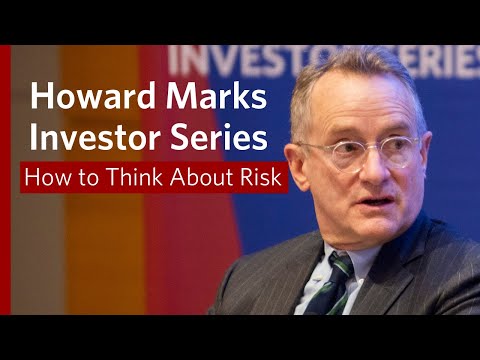
“The most important risk is the permanent loss of capital.”Wharton School Investor Series conversation, 2021 · full transcript →
Because forecasts are weak, portfolios must be built to endure
Marks is deeply skeptical of forecasting as the foundation of risk control. He argues that confidence about the future is dangerous because the future is unknowable in the precise way investors wish it were knowable. Rather than trying to be right about one path, the investor should prepare for several paths at once15161718.
This is why he thinks in probabilities instead of certainties. Risk control starts with humility: all knowledge is about the past, while decisions are about the future. A sound process therefore asks not what will happen for sure, but what could happen, how bad it could be, and whether the portfolio can survive if conditions turn unfavorable1319.

“You can predict you can't predict, you can prepare.”WTF is Finance interview with Nikhil Kamath, 2026 · full transcript →
Avoiding losers is often the most reliable path to winning
One of Marks's most practical ideas is that investors can do very well by avoiding big mistakes. He explicitly embraces the view that if you avoid the losers, the winners can take care of themselves. In credit especially, he sees strong performance as coming from disciplined underwriting and loss avoidance rather than heroic home runs21222324.
That logic fits his preference for contractual claims and seniority. In debt investing, especially senior debt bought at sufficiently discounted prices, you do not need perfection or explosive upside to succeed. You need structures and prices that leave room for error and still protect capital if outcomes are merely okay or even quite poor2526.

“…avoiding the losers is good enough.”Wharton School Investor Series conversation, 2024 · full transcript →
Price and psychology determine when risk is high or low
Marks does not treat risk as fixed inside an asset. Risk changes with price, behavior, and the phase of the cycle. An asset can become dangerous when optimism is extreme, standards are loose, and investors pay too much; it can become attractive when fear is widespread and prices are cheap272829.
This is why understanding psychology matters so much in his framework. Investors tend to swing from overconfidence to despair, mentally moving from flawless to hopeless faster than fundamentals justify. Risk control therefore requires emotional independence: recognizing when the crowd is extrapolating too much, and refusing to chase what has become imprudent30313233.
He also warns against waiting for certainty, such as trying to buy at the exact bottom. You cannot know the turning point in real time, but you can judge whether prices are cheap enough to offer a favorable balance between upside and downside. For Marks, buying well matters more than timing perfectly3536.

“When behavior is imprudent, then asset prices go too high based on favorable expectations, and the world becomes a risky place.”Book talk / public lecture, 2017 · full transcript →
Good risk control keeps you in the game through bad times
Marks returns again and again to the importance of survival. Investors fail not only by losing money, but also by putting themselves in positions where they must sell at the wrong time or cannot stay invested long enough for value to be realized. He sees forced selling near the bottom as one of the worst errors in investing3738.
That is why he favors a normal risk posture suited to the investor's circumstances, with only measured adjustments at the margin. He is wary of all-in moves like going to cash, because they require being right twice and immediately. Better risk control means structuring a portfolio, and a temperament, that can withstand the bad days and still participate when conditions improve394041.

“…the biggest screw-up you can do is to sell out at the bottom.”The Investor’s Podcast interview, 2013 · full transcript →
Marks on risk control, in his own words
“…the most important thing in investing is controlling risk…”
“The most important risk is the permanent loss of capital.”
“You can predict you can't predict, you can prepare.”
“I think that an exceptional investor is someone who has a good return disproportionate to the risk borne.”
“It's not what you buy, it's what you pay that counts.”
“The riskiest thing in the world is the belief that there's—there's no risk.”
Where to watch
 Howard Marks on Risk: How to Think About It2024 · 36 min · full transcriptBest single overview of his risk framework: loss, asymmetry, and why volatility is not the real definition of risk.
 Howard Marks on Risk Control: Avoiding Losers and Buying Cheap2024 · 41 min · full transcriptMost concrete discussion of risk control in practice, especially avoiding losers, buying cheap, and handling market psychology.
 Howard Marks on Risk and Cycles: The Truth about Investing2019 · 79 min · full transcriptConnects risk control to the actual job of an investor and explains why forecasting is a weak basis for success.
 Howard Marks on Market Cycles: Risk, Probabilities, and Timing2012 · 24 min · full transcriptShort, concentrated version of his approach: control risk, know where you are in the cycle, think in probabilities.
 Howard Marks on Investing Risk: How to Think About It2021 · 86 min · full transcriptStrong explanation of permanent loss, uncertainty, and the limits of measuring risk with models.
Questions people ask
- What did Howard Marks say about asymmetry in investing?
- What did Howard Marks say about avoiding losers in investing?
- What did Howard Marks say about buying distressed debt safely?
- What did Howard Marks say about learning from bad investments?
- What did Howard Marks say about waiting for the bottom?
- How did Howard Marks develop his view of risk?
Sources
Every quote above, word for word from the transcripts. Numbers match the text.
“…the most important thing in investing is controlling risk…”
“I think that an exceptional investor is someone who has a good return disproportionate to the risk borne.”
“Risk, in my opinion, is the ultimate test of an investor's skill.”
“…the most important thing is risk…”
“…the most important thing is controlling risk…”
“So the first one says that the most important thing is risk control. And we tell the clients we think that for excellence in investing, the most important thing is not making a lot of money. It's not beating the market. It's not being in the top quartile. The most important thing is controlling risk. That's our job. That's what we'll do for you. And the clients come to us who want to invest in our asset classes with the risks under control. There are other people who put less emphasis on controlling risk.”
“I believe that risk is not volatility.”
“The most important risk is the permanent loss of capital.”
“So the point is that volatility is measurable. It's just not right. And, you know, Einstein -- there's a great quote from Einstein, who said that not everything that counts can be counted, and not everything that can be counted counts. And it's one of the things that guides me, and I hope it'll guide you. And so, as I say here in bold, volatility can be an indicator of the presence of risk. Sometimes things fluctuate, because they are inherently risky, a symptom that is, but volatility is not risk itself. So what is risk? If you think about it, what is the lay definition of risk? It's the probability of a bad event. So the -- I think the most important risk is the permanent loss of capital. Now, permanent is an important word, because things fluctuate. And a downward fluctuation, by definition, is temporary.”
“…risk means more things can happen than will happen…”
“Risk means more things can happen than will happen.”
“The future can only be thought of intelligently as a probability distribution.”
“You can predict you can't predict, you can prepare.”
“We have two kinds of forecasters—the ones who don't know and the ones who don't know they don't know.”
“…it just strikes me as folly to be confident that you know the future.”
“The views of that forecaster would not be of any value to you unless he was right consistently. And nobody's right consistently in making deviant forecasts. So the bottom line for me is their forecasting is not valuable. And that's something that my experience has told me. So we don't know what's going to happen and randomness will play a big role in what happens. And randomness is, by definition, unpredictable.”
“All the sophistication in the world will not change the fact that all your knowledge is about the past, and all your decisions are about the future.”
“…if we avoid the losers, the winners take care of themselves…”
“…avoiding the losers is good enough.”
“I just don't have to hit any losers. So Charlie Ellis took this idea to investing. Should you go for winners or should you try to avoid hitting losers? And that appealed to me. And, given my chicken nature, I said, well, I can win by not hitting losers. And so, now, Oaktree, my company, invests primarily in credit. You make a bunch of loans. If you can make a bunch of loans without having any that default, you'll get the return you were after. So that's a good formula in credit, or in fixed income, or in debt, or bonds, whatever you want to call it. It's not a good formula in venture capital or even in equities-- or maybe in real estate.”
“So we try to avoid holding strongly to those macro opinions. And finally, we don't do a lot of market timing, which is very, very hard to do. We do long term investing in assets that we think are underpriced. So that's the Oak Tree philosophy. You could see how the origins and inspirations that I went through fit into that. And in fact, it's all distilled in our model, which says that if we avoid the losers, the winners take care of themselves.”
“…bond investing is a negative art…”
“And, given our predilection, we were buying the senior most debt of these companies. So, in order for the senior most debt holders to lose money, all the equity has to disappear. And all the junior classes of debt have to go unpaid. And if it gets bad enough, then the senior creditors start losing money. And we were buying the senior most debt of these companies at prices such that if these companies ended up being worth a third, or a quarter, or a fifth of what these great buyout firms had bought them for a year or two ago, we would be OK.”
“It's not what you buy, it's what you pay that counts.”
“When behavior is imprudent, then asset prices go too high based on favorable expectations, and the world becomes a risky place.”
“…too much money chasing too few deals…”
“…the human brain's ability to reject information which is at odds with its predisposition…”
“…in real life, things fluctuate between pretty good and not so hot. But in the minds of investors, they go from flawless to hopeless.”
“Excesses and corrections, excesses and corrections.”
“History does not repeat, but it does rhyme.”
“So I think one of the dumbest things you can do in the investment business is to say, I'm going to wait for the bottom, because logically and practically, you'll never know. And so the only basis for buying is that things are cheap. You can tell when things are cheap. You can't tell when the day has been reached that it's never going to go down anymore.”
“…overpriced and going down tomorrow are not synonymous…”
“…the biggest screw-up you can do is to sell out at the bottom.”
“If you think about it, as I described it, secular trend, oscillation around the trend, in general, each high is higher than the preceding high. So if you buy at a high, you may feel badly when it hits a low, but when it returns, when it recovers, as historically, it always has, you feel okay. You're ahead. That's -- so buying high and seeing a decline is not the worst thing in the world. Selling low and missing the rise, I think, is the cardinal sin of investing, because it takes you out of the game at a time when you don't want to be out of the game. Now, let's think a little more theoretically. An important thing for you to note, I think, is that risk is unquantifiable in advance.”
“…going to cash? We don't go to cash…”
“…we never know where we're going, but we're sure as hell ought to know where we are…”
“One of my favorite sayings is never forget the six foot tall man who drowned crossing the stream that was five feet deep on average. We can't live by the averages. We can't say, well, I'm happy to survive on average. We got to survive on the bad days. And if you're a decision maker, you have to survive long enough for the correctness of your decision to become evidence. And you can't count on it happening right away. I always remind people overpriced is not the same as going down tomorrow. And if you bear that simple truth in mind, I think it helps.”
How this guide was made: drafted with AI from the full transcripts of the recordings cited, then checked: every quotation must match a transcript word for word and be the speaker's own words, and an independent review gates accuracy. Methodology and corrections.