Howard Marks on Life Lessons
Howard Marks’s core life lesson is to build a life and career around your own strengths, judgment, and temperament rather than copying the crowd or chasing status.
- Success means living your life your way, not following someone else’s script.
- Choose work that fits your strengths and temperament, not just the highest paycheck.
- Think independently, but stay humble: being different only helps if your judgment is better.
- Focus less on prediction and more on risk control, survival, and avoiding big mistakes.
- Clear thinking comes from simplicity, reflection, history, and turning ideas into action.

“Living life your way is the most important thing.”What Got You There conversation, 2019 · 0:00
Success is living on your own terms
Marks’s clearest life principle is that success is personal. He does not define it by prestige, money, or meeting other people’s expectations. He defines it by whether you can shape your life in a way that fits who you are.12
That leads directly to a strong warning: do not let other people choose your path for you. A career can look impressive from the outside and still be wrong for your nature, interests, or values. Marks treats borrowed ambition as a recipe for frustration.32
Applied practically, this means asking not just What pays well? but What kind of life do I want, and what kind of work lets me live it? His standard is fit, not conformity.124
“Living life your way is the most important thing.”What Got You There conversation, 2019 · full transcript →
Pick the path that fits your strengths
Marks believes people should choose a course that matches their own abilities rather than imitate what works for someone else. Not everyone is suited for the same game, and trying to win in the wrong one can waste years. The point is not to copy a successful template but to find the right course for you.4
This is why his advice on career choice is more subtle than simply aiming high. Ambition matters, but self-knowledge matters more. You need to understand what you are good at, what you are not good at, and what kind of effort you can sustain with conviction.14
That mindset also reduces envy and herd behavior. Once you accept that different people are built for different paths, it becomes easier to stop measuring your progress against somebody else’s scoreboard.34

“If you don't learn how to hit winners and try to do it, you'll never become a champion. Of course, most people can't. So you have to pick your course, but it has to be the right course for you-- not for me, not for you, not for your parents, but for you. And a lot of life is figuring out what you're about and then pursuing life accordingly.”Wharton School Investor Series conversation, 2024 · full transcript →
Independent thinking requires humility, not ego
Marks repeatedly argues that good judgment depends on thinking differently from the crowd. In competitive fields, average thinking usually leads to average results. To add value, you need independent conclusions rather than borrowed opinions.53
But he pairs independence with humility. Other capable people are looking at the same world, which means confidence should never turn into arrogance. The fact that you disagree with the crowd does not make you right; it only gives you the chance to be right for reasons others have missed.65
That is a useful career lesson far beyond investing. In meetings, decisions, and major life choices, the goal is not to be contrarian for its own sake. The goal is to see more clearly, think more deeply, and then act only when your judgment is genuinely better.56
Avoiding big mistakes matters more than flashy wins
A central Marks lesson is that long-term success often comes less from brilliance than from error avoidance. He emphasizes risk control, survival, and staying in the game. In life and career, this translates into protecting yourself from decisions that can cause lasting damage.789
He also stresses that reality is uncertain and outcomes are not fully predictable. Because you cannot know the future in advance, you should be careful about overconfidence, especially when the downside is severe. This is why he focuses on surviving bad days, not just doing well on average.101112
That perspective can shape career choices, partnerships, financial decisions, and reputation. A path with upside is not automatically attractive if it exposes you to ruin, and a setback does not automatically mean the decision was bad. The key is to make sound decisions that can survive uncertainty.1210
Clear thinking is built through simplicity, study, and implementation
Marks values ideas that change how you see things, not ideas that merely sound sophisticated. He prefers simple language, durable principles, and concepts that travel across situations. For him, real understanding shows up as clarity, not jargon.1314
He also believes judgment deepens when you stay with worthwhile ideas long enough for them to become part of you. That requires real study, reflection, and respect for what thoughtful people before you have already figured out. Broad reading and pattern recognition help you understand where you are, even when you cannot know exactly what comes next.15161718
Finally, Marks draws a line between knowing and doing. Principles only matter if you can implement them under real conditions. In careers and life, that means building habits, emotional control, and decision processes that hold up when circumstances get hard.191

“The secret to success in these areas is not knowing these concepts, but it's being able to implement them…”Interview on Howard Marks's writing and investing ideas, 2024 · full transcript →
Marks on life lessons, in his own words
“Living life your way is the most important thing.”
“There's only one success: to be able to live your life your way.”
“The worst thing you can do is do what other people tell you to do…”
“If you don't learn how to hit winners and try to do it, you'll never become a champion. Of course, most people can't. So you have to pick your course, but it has to be the right course for you-- not for me, not for you, not for your parents, but for you. And a lot of life is figuring out what you're about and then pursuing life accordingly.”
Where to watch
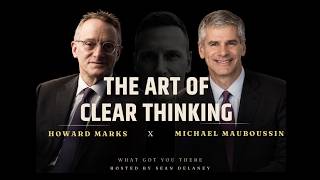 Howard Marks on Clear Thinking: Live Your Life Your Way2019 · 94 min · full transcriptBest single source for Marks’s direct advice on living your own life, choosing careers by fit, and resisting herd pressure.
 Howard Marks on Practical Wisdom: Independent Thinking in Markets2019 · 57 min · full transcriptShows why humility and independent thinking have to go together if you want sound judgment.
 Howard Marks on Investing Philosophy: Origins and Inspirations2012 · 69 min · full transcriptExplains his practical philosophy of risk control, mistake avoidance, and surviving uncertainty.
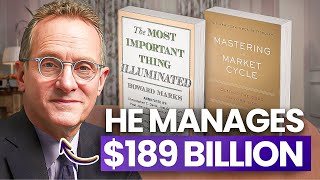 Howard Marks on Clear Investing Writing: Simple Ideas That Travel2024 · 54 min · full transcriptUseful for understanding how Marks thinks clearly, writes clearly, and turns ideas into usable principles.
 Howard Marks on Market Cycles: How to Read the Tape2017 · 61 min · full transcriptBest for learning his broader lesson that judgment comes from history, pattern recognition, and knowing where you are.
Questions people ask
- What did Howard Marks mean by second-level thinking?
- What did Howard Marks say about forecasting in investing?
- What did Howard Marks say about macro forecasting and investing?
- What did Howard Marks say about reading and quoting other thinkers?
- What did Howard Marks say about surviving in investing?
- What did Howard Marks say about choosing the right path for yourself?
Sources
Every quote above, word for word from the transcripts. Numbers match the text.
“Living life your way is the most important thing.”
“There's only one success: to be able to live your life your way.”
“The worst thing you can do is do what other people tell you to do…”
“If you don't learn how to hit winners and try to do it, you'll never become a champion. Of course, most people can't. So you have to pick your course, but it has to be the right course for you-- not for me, not for you, not for your parents, but for you. And a lot of life is figuring out what you're about and then pursuing life accordingly.”
“None of this is any good unless the person making the decision has superior judgment. And the first chapter of the book says the most important thing is second level thinking. Most people think on the first level. To be a superior investor, you must think on the second level. You have to think different from everybody else. But in being different, you have to be better. So the first level thinker is naive. He says, this is a great company, let's buy the stock. The second level thinker says it's a great company, but it's not as great as everybody thinks it is. We better sell the stock. That's the difference between being an average person and a person with superior insight.”
“…the other people aren't idiots.”
“…the most important thing in investing is controlling risk…”
“…if we avoid the losers, the winners take care of themselves…”
“So the first one says that the most important thing is risk control. And we tell the clients we think that for excellence in investing, the most important thing is not making a lot of money. It's not beating the market. It's not being in the top quartile. The most important thing is controlling risk. That's our job. That's what we'll do for you. And the clients come to us who want to invest in our asset classes with the risks under control. There are other people who put less emphasis on controlling risk.”
“…risk means more things can happen than will happen…”
“Risk cannot be quantified in advance.”
“One of my favorite sayings is never forget the six foot tall man who drowned crossing the stream that was five feet deep on average. We can't live by the averages. We can't say, well, I'm happy to survive on average. We got to survive on the bad days. And if you're a decision maker, you have to survive long enough for the correctness of your decision to become evidence. And you can't count on it happening right away. I always remind people overpriced is not the same as going down tomorrow. And if you bear that simple truth in mind, I think it helps.”
“I never thought of it that way…”
“One of the most important things that I point out to people about my writing is that it is essentially my goal to write the way I speak. I don't want to do any different. My speaking hopefully is clear, hopefully my writing is clear, and hopefully it's the same. So I use contractions. I use hopefully common language. I can think of authors, I can think of one in particular, who seems to have the goal that I'm going to say things that my reader doesn't understand and I'm going to show them how smart I am, and how erudite. My goal is not to do that. I don't want to create a barrier or a level difference between myself and my writers. My goal is to say, "I'm a person. You're a person. We're both people.”
“When you find one that's worthy of pursuing, to really study it and to let that idea become a part of you in a way that you don't come to appreciate if you're just skipping between books and different writers. Well, look, it's an unacceptable conceit to think that nobody who went before you knew it better. Quotes and adages and books wouldn't remain popular over time if they weren't substantial. So I use a lot of quotes and adages and stories and that kind of thing because there were smarter people than me in the past who said things in a more substantial or maybe a clearer way than I can. So why reinvent the wheel in an inferior way?”
“…we never know where we're going, but we sure as hell ought to know where we are…”
“…history does not repeat itself, but it does rhyme…”
“…the future is not ours to know…”
“The secret to success in these areas is not knowing these concepts, but it's being able to implement them…”
How this guide was made: drafted with AI from the full transcripts of the recordings cited, then checked: every quotation must match a transcript word for word and be the speaker's own words, and an independent review gates accuracy. Methodology and corrections.