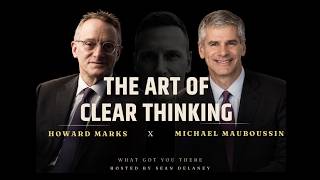
Howard Marks on Decision Making
Howard Marks treats decision making as judgment under uncertainty: control downside, think in probabilities, and act with humility rather than certainty.
- Good decisions are not the same as good outcomes; randomness matters.
- The first job of decision making is controlling risk and avoiding ruin.
- You cannot know the future, so think in ranges and probabilities, not forecasts.
- Context matters more than prediction: know where you are in the cycle.
- Independent thinking helps only if it is both different and better.
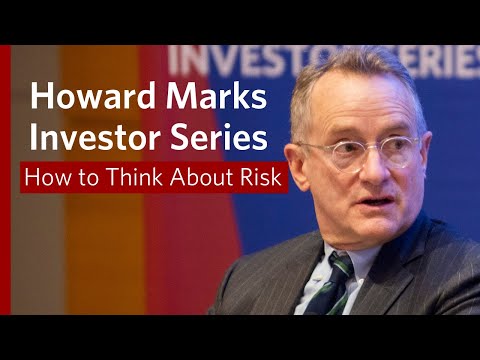
“All the sophistication in the world will not change the fact that all your knowledge is about the past, and all your decisions are about the future.”Wharton School Investor Series conversation, 2021 · 31:48
Decision making starts with humility about the future
Marks’s starting point is that decision makers operate in uncertainty, not knowledge. He repeatedly argues that the future cannot be known with confidence, forecasts are unreliable, and randomness plays a large role in outcomes. That means a sound process cannot depend on being right about tomorrow.1234
This view changes what a good decision looks like. Instead of asking whether you can predict the future, Marks pushes you to ask whether your judgment is sensible given incomplete information and a range of possible outcomes. In his framing, risk exists precisely because many different things could happen and you do not know which one will.56
“All the sophistication in the world will not change the fact that all your knowledge is about the past, and all your decisions are about the future.”Wharton School Investor Series conversation, 2021 · full transcript →
The first duty is to avoid decisions that can seriously hurt you
Marks makes risk control the center of decision making. He says the real achievement is not simply producing gains, but getting acceptable returns while exposing yourself to less than proportionate downside. In practice, that means avoiding permanent loss, forced selling, and other outcomes that take you out of the game.8
This is why his style is so focused on error avoidance. He favors a negative art: remove the big losers, and a lot of the rest takes care of itself. For Marks, the best decisions are often less about brilliance and more about surviving bad days, limiting damage, and keeping the ability to benefit when conditions improve.11121314

“…if we avoid the losers, the winners take care of themselves…”Talks at Google, 2012 · full transcript →
Think in probabilities and ranges, not certainties
Marks sees decision making as probabilistic. Since the future is unknowable, the goal is not certainty but a better estimate of possible outcomes and their attractiveness relative to the downside. He stresses that risk is broader than what will actually happen, because the unchosen and unrealized possibilities still matter when you make the decision.56
That is also why he rejects simple scorekeeping by outcome. A decision can be wise and still turn out badly, and a reckless one can appear successful for a while. He emphasizes asymmetry instead: look for situations where favorable outcomes offer meaningful upside while unfavorable outcomes do less damage.15
Use the present better than you try to predict the turning point
Marks does not center decisions on calling exact tops and bottoms. His practical alternative is to understand present conditions: how much optimism, fear, aggressiveness, or caution is already in the market, and what that implies for risk and return. He argues that you may not know where things are going, but you should work hard to know where you are.171819
This leads to incremental rather than extreme moves. He warns against all-or-nothing shifts like going fully to cash, because those decisions require precise timing and can leave you missing the recovery. Better decision making means setting a normal posture that fits your needs and temperament, then adjusting at the margin when conditions become unusually risky or unusually attractive.2021
Independent judgment matters, but only if it is better
Marks wants decision makers to think for themselves, especially when crowd psychology becomes extreme. But he balances that with humility: other participants are capable too, so being different is not enough by itself. Superior decisions require second-level thinking, where you look past the obvious and ask what is already priced in, what others believe, and whether their expectations are too high or too low.2324
This is where price and contrarianism connect. Marks argues that quality alone is not enough; what matters is what you pay relative to value. Often the best opportunities appear when others are unwilling to act, but contrarian decisions are valuable only when they are based on better judgment rather than reflexive opposition to the crowd.252624
Marks on decision making, in his own words
“All the sophistication in the world will not change the fact that all your knowledge is about the past, and all your decisions are about the future.”
“…it just strikes me as folly to be confident that you know the future.”
“…if we avoid the losers, the winners take care of themselves…”
Where to watch
 Howard Marks on Investing Risk: How to Think About It2021 · 86 min · full transcriptBest single discussion of how Marks connects decisions, uncertainty, and risk control.
 Howard Marks on Market Cycles: How to Read the Tape2017 · 61 min · full transcriptShows how to make decisions from present conditions and cycles instead of forecasts.
 Howard Marks on Investing Philosophy: Origins and Inspirations2012 · 69 min · full transcriptExplains the roots of his decision system: avoid losers, distrust forecasts, respect randomness.
 Howard Marks on Market Cycles: Risk, Probabilities, and Timing2012 · 24 min · full transcriptA compact statement of his practical approach to probabilities, timing, and risk.
 Howard Marks on Practical Wisdom: Independent Thinking in Markets2019 · 57 min · full transcriptUseful for understanding the humility and independent thinking behind good judgment.
Questions people ask
- What did Howard Marks mean by second-level thinking?
- What did Howard Marks say about asymmetry in investing?
- What did Howard Marks say about forecasting in investing?
- What did Howard Marks say about learning from bad investments?
- What did Howard Marks say about macro forecasting and investing?
- What did Howard Marks say about selling at the bottom?
Sources
Every quote above, word for word from the transcripts. Numbers match the text.
“The views of that forecaster would not be of any value to you unless he was right consistently. And nobody's right consistently in making deviant forecasts. So the bottom line for me is their forecasting is not valuable. And that's something that my experience has told me. So we don't know what's going to happen and randomness will play a big role in what happens. And randomness is, by definition, unpredictable.”
“All the sophistication in the world will not change the fact that all your knowledge is about the past, and all your decisions are about the future.”
“…the future is not ours to know…”
“…it just strikes me as folly to be confident that you know the future.”
“…risk means more things can happen than will happen…”
“Risk means more things can happen than will happen.”
“The most important risk is the permanent loss of capital.”
“…bond investing is a negative art…”
“…if we avoid the losers, the winners take care of themselves…”
“So we try to avoid holding strongly to those macro opinions. And finally, we don't do a lot of market timing, which is very, very hard to do. We do long term investing in assets that we think are underpriced. So that's the Oak Tree philosophy. You could see how the origins and inspirations that I went through fit into that. And in fact, it's all distilled in our model, which says that if we avoid the losers, the winners take care of themselves.”
“One of my favorite sayings is never forget the six foot tall man who drowned crossing the stream that was five feet deep on average. We can't live by the averages. We can't say, well, I'm happy to survive on average. We got to survive on the bad days. And if you're a decision maker, you have to survive long enough for the correctness of your decision to become evidence. And you can't count on it happening right away. I always remind people overpriced is not the same as going down tomorrow. And if you bear that simple truth in mind, I think it helps.”
“Risk, in my opinion, is the ultimate test of an investor's skill.”
“…we never know where we're going, but we sure as hell ought to know where we are…”
“…we never know where we're going, but we're sure as hell ought to know where we are…”
“…history does not repeat itself, but it does rhyme…”
“…going to cash? We don't go to cash…”
“…the biggest screw-up you can do is to sell out at the bottom.”
“…the other people aren't idiots.”
“None of this is any good unless the person making the decision has superior judgment. And the first chapter of the book says the most important thing is second level thinking. Most people think on the first level. To be a superior investor, you must think on the second level. You have to think different from everybody else. But in being different, you have to be better. So the first level thinker is naive. He says, this is a great company, let's buy the stock. The second level thinker says it's a great company, but it's not as great as everybody thinks it is. We better sell the stock. That's the difference between being an average person and a person with superior insight.”
“It's not what you buy, it's what you pay.”
“…you want to buy when nobody else wants to buy…”
How this guide was made: drafted with AI from the full transcripts of the recordings cited, then checked: every quotation must match a transcript word for word and be the speaker's own words, and an independent review gates accuracy. Methodology and corrections.