Invent The Future
Travel, AI, and technology should serve human life.

“…the holy grail of over-tourism is travel redistribution…”Skift Global Forum interview, 2021 · 10:15
The lesson
Chesky’s long-term view starts with a warning: technology should remain a tool that serves people rather than something that replaces human life. He argues that many digital products drift when they stop helping people connect and start becoming destinations in themselves, especially when they reward performance over intimacy and authenticity1. That is why he frames design as working backward from human needs and using technology to better suit society, not the other way around23.
From that perspective, AI is both promising and risky. Chesky describes it as an unusually powerful tool and believes its effects will be far larger than most people expect, which means its direction matters as much as its capability45. His concern is that if AI gets layered onto already unhealthy digital systems, it could amplify their problems; his hope is that it can instead improve matching, personalization, and trust, helping people find what fits them rather than forcing them through generic search67.
He applies that same lens to travel. Chesky thinks travel has already changed permanently: flexibility, remote work, and longer stays are blurring the line between living and traveling, so the old model of short trips to the same crowded places is giving way to something more distributed89. In that world, travel platforms should not just process demand; they should inspire people, spread demand across more places and times, and make travel feel more human and less standardized101112.
This is also why he sees a large future for travel rather than a zero-sum fight over a fixed market. Chesky argues that more people around the world will travel over time, and that growth can come from expanding access and redistributing tourism, not merely taking share from someone else131415. His optimistic case is that technology can help create a broader, more personalized, and more inclusive travel ecosystem if it is designed to open up the physical world rather than trap people in the digital one1617.
For builders, this future requires a particular style of leadership. Chesky believes leaders, especially CEOs, need to stay close to the product and details because the AI era will move quickly and punish detached management181920. But that involvement is not for control alone; it is how you make sure the technology, interface, and business all remain anchored in real human experience, which for him is the point of design and the purpose of digital tools in the first place211722.
5 principles from Brian Chesky
Start with human life, then choose the technology
Define the real human problem before you decide what tool to use. Chesky’s approach is to treat design as fitting technology to society’s needs, not forcing people to adapt to the tool.
“…the role of a designer is to assemble things, components or technology to better suit the needs of society…”
Use AI to improve matching, not addiction
AI becomes valuable when it helps people find what truly fits them and increases trust and personalization. Be careful about applying it to systems that already reward performance, manipulation, or confusion, because it may amplify those weaknesses.
“…if social media is like a car, we're about to put a jet engine on the back of that car in the form of AI…”
Build digital products that lead back to the real world
A healthy product should strengthen real relationships and physical experience rather than replace them. Ask whether your product leaves people more connected offline, not just more engaged online.
“…make sure you have real friends in the real world…”
Design for a world where living and traveling blur
Travel behavior is shifting toward flexibility, longer stays, and broader geography. Products should help people discover possibilities, not just execute a narrow destination search.
“…travel as we know it is never coming back…”
Stay in the details when the future is changing fast
Chesky’s view is that leaders cannot delegate away understanding of the product, especially in the AI era. Staying close to the work helps ensure fast-changing technology still serves a coherent human purpose.
“The point is this: great leaders are in the details. That's what founder mode is.”
Moments to watch
In his own words
The quotes behind the lesson, word for word from the transcripts. Numbers match the lesson above.
“Then your friends pretty soon became your followers, and when your friends became your followers, it no longer meant it was about connection, it was about performing. And when you start performing for other people, you lose intimacy and you lose authenticity, which is not really a bad thing, but it's not meant to fill the void of connection in your life. and I started thinking to myself, I said, I want Airbnb to be able to help combat loneliness because we were about connecting the real world. We weren't about devices. We spend our whole lives and devices. And I noticed I've never had a dream where the devices in my dream. But there's something about that. Yeah. The real world is the real world.”
“…the role of a designer is to assemble things, components or technology to better suit the needs of society…”
“And say that like, we can design that world. And I think that's the role of a designer. The role of a designer is to assemble things, components or technology to better suit the needs of society. And you're constantly in a state of redesigning based on getting more information. and it's easy to get defensive for those people just attacking me. Yeah. So I'm going to defend. But at some point you do have to look in the mirror and ask well is what they're saying true. And if it is true and sometimes usually what happens is some things are saying is true and then some things aren't and not take it personally and say well I'm going to address the part that is true.”
“AI, I think, we should think of as the most powerful tool that we've ever put in our hands.”
“AI is going to change the world much more than anybody realizes.”
“…if social media is like a car, we're about to put a jet engine on the back of that car in the form of AI…”
“That. I mean, when that Pope photo circulated, I thought that was a real photo first. I did too. I was like, that's weird. The Pope is going for it. Yeah, I was like, pretty awesome. He's got Balenciaga, go for him. But that's today's technology. So, we're about to live in a world where someone can sound like me, they can behave like me, and as we spend more and more time online, it's going to be hard to discern what is real and what's not real. So, I think in the age of artificial intelligence, the other thing people want is authenticity. And authenticity is whatever's real and whatever's authenticated. So, I think our brand is kind of authenticity. Like, we're not going to ever be the most digitally immersive company. That's going to be social media or entertainment. Our value is really the physical world, you online, offline with people different from you all over the world.”
“…travel as we know it is never coming back…”
“…the more we live remotely and live flexibly, the more we're home all day…”
“…the holy grail of over-tourism is travel redistribution…”
“…we want to be more in the inspiration business…”
“Instead of being sightseeing, it's people seeing…”
“I think we're going to live in a world where two, three, four billion international tourism arrivals will one day happen…”
“…for me to win, you don't have to lose.”
“I don't think any of us believe there's too much tourism in the world.”
“I think that we're about to experience a golden age of travel…”
“Technology alone is not enough; it's the creativity, it's the soul.”
“…great leaders are in the details.”
“I think that the CEO of the company should always be the chief product officer…”
“I think founder mode is gonna be the only way to operate in the age of AI.”
“Over time, basically, what I did is I reviewed every single thing for two, three years. I worked like a hundred hours a week, reviewed every little detail of the company. My vision wasn't do this forever. My vision wasn't to micromanage forever. My vision was before I empower people, I need to know what's going on. This notion that great leadership is hiring great people and trust them to know what to do. Well, how do you know they're great if you're not auditing what they're doing? And you actually want to start hands on under control and give ground grudgingly. Everyone does the opposite. They let go, they hire someone, they go in the wrong direction. And by the way, that's bad for the leader. You're not training them. So to bring it back to your question, that's founder mode. We need AI founder mode. AI founder mode is gonna be even more intense than founder mode.”
“…make sure you have real friends in the real world…”
Reflect
- Where in your work are you optimizing for digital engagement when you should be optimizing for real-world value or connection?
- If AI removed the limits of search and interfaces became highly personalized, what matching problem in your field would become more important than today’s discovery problem?
- What would it look like to design your product or career around a world where people live more flexibly across places, schedules, and identities?
Check your understanding
Go deeper
 Brian Chesky on Travel Revolution: Flexibility Is Changing Everything2021 · 29 min · full transcript
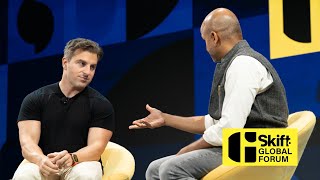 Brian Chesky on the Future of Travel: Living and traveling in a blur2022 · 34 min · full transcript
 Brian Chesky on Travel, Pricing, and AI: Airbnb's Next Chapter2023 · 34 min · full transcript
 Brian Chesky on Founder Mode: The CEO as Chief Product Officer2024 · 42 min · full transcript
 Brian Chesky on Design and AI: Building Companies With Soul2023 · 58 min · full transcript
 Brian Chesky on Technology and Loneliness: Designing for Connection2024 · 55 min · full transcript
 Brian Chesky on Founder Mode: Building in the AI Era2025 · 83 min · full transcript