Brené Brown on Worthiness
Brené Brown treats worthiness as the belief that love and belonging are your birthright, not prizes you earn by becoming different, perfect, or less vulnerable.
- Worthiness means love and belonging do not have to be earned.
- Shame attacks worthiness by telling us we are not good enough.
- Vulnerability is how worthiness becomes real in relationships, creativity, and joy.
- Wholehearted people do not become worthy; they live from the belief that they already are.
- True belonging comes from being yourself, not reshaping yourself to fit in.
Worthiness starts with the belief that you are enough now
Brown’s clearest claim is that worthiness is not something you achieve after improving yourself enough. She presents it as an as-is reality: love and belonging are basic human needs, and being worthy of them does not depend on performance, perfection, or meeting conditions first1.
That is why Brown keeps pairing worthiness with enoughness. When people act from the belief that they are enough, they become less reactive and more able to listen, connect, and live with gratitude instead of panic3.
Shame is the main force that undermines worthiness
For Brown, shame is not just feeling bad about a mistake. It is the painful belief that something about you makes you unworthy of connection, love, or belonging4. She names its recurring messages directly: not good enough and who do you think you are5.
This is why she says shame is the enemy of worthiness. Guilt can help people recognize a bad action, but shame turns the whole self into the problem, which cuts people off from connection and makes them hide, protect, or attack67.
Vulnerability is what lets worthiness show up in real life
Brown does not treat worthiness as a private feeling you settle once and for all. It becomes visible when you risk being seen, because vulnerability is the path to love, belonging, intimacy, trust, and joy910.
This matters because many people try to protect worthiness by avoiding risk. Brown argues the opposite: vulnerability sits at the core of fear and shame, but it is also the birthplace of joy, love, belonging, creativity, and faith111213. If you armor up against uncertainty and emotional exposure, you also shut down the experiences that make life meaningful1415.
Wholehearted people live from worthiness rather than chasing it
Brown’s early research on wholeheartedness led her to a simple distinction: some people move through life believing they are worthy of love and belonging, and that belief changes how they relate to imperfection, compassion, and authenticity16. They do not wait to become flawless before they show up.
This is why courage matters so much in her work. Courage means sharing your whole story with your whole heart, and that requires letting go of who you think you should be in order to be who you are1716. Worthiness, in Brown’s view, is not proved by hiding flaws; it is practiced by showing up honestly and staying connected19.
True belonging protects worthiness better than fitting in
Brown draws a sharp line between belonging and fitting in. Fitting in means scanning the group, figuring out what will be accepted, and changing yourself to match it; true belonging never asks for that trade2021.
This distinction matters because many people try to secure worthiness socially by becoming more acceptable. Brown thinks that strategy backfires: if acceptance depends on a false self, it cannot produce real belonging. Worthiness grows when you belong to yourself and stay connected from that place2122.
Worthiness is learned and taught through self-compassion and connection
Brown applies worthiness most concretely in families and close relationships. Children learn whether they are worthy not only from what adults say, but from whether adults practice self-compassion, embrace imperfection, and create a home where belonging is secure232422.
The same logic applies to adults. Connection heals shame, and empathy is one of the clearest ways to restore worthiness because it tells someone they are not alone252627. In Brown’s framework, worthiness becomes sturdier when people are met with compassion rather than judgment1627.
Brown on worthiness, in her own words
“To love with our whole hearts even though there's no guarantee. And that's really hard, I can tell you as a parent, that's excruciatingly difficult. To practice gratitude and joy in those moments of terror when we're wondering, "Can I love you this much? Can I believe in this as passionately? Can I be this fierce about this?" Just to be able to stop and instead of catastrophizing about what might happen, to say, "I'm just so grateful. Because to feel this vulnerable means I'm alive." And the last, which I think is probably the most important, is to believe that we're enough. Because when we work from a place that says, "I'm enough," then we stop screaming, and we start listening.”
Where to watch
 Brené Brown on Imperfect Parenting: Raising Kids with Worthiness2015 · 10 min · full transcriptHer most direct statement on worthiness: it is an as-is proposition, central to love, belonging, and parenting.
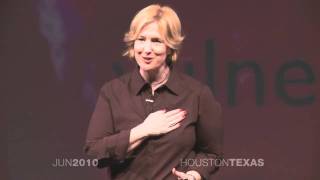 Brené Brown on Vulnerability and Connection: The Power of Being Seen2010 · 21 min · full transcriptShows how her research on shame and connection led to the idea that believing we are enough changes how we live and love.
 Brené Brown on True Belonging: Own Your Story, Don’t Fit In2017 · 59 min · full transcriptBest for understanding why worthiness is damaged by fitting in and strengthened by true belonging.
 Brené Brown on Invulnerability: The Price of Emotional Armor2013 · 16 min · full transcriptExplains why scarcity and emotional armor make people feel not enough, and why vulnerability is still the birthplace of belonging and joy.
 Brené Brown on Shame and Vulnerability: Why Connection Matters2011 · 22 min · full transcriptStrong on the link between vulnerability, empathy, and the kind of connection that restores worthiness.
Questions people ask
- What did Brené Brown say about being enough?
- What did Brené Brown say about courage?
- What did Brené Brown say about shame?
- What did Brené Brown say about the difference between belonging and fitting in?
- What did Brené Brown say about vulnerability and connection?
- What is Brené Brown's parenting manifesto?
Sources
Every quote above, word for word from the transcripts. Numbers match the text.
“…worthiness is an as-is proposition.”
“To love with our whole hearts even though there's no guarantee. And that's really hard, I can tell you as a parent, that's excruciatingly difficult. To practice gratitude and joy in those moments of terror when we're wondering, "Can I love you this much? Can I believe in this as passionately? Can I be this fierce about this?" Just to be able to stop and instead of catastrophizing about what might happen, to say, "I'm just so grateful. Because to feel this vulnerable means I'm alive." And the last, which I think is probably the most important, is to believe that we're enough. Because when we work from a place that says, "I'm enough," then we stop screaming, and we start listening.”
“And it turned out to be shame. And "shame" is really easily understood as the fear of disconnection. Is there's something about me that if other people know it or see it, that I won't be worthy of connection? The things I can tell you about it is: it's universal, we all have it. The only people who don't experience shame have no capacity for human empathy or connection. No one wants to talk about it, and the less you talk about it the more you have it. What underpinned this shame, this "I'm not good enough," which we all know that feeling, that "I'm not blank enough, I'm not thin enough, rich enough, beautiful enough, smart enough, promoted enough.”
“…shame drives two primary tapes: not good enough and who do you think you are?”
“The enemy of worthiness is shame.”
“I am bad;" guilt, "I did something bad.”
“Vulnerability is the path to love, belonging, joy, intimacy, trust, innovation, and creativity.”
“Vulnerability is the path to love, belonging, joy, intimacy, trust, innovation, and creativity. Sympathy. So what is empathy and why is it very different than sympathy? How many of you think about empathy and sympathy as very different things? A few people. Empathy fuels connection; sympathy drives disconnection. I'll tell you...”
“Vulnerability is absolutely at the core of fear and anxiety and shame…”
“…vulnerability is also the birthplace of joy, of love, of belonging, of creativity, of faith…”
“Vulnerability is absolutely at the core of fear and anxiety and shame and very difficult emotions that we all experience. But vulnerability is also the birthplace of joy, of love, of belonging, of creativity, of faith. And so it becomes very problematic when, as a culture, we lose our capacity to be…”
“Here's the consequence to numbing that I've learned, you know. And I'm, as a vulnerability researcher, I've spent the first six years of my research studying shame, empathy, and courage, and the last four years studying joy, authenticity, love, and belonging. And one of the things that I learned that was very startling for me personally and everyone I've ever met is that you cannot selectively numb emotion. When we numb the dark emotion, when we numb vulnerability and fear and shame of not being good enough, we by default numb joy. We cannot selectively just numb the dark emotions. We have interesting…”
“But that's no—that's it. And so guess what the number one casualty is of a scarcity culture? What? Vulnerability. We shut down. We shut down because I'm not... I'm not going to let you know. No, because I'm—not altogether. Yeah, yeah. And the thing is that, like, oh well, we lose a little vulnerability, but vulnerability is not just about fear and grief and disappointment. It's the birthplace of everything we're hungry for: creativity, joy, creativity, faith, love, innovation, and all of that.”
“And so these folks, very simply, had the courage to be imperfect. They had the compassion to be kind to themselves first and then to others, and as it turns out we can't practice compassion with other people if we can't treat ourselves kindly. And the last was they had connection - and this was the hard part - as a result of authenticity, they were willing to let go of who they thought they should be in order to be who they were, which you have to absolutely do that for connection.”
“…share all of yourself—share your whole story with your whole heart…”
“…most of us are brave and afraid in the exact same moment all day long.”
“The opposite of belonging is fitting in.”
“Yeah, so if I did stand up against them, then that means I was alone, and that was my biggest fear: was being alone. Oh yeah, because that's what teams and groups deliver. They deliver this thing that you're not alone. The problem is, I was so shocked to learn in the research that the opposite of belonging is fitting in, because fitting in is assessing a group of people and thinking, "Who do I need to be? What do I need to say? What do I need to wear? How do I need to act?" and changing who you are. And true belonging never asks us to change who we are. It demands that we be who we are, because if we—if we belong—if we fit in because we've changed ourselves, that's not belonging.”
“Because she, I think she had the confidence to put herself out there and, you know, student council president and the, you know, that kind. I think because we have a rule at our house that no matter what, you belong here. No matter how goofy, awkward, afraid, wrong, it doesn't matter. You belong here. And so I think when we give our kids a platform like that at home, it gives them the courage to take risks outside of home. Does that make sense? Because they feel safe coming back no matter what happens. They always have a place to come home to.”
“…who we are is a much more accurate predictor of how our kids will do than what we know…”
“IF YOU DON'T, THEN YOUR HOME IS OPERATING UNDER, YOU KNOW, CONFUSION AND CHAOS AND WHATEVER. AND MAYBE YOU HAVE A MANIFESTO THAT HASN'T BEEN SPOKEN. BUT I LOVE THIS FOR PEOPLE TO SORT OF INCORPORATE AS THEIR OWN AND ADJUST AS THEY WILL. "ABOVE ALL ELSE, I WANT YOU TO KNOW THAT YOU ARE LOVED AND LOVEABLE." YOU'RE SAYING THIS TO YOUR CHILDREN? YES. OKAY. "YOU WILL LEARN THIS FROM MY WORDS AND MY ACTIONS. "THE LESSONS ON LOVE ARE IN HOW I TREAT YOU "AND HOW I TREAT MYSELF. "I WANT YOU TO ENGAGE WITH THE WORLD "FROM A PLACE OF WORTHINESS. "YOU WILL LEARN THAT YOU ARE WORTHY "OF LOVE, BELONGING, AND JOY "EVERY TIME YOU SEE ME PRACTICE SELF-COMPASSION AND EMBRACE MY OWN IMPERFECTIONS." YES! "WE WILL PRACTICE COURAGE IN OUR FAMILY BY SHOWING UP, "LETTING OURSELVES BE SEEN, AND HONORING VULNERABILITY.”
“Empathy fuels connection; sympathy drives disconnection.”
“What makes something better is connection.”
“Empathy is "I'm feeling with you." Sympathy is "I'm feeling for you." And to me, I always think of empathy as this kind of sacred space when someone's kind of in a deep hole and they shout out from the bottom and they say, "I'm stuck. It's dark. I'm overwhelmed," and then we look and we say, "Hey," and climb down, "I know what it's like down here and you're not alone." Sympathy is dark deep hole, "oo, it's bad," uh-huh uh.”
How this guide was made: drafted with AI from the full transcripts of the recordings cited, then checked: every quotation must match a transcript word for word and be the speaker's own words, and an independent review gates accuracy. Methodology and corrections.


