Andrew Huberman on Fear & Resilience
Huberman treats fear as a measurable brain-body state that can sharpen performance or overwhelm it, and resilience as the ability to regulate that state, use challenge intelligently, and recover quickly.
- Fear is not just a feeling; it is a whole brain-body state that changes perception, physiology, and action tendencies.
- Resilience is not the absence of stress. It is the ability to use stress when it helps and shut it down when it no longer serves you.
- Performance improves when your internal state matches the real demands of the moment, not when you try to be calm all the time.
- Moving toward challenge can be a powerful response to fear, and Huberman highlights forward action as a high-engagement stress response.
- Daily biology matters: morning light, lower evening activation, better sleep, and tools like long exhales support durable resilience.
Fear is a full-body state, not just an emotion
Huberman frames fear and stress through the nervous system. His basic view is that mental states come from the combined activity of brain and body, so fear should be understood as a measurable state that changes how you feel, think, and act, not as a vague mood floating above physiology.12
That view helps explain why fear changes perception. Under stress, attention tightens and the world becomes more narrowly framed, while calmer states allow broader awareness and better control over what you notice.3
This is also why he studies fear with objective signals such as heart rate, breathing, perspiration, and pupil changes. For Huberman, fear becomes more workable once you stop treating it as mysterious and start treating it as a state you can recognize and shape.
Stress is useful when it matches the challenge
Huberman does not present stress as the enemy. He argues that stress is a generic survival response that can increase focus, mobilize energy, and prepare the body for action, which is why he can describe it as an especially powerful performance enhancer in the right context.4
But usefulness depends on fit. His performance model is that you do best when your internal state is matched to the space-time demands in front of you, meaning the right level of activation for the actual task, environment, and time horizon.5
That makes resilience more precise than grit alone. It is not endless activation or constant intensity; it is having enough stress to meet the moment, while keeping the flexibility to come back down.67
A resilient person can shift gears, not just push harder
One of Huberman’s clearest themes is that toughness includes recovery. He repeatedly emphasizes that the key skill is learning to turn the stress response off when it is no longer useful, rather than staying revved up and calling that discipline.6
That is why he puts so much weight on sleep and the ability to quiet the mind at night. He argues that the person who can disengage in the final hour of the day and get deeper sleep will outperform the person who stays mentally activated.89
He ties this to circadian biology as well: higher morning cortisol supports alertness and action, while lower evening cortisol helps melatonin and deep sleep do their work. In his view, resilience is built partly by respecting these natural rhythms instead of fighting them.1011
Breathing is the fastest tool for reducing fear and stress in real time
Huberman consistently highlights breathing as a direct lever on state. His simple rule is that if you want to calm down quickly, your exhales should be longer or more forceful than your inhales, because that pattern pushes the system toward parasympathetic calm.12
He gives special emphasis to the physiological sigh as a fast, self-directed way to reduce arousal. This matters for fear and resilience because it offers a practical way to interrupt spiraling activation before it starts driving worse decisions or more panic.13
The broader point is that resilience is trainable when you can regulate state in the moment. Instead of waiting to feel different, you can use physiology to change what your mind is doing.16
Forward action can transform fear into engagement
Huberman’s fear research points to something many people miss: under threat, the response is not only freezing or retreating. He specifically highlights advancing as an extreme stress response, which suggests that moving toward a challenge can recruit a different relationship to fear than passive avoidance does.
That helps explain why certain hard things can become energizing rather than purely aversive. He describes deliberate cold exposure as a form of eustress, a manageable challenge that can strengthen your ability to regulate mind and body under pressure.1516
This does not mean intensity is always better. He notes that the most potent stimulus is not always the one that feels most intense in the moment, which fits his broader view that resilience comes from well-calibrated challenge, not reckless overload.17
Resilience is built through repeated challenge and recovery
Huberman’s image of resilience is dynamic, not static. He points to the value of moving up and down the staircase of activation, meaning the repeated transitions between stress and recovery are themselves part of the training process.7
That same logic appears in his daily habit advice. Morning light helps establish a strong daytime alertness signal, while lower evening activation helps the system reset, creating a reliable rhythm of mobilization and restoration.1011
He also warns against getting stuck in half-on, half-off states. Better resilience comes from committing to deep work or true recovery, rather than lingering in a hybrid mode that keeps the nervous system partially activated without clear benefit.18

“…the key is the journey back and forth up and down that staircase…”Lex Fridman Podcast #139, 2023 · full transcript →
Huberman on fear & resilience, in his own words
“…the key is the journey back and forth up and down that staircase…”
Where to watch
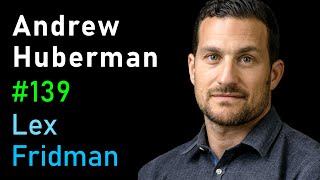 Andrew Huberman on Fear and Optimal Performance2023 · 152 min · full transcriptBest single recording for Huberman’s direct model of fear, threat response, performance, and why advancing toward challenge can matter.
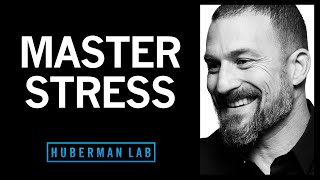 Andrew Huberman on Stress Management: Tools to Downshift Fast2021 · 98 min · full transcriptMost practical guide to using stress well and shutting it down fast with breathing and autonomic tools.
 Andrew Huberman on Mental Performance: Build Resilience With Daily Habits2023 · 167 min · full transcriptBest for understanding how sleep, circadian rhythm, and evening shutdown support long-term resilience.
 Andrew Huberman on States of Mind: Stress, Sleep, and Focus2023 · 165 min · full transcriptBest overview of how states of mind emerge from the nervous system and why stress changes perception and focus.
 Andrew Huberman on Deliberate Cold Exposure: Health and Performance2021 · 135 min · full transcriptUseful if you want Huberman’s view of eustress and how controlled discomfort can build resilience.
Questions people ask
- What did Andrew Huberman say about stress and perception?
- What did Andrew Huberman say about turning your mind off at night?
- What did Andrew Huberman say is the fastest way to calm down from stress?
- How does Andrew Huberman decide whether to rest or keep working?
- What did Andrew Huberman say about deliberate cold exposure and resilience?
- When should Andrew Huberman say you avoid cold exposure if you want to sleep?
Sources
Every quote above, word for word from the transcripts. Numbers match the text.
“…all our states of mind come from the brain and the body…”
“…the nervous system—the brain and those connections—is really what it's about…”
“Eyes are literally going to change their focus. My world will become more like portrait mode. I'll see you, and everything else will become blurry. When I'm calm, I actually have panoramic vision. I can see everything around me. So, I better. So, my state, my internal state of alertness or sleepiness impacts all this. And in sleep, which is kind of the opposite extreme of stress, I'm not in relation to anything outside me. I'm not perceiving anything. I'm sensing things. It's non-negotiable. I'm not having real thoughts, but the thoughts are kind of disoriented in space and time. And behavior is done. You're lying down; you're sometimes paralyzed in sleep. So, when I say states, it's really about this dynamic shift between what we're perceiving and how we're perceiving it.”
“The most powerful nootropic or smart drug is stress.”
“…optimal or peak performance is going to rise when internal state is ideally matched to the space-time features of the external demands…”
“We need to learn how to turn off our stress response.”
“…the key is the journey back and forth up and down that staircase…”
“The person that can turn their mind off in the final hour of their day and get the better, deeper sleep, I'm going to put all my money on that person.”
“The person that can turn their mind off in the final hour of their day and get the better, deeper sleep, I'm going to put all my money on that person within 5 to 10 years far surpassing the other.”
“High morning cortisol, low night time cortisol.”
“The best way to spike that morning cortisol is to get bright light in your eyes within the first 30 to 60 minutes of your day.”
“If you want to calm down quickly, you need to make your exhales longer and or more vigorous than your inhales.”
“The physiological sigh was discovered in the '30s.”
“…deliberate cold exposure can create what we call or what Hans Selye called eustress…”
“There are cold protocols that have been tested in peer reviewed studies that are designed to improve mental performance. They are designed to improve things like resilience or your grittiness, or your ability to move through challenge or to regulate your mind and your internal state under conditions of stress and we can define stress very specifically as times when adrenaline also called epinephrine and or norepinephrine also called noradrenaline, are elevated in your body.”
“…the most potent stimulus isn't always the one that you experience as the most intense in the moment…”
“Do I completely relax, or do I continue to work? What I don't do is any in between. I am perfectly fine just sitting there completely relaxing. Yes, let yourself scroll social media for a short period of time. Let yourself watch a movie, socialize, text with friends, call your mother. You know, my mother said, "Call me more." So, but don't do a hybrid of the two or really focus in and get some work done.”
How this guide was made: drafted with AI from the full transcripts of the recordings cited, then checked: every quotation must match a transcript word for word and be the speaker's own words, and an independent review gates accuracy. Methodology and corrections.
