Andrew Huberman on Addiction & Craving
Huberman frames addiction and craving as dopamine-driven learning shaped by surprise, cues, context, and the drop that follows repeated reward-seeking.
- Addiction sits on dopamine systems for motivation, pursuit, and craving, not pleasure alone.
- What matters is baseline dopamine versus peaks; repeated big peaks can raise the threshold for feeling good.
- Surprise and novelty strongly amplify dopamine, which helps explain compulsive seeking.
- Cues and context teach reward circuits what to want, so craving gets linked to places, states, and routines.
- Alcohol weakens top-down control, and nicotine can strongly affect attention and motivation, which changes addiction risk in different ways.

Addiction is about wanting and pursuit more than pleasure
Huberman’s core view is that dopamine is central to motivation, craving, and the drive to act. That is why he treats addiction as a problem of learned pursuit and repeated wanting, not simply a search for pleasure.123
He also separates dopamine from the common idea of a simple reward burst. His emphasis is that craving depends on the relationship between baseline dopamine and peaks above baseline, which is why the same experience can feel very different across time.45
A practical implication is that addictive behaviors often feel compelling before and during pursuit, even when the payoff itself is shrinking. In his framework, the circuitry that energizes effort can keep driving behavior after enjoyment has started to fall.36
Repeated dopamine spikes can make everyday life feel flatter
Huberman argues that the important issue is not chasing isolated highs but what those highs do to baseline dopamine over time. When people repeatedly push for large peaks, the threshold for enjoyment can rise, making ordinary experiences less satisfying and fueling more seeking.75
This creates a vicious cycle: the person needs stronger stimulation to feel motivated or rewarded, yet repeated strong stimulation can further degrade the background state against which rewards are measured. That is one reason addiction can involve both intense pursuit and a growing sense of dissatisfaction.57
He therefore advises against expecting intense dopamine release every time from rewarding activities. The broader lesson is to protect the ability to enjoy normal levels of reward rather than constantly escalating stimulation.78
Novelty and surprise are powerful drivers of craving
Huberman highlights surprise as especially potent for dopamine. That helps explain why variable rewards, novelty, and intermittent reinforcement can be so habit-forming: the brain becomes tuned to seek what is uncertain and potentially rewarding.9
This matters for addiction because the nervous system is not only responding to the substance or behavior itself. It is also learning from unpredictability, anticipation, and the possibility that the next attempt could feel especially good.93
In everyday life, this shows up whenever people find themselves pulled back by the possibility of something exciting, new, or different, even if past outcomes were mixed. The craving is often bound to anticipation as much as consumption.96
Craving gets attached to cues, context, and memory
Huberman’s discussion of reward learning stresses that dopamine systems do not operate alone. They interact with memory, arousal, and context, which is why craving can become tied to specific places, people, times of day, or internal states.10
That means addiction is not just about the substance or behavior. The brain learns a whole pattern around it, and those learned associations can later trigger motivation and craving even before the reward appears.102
This is also why changing behavior often requires changing environments and routines, not merely relying on willpower. Once reward circuits have assigned value to a context, the context itself can help reactivate the urge.103
“They don't work in isolation.”Huberman Lab podcast with Robert Malenka, 2021 · full transcript →
Alcohol and nicotine change the addiction picture in different ways
On alcohol, Huberman emphasizes direct biological cost and reduced self-control. He says alcohol damages cells and diminishes prefrontal top-down inhibition, which can make impulsive and habitual behavior more likely in the moment and over time.1112
He is also unusually clear that less alcohol is better for health, with zero being best. For people already in serious trouble with alcohol, he says the goal should be complete quitting, while recognizing that recovery should be guided by qualified professionals.13
On nicotine, he distinguishes nicotine itself from the harms of smoking, vaping, dipping, and snuffing. Nicotine acts through nicotinic acetylcholine receptors and can alter attention, motivation, and mood, while the delivery methods carry broad bodily harms.1516
That distinction matters because a substance can have real effects on focus or cognition and still carry strong addiction liability or serious health tradeoffs through how it is used. Huberman’s general approach is to separate mechanism from overall wisdom.1516
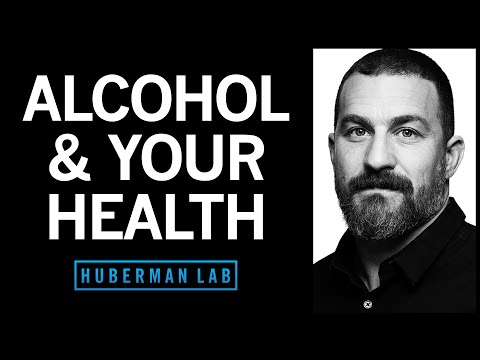
“…the prefrontal cortex and top-down inhibition is diminished…”Huberman Lab podcast, 2021 · full transcript →
Huberman on addiction & craving, in his own words
“…the prefrontal cortex and top-down inhibition is diminished…”
“…smoking, vaping, dipping, and snuffing negatively impact every organ and tissue system and cell of the body…”
Where to watch
 Andrew Huberman on Motivation and Dopamine: Drive, Reward, and Craving2022 · 89 min · full transcriptBest single overview of how dopamine drives motivation, reward-seeking, and craving.
 Andrew Huberman on Dopamine: Motivation, Focus & Satisfaction2021 · 137 min · full transcriptBest for understanding baseline versus peaks and why repeated pursuit can deepen addiction.
 Andrew Huberman on Dopamine and Social Reward: Reward, Learning, and Context2021 · 170 min · full transcriptBest for seeing how reward learning depends on context, memory, and cue associations.
 Andrew Huberman on Alcohol and Health: Brain, Body, Sleep2021 · 121 min · full transcriptBest for how alcohol lowers prefrontal control and why it can promote impulsive, habitual behavior.
 Andrew Huberman on Nicotine: Effects on the Brain, Body & Quitting2021 · 114 min · full transcriptBest for distinguishing nicotine’s brain effects from the harms of smoking and other delivery methods.
Questions people ask
Sources
Every quote above, word for word from the transcripts. Numbers match the text.
“Today, we are going to talk all about dopamine and what drives you to do the things that you do.”
“…dopamine lies at the heart of addiction to all things.”
“There's a fundamental relationship between dopamine released in your brain and your desire to exert effort.”
“…there's no such thing as a dopamine hit.”
“Again, how much dopamine you experience from something depends on your baseline level of dopamine when you arrive there, and your previous dopamine peaks. Okay? That's super important to understand, and it's completely neglected by the general language of dopamine hits. This is why when you repeatedly engage in something that you enjoy, your threshold for enjoyment goes up and up and up. So I want to talk about that process.”
“Pleasure is really two things. It's a joy in pursuit but it's also the joy in what you have.”
“The real key is to not expect or chase high levels of dopamine release every time we engage in these activities.”
“Dopamine is a currency, and it's the way that you track pleasure.”
“The one thing dopamine loves more than anything else is surprise.”
“They don't work in isolation.”
“Ethanol produces substantial damage to cells.”
“…the prefrontal cortex and top-down inhibition is diminished…”
“…zero consumption, consumption of zero ounces of alcohol is going to be better for your health…”
“Nicotine only binds to the nicotinic acetylcholine receptors…”
“…smoking, vaping, dipping, and snuffing negatively impact every organ and tissue system and cell of the body…”
How this guide was made: drafted with AI from the full transcripts of the recordings cited, then checked: every quotation must match a transcript word for word and be the speaker's own words, and an independent review gates accuracy. Methodology and corrections.
