Andrew Huberman on Stress
Andrew Huberman treats stress as a normal brain-body state that can sharpen performance when brief, but needs to be shifted down deliberately through breathing, sleep, and daily regulation habits.
- Stress is a brain-body state, not just a feeling.
- Acute stress can improve focus and performance when matched to the task.
- The main skill is turning stress off once it is no longer useful.
- Longer, stronger exhales—especially the physiological sigh—can reduce arousal quickly.
- Daily habits like morning light, low evening activation, and good sleep make stress easier to handle.

“…all our states of mind come from the brain and the body…”Joe Rogan Experience #1513, 2023 · 0:44
Stress is a whole-body state, not just a bad emotion
Huberman frames stress as something generated by the nervous system across brain and body, not as a purely mental event. In his view, what people call stress changes vision, breathing, heart rate, attention, and behavior all at once, because states of mind arise from bodily and neural activity together.12
That is why he focuses less on talking about stress as a vague feeling and more on understanding state shifts. When stress rises, perception tends to narrow; when calm returns, awareness can widen and control improves.1
“…all our states of mind come from the brain and the body…”Joe Rogan Experience #1513, 2023 · full transcript →
Huberman does not see stress as the enemy
A core part of his view is that stress is useful in the short term. He argues that acute stress can sharpen focus and mobilize the body for action, which is why he can describe stress as extraordinarily powerful for performance and learning when it is applied in the right dose and context.45
He also ties performance to matching internal state to real demands. The goal is not to be calm all the time, but to be activated enough for the challenge in front of you and then able to come back down afterward.56
This same logic shows up in his discussion of deliberate cold exposure, which he presents as a form of controlled challenge that can build resilience. In that setting, stress can function as eustress: a manageable load that trains the system rather than overwhelming it.78
“The most powerful nootropic or smart drug is stress.”Huberman Lab podcast, 2021 · full transcript →
The real problem is stress that stays on
If acute stress is helpful, chronic unresolved stress is where trouble starts in Huberman's framework. He repeatedly emphasizes that the crucial skill is not eliminating all activation, but learning to switch the stress response off when it is no longer serving you.9
He connects that ability directly to sleep and recovery. A person who can stop mental overactivation at night is more likely to get deeper sleep, and he treats that recovery capacity as a major advantage for long-term resilience and performance.1011
His circadian view is simple: activation should be higher earlier in the day and lower at night. He uses cortisol rhythm as a marker of that pattern, with strong morning activation helping energy and low evening activation allowing sleep systems to work properly.1213
Breath is his fastest tool for downshifting stress
Huberman's most practical stress tool is breathing that biases the body toward parasympathetic control. His basic rule is that to calm down quickly, exhales should be longer than inhales or more forceful than inhales.14
His flagship technique is the physiological sigh, which he presents as the fastest self-directed method he knows for reducing stress in real time. He treats it as grounded in physiology rather than mindset alone, which fits his broader view that changing the body is often the fastest way to change the mind.1516
This is why he often returns to respiration when discussing focus, calm, and recovery. If stress is a body-wide state, then breath is one of the most direct levers for changing that state on demand.116
“Whereas the parasympathetic nervous system has certain entry points or what I'll call leavers that will allow you to push back on the stress response in real time and diminish it and feel more relaxed really quickly. So, I'm going to teach you the first tool now, so I don't overwhelm you with all this academic knowledge without giving you something useful. And the tool that at least to my knowledge is the fastest and most thoroughly grounded in physiology and neuroscience for calming down in a self-directed way is what's called the physiological sigh, S-I-G-H.”Huberman Lab podcast, 2021 · full transcript →
Your daily routine determines how manageable stress feels
Huberman does not treat stress management as something you do only in emergencies. He places a lot of weight on daily habits that set the nervous system's baseline, especially morning light exposure, lower evening stimulation, and protection of sleep.1310
Morning bright light helps establish a healthy early-day activation signal, while the evening should move in the opposite direction. He advises against carrying intense activation too late, because high nighttime activation interferes with the deeper sleep that restores stress resilience.121310
He also warns against half-working and half-recovering. In his view, it is better to focus hard or rest clearly, because the in-between state can keep the system mentally engaged without giving true recovery.
Use controlled challenge carefully, and avoid piling on unnecessary stressors
Huberman sees some stressors as useful training inputs, but only when they are intentional and recoverable. Deliberate cold exposure is one example: a controlled challenge that may improve resilience, mood, and the ability to regulate internal state under stress.78
At the same time, he is clear that not every stressor is worth adding. He describes alcohol as broadly damaging to cells, disruptive to top-down control, and generally worse for health than not drinking, which matters because stress regulation depends heavily on sleep, self-control, and brain function.181920
His broader message is to choose stressors that train you and reduce stressors that quietly degrade regulation. Helpful stress should leave you stronger; unhelpful stress tends to erode recovery and control.720
“…deliberate cold exposure can create what we call or what Hans Selye called eustress…”Huberman Lab podcast, 2021 · full transcript →
Huberman on stress, in his own words
“The most powerful nootropic or smart drug is stress.”
“If you want to calm down quickly, you need to make your exhales longer and or more vigorous than your inhales.”
“…all our states of mind come from the brain and the body…”
Where to watch
 Andrew Huberman on Stress Management: Tools to Downshift Fast2021 · 98 min · full transcriptBest single source for Huberman's basic model of stress and his fast downshift tools, especially breathing.
 Andrew Huberman on States of Mind: Stress, Sleep, and Focus2023 · 165 min · full transcriptExplains how stress fits into his broader view of states of mind and body, perception, and nervous system control.
 Andrew Huberman on Mental Performance: Build Resilience With Daily Habits2023 · 167 min · full transcriptShows how circadian habits, evening shutdown, and sleep determine stress resilience day to day.
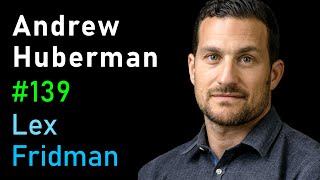 Andrew Huberman on Fear and Optimal Performance2023 · 152 min · full transcriptBest for understanding stress, fear, measurement, and how the right level of activation supports peak performance.
 Andrew Huberman on Deliberate Cold Exposure: Health and Performance2021 · 135 min · full transcriptUseful if you want Huberman's view of controlled stress exposure as a way to build resilience.
 Andrew Huberman on Alcohol and Health: Brain, Body, Sleep2021 · 121 min · full transcriptHelpful for seeing how common behaviors like drinking can undermine stress regulation, sleep, and self-control.
Questions people ask
- How does Andrew Huberman say to cool the body down quickly?
- What did Andrew Huberman say about low to moderate alcohol use and brain degeneration?
- What did Andrew Huberman say about misdiagnosing anxiety?
- What did Andrew Huberman say about stress and perception?
- What did Andrew Huberman say about turning your mind off at night?
- What did Andrew Huberman say is the fastest way to calm down from stress?
Sources
Every quote above, word for word from the transcripts. Numbers match the text.
“…all our states of mind come from the brain and the body…”
“…the nervous system—the brain and those connections—is really what it's about…”
“The most powerful nootropic or smart drug is stress.”
“…optimal or peak performance is going to rise when internal state is ideally matched to the space-time features of the external demands…”
“…the key is the journey back and forth up and down that staircase…”
“…deliberate cold exposure can create what we call or what Hans Selye called eustress…”
“There are cold protocols that have been tested in peer reviewed studies that are designed to improve mental performance. They are designed to improve things like resilience or your grittiness, or your ability to move through challenge or to regulate your mind and your internal state under conditions of stress and we can define stress very specifically as times when adrenaline also called epinephrine and or norepinephrine also called noradrenaline, are elevated in your body.”
“We need to learn how to turn off our stress response.”
“The person that can turn their mind off in the final hour of their day and get the better, deeper sleep, I'm going to put all my money on that person.”
“The person that can turn their mind off in the final hour of their day and get the better, deeper sleep, I'm going to put all my money on that person within 5 to 10 years far surpassing the other.”
“High morning cortisol, low night time cortisol.”
“The best way to spike that morning cortisol is to get bright light in your eyes within the first 30 to 60 minutes of your day.”
“If you want to calm down quickly, you need to make your exhales longer and or more vigorous than your inhales.”
“The physiological sigh was discovered in the '30s.”
“Whereas the parasympathetic nervous system has certain entry points or what I'll call leavers that will allow you to push back on the stress response in real time and diminish it and feel more relaxed really quickly. So, I'm going to teach you the first tool now, so I don't overwhelm you with all this academic knowledge without giving you something useful. And the tool that at least to my knowledge is the fastest and most thoroughly grounded in physiology and neuroscience for calming down in a self-directed way is what's called the physiological sigh, S-I-G-H.”
“Ethanol produces substantial damage to cells.”
“…the prefrontal cortex and top-down inhibition is diminished…”
“…zero consumption, consumption of zero ounces of alcohol is going to be better for your health…”
How this guide was made: drafted with AI from the full transcripts of the recordings cited, then checked: every quotation must match a transcript word for word and be the speaker's own words, and an independent review gates accuracy. Methodology and corrections.