Andrew Huberman on Sleep
Andrew Huberman treats sleep as the biological foundation of mental health, learning, and performance, best improved by controlling light, timing, temperature, and pre-sleep arousal across the whole day.
- Sleep is the foundation of mental health, physical health, learning, and performance.
- The two big drivers are sleep pressure from adenosine and circadian timing set mainly by light.
- Morning sunlight and low light at night are central tools for better sleep and better daytime alertness.
- Good sleep depends on lowering mental and physiological activation in the final hour, not just getting into bed.
- NSDR, meal timing, temperature control, and avoiding alcohol can all support sleep quality and next-day function.

“…the most powerful thing that's governing when you want to be asleep and when you want to be awake is light…”Huberman Lab podcast, 2022 · 13:24
Sleep is the base layer for health, mood, learning, and performance
Huberman puts sleep at the center of nearly everything people care about: mental health, physical health, energy, learning, and day-to-day performance. He describes it as the most effective reset for the brain and body, not a passive shutdown but an active biological process with broad consequences for how well you function.12
He also links sleep directly to memory and neuroplasticity. In his view, focus during the day matters, but many of the nervous system changes that support learning are consolidated afterward, and sleep both helps new memories stick and helps connect them to older knowledge.34
Huberman's model starts with two forces: adenosine and light
Huberman explains sleep and wakefulness through two main forces. One is sleep pressure, which builds across the day as adenosine accumulates and creates a growing drive for sleep. The other is circadian timing, which he says is governed most powerfully by light.57
That framework is why he emphasizes daytime and nighttime behaviors rather than only bedtime tactics. If light exposure is mistimed, or if stimulants interfere with the natural rise and fall of alertness, sleep can get harder even when you feel tired. He also notes that morning biology should be activating while nighttime biology should be quieting, with high morning cortisol and low nighttime cortisol.87
“…the most powerful thing that's governing when you want to be asleep and when you want to be awake is light…”Huberman Lab podcast, 2022 · full transcript →
Morning sunlight is the anchor habit
If there is one practical tool Huberman returns to again and again, it is bright light soon after waking. He says getting bright sunlight in the eyes early is the fastest way to set the circadian system, elevate morning alertness, and establish the hormonal timing that supports better sleep later that night.101112
He is especially focused on light in the early part of the day because it helps establish the daily rhythm of cortisol and melatonin. The point is not just to feel awake in the morning; it is to set the whole clock so that alertness arrives earlier and sleepiness arrives at the appropriate time later.81011

“…view bright sunlight within the first 30 to 60 minutes after waking…”Huberman Lab podcast, 2022-03 · full transcript →
Better sleep at night depends on reducing stimulation before bed
Huberman does not treat sleep as something you can force on command. He favors a wind-down process, arguing that sleep is more like landing a plane than flipping a switch, so the final hour of the day should lower cognitive and physiological arousal rather than keep it high.1415
That is why he emphasizes the ability to turn the mind off as a real performance skill. He recommends reducing the sense of stakes, avoiding half-work and half-rest, and shifting clearly into relaxation so the nervous system can transition toward deeper sleep.151617
He also highlights limiting bright artificial light at night, since light is the strongest signal governing when you feel sleepy or awake. The basic idea is simple: protect the conditions that let melatonin rise and let the mind stop rehearsing tomorrow.1214
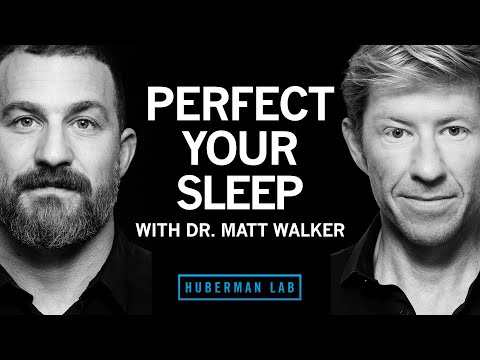
“I think the second tip I would offer in terms of unconventional is have a wind down routine. Many of us think of sleep as if it's like a light switch, that we just jump into bed, and when we turn the light out sleep should arrive in that same way. Just the binary you know it's on or it's off. Sleep is a physiological process, it's much more like landing a plane, it takes time to gradually descend down onto the terra firma of what we call good solid sleep at night.”Huberman Lab podcast with Matt Walker, 2021 · full transcript →
Caffeine, alcohol, food timing, and temperature all change sleep quality
Huberman's sleep advice extends well beyond bedtime. Because caffeine blocks adenosine receptors, he frames it as a tool that can distort the natural buildup of sleep pressure, which is one reason he discusses delaying caffeine after waking and being thoughtful about its timing.5
He is also clear that alcohol is bad for health overall and discusses it as a substance with real biological costs rather than a harmless sleep aid. In his framework, zero alcohol is better for health, and drinking can disrupt the systems that support good brain and body function.181920
Meal timing matters too. He says when you eat is as important as what you eat, and he consistently ties timing of feeding to circadian biology and health, with the active phase of the day being more appropriate than late-night eating.212223
Temperature is another lever. He emphasizes that body temperature rhythms are part of circadian biology, that cooling can support sleep, and that late-day cold exposure may be unhelpful if your goal is to fall asleep easily. He also notes that cooling the palms, soles, and upper face is an efficient way to reduce core body temperature.242526
“That background or what we call baseline circadian rhythm in core body temperature is important to remember because it helps us frame both the effects of deliberate cold exposure and helps us frame when you might want to use deliberate cold exposure in order to access specific states. It also points to times within the 24 hour cycle when you might want to avoid using deliberate cold exposure, if your primary goal is to get to sleep. So that's the circadian rhythm in temperature.”Huberman Lab podcast, 2021 · full transcript →
Recovery tools matter, but regularity still leads
Huberman includes NSDR among the most useful recovery tools around sleep and wakefulness. He describes NSDR, including Yoga Nidra and related practices, as a way to restore alertness, improve emotional stability, and sometimes make it easier to fall asleep later.27284
He also warns against overreacting to one bad night. Rather than sleeping in, napping excessively, taking extra caffeine, or going to bed unusually early, he recommends keeping the system stable so the sleep drive and circadian rhythm can reassert themselves.
Across his sleep discussions, regularity keeps showing up as the hidden principle. A stable daily rhythm of light, arousal, eating, and temperature gives the brain and body the conditions to produce better sleep consistently rather than relying on hacks at the last minute.7122
Huberman on sleep, in his own words
“…sleep is the foundation of mental health, physical health, and performance of all kinds…”
“…the most powerful thing that's governing when you want to be asleep and when you want to be awake is light…”
“The person that can turn their mind off in the final hour of their day and get the better, deeper sleep, I'm going to put all my money on that person.”
“The best way to spike that morning cortisol is to get bright light in your eyes within the first 30 to 60 minutes of your day.”
“I think the second tip I would offer in terms of unconventional is have a wind down routine. Many of us think of sleep as if it's like a light switch, that we just jump into bed, and when we turn the light out sleep should arrive in that same way. Just the binary you know it's on or it's off. Sleep is a physiological process, it's much more like landing a plane, it takes time to gradually descend down onto the terra firma of what we call good solid sleep at night.”
Where to watch
 Andrew Huberman on Sleep and Wakefulness: How to Set Your Clock2022 · 82 min · full transcriptBest single overview of Huberman's sleep model: adenosine, light, circadian timing, melatonin, and practical sleep tools.
 Andrew Huberman on Sleep Optimization: Tools for Timing and Recovery2022 · 102 min · full transcriptMost action-oriented guide for improving sleep and wakefulness using light, temperature, and daily timing.
 Andrew Huberman on Sleep and Wakefulness: Caffeine, Light, and NSDR2023 · 207 min · full transcriptStrong practical discussion of caffeine timing, afternoon crashes, morning light, hydration, and NSDR.
 Andrew Huberman on Sleep Optimization: The Science & Practice2021 · 186 min · full transcriptBest deep dive on what sleep does for the brain and body, and why sleep timing and architecture matter.
 Andrew Huberman on Sleep Biology: Your Unique Sleep Needs2022 · 180 min · full transcriptBest for understanding sleep stages, cycles, memory, and why quality, quantity, regularity, and timing all matter.
 Andrew Huberman on Mental Performance: Build Resilience With Daily Habits2023 · 167 min · full transcriptBest short practical discussion of winding down, lowering evening activation, and protecting deep sleep.
Questions people ask
Sources
Every quote above, word for word from the transcripts. Numbers match the text.
“…sleep is the foundation of mental health, physical health, and performance of all kinds…”
“…sleep is the absolute foundation of your mental health, your physical health, and your performance in all endeavors…”
“…the actual changes in the nervous system, the strengthening and weakening predominantly of connections between neurons that underlie learning, do not occur during the focusing and learning…”
“The most important components to learning are that you be alert so that you can attend, so you can pay attention to the material you're trying to learn, and then testing yourself later, and of course, the other component, which is getting sufficient amounts of great sleep each night. And I highly recommend doing NSDR.”
“Adenosine creates a sort of sleep drive or a sleep hunger…”
“…the most powerful thing that's governing when you want to be asleep and when you want to be awake is light…”
“High morning cortisol, low night time cortisol.”
“The best way to spike that morning cortisol is to get bright light in your eyes within the first 30 to 60 minutes of your day.”
“What you want to do is get sunlight in your eyes as close to waking as possible.”
“…view bright sunlight within the first 30 to 60 minutes after waking…”
“I think the second tip I would offer in terms of unconventional is have a wind down routine. Many of us think of sleep as if it's like a light switch, that we just jump into bed, and when we turn the light out sleep should arrive in that same way. Just the binary you know it's on or it's off. Sleep is a physiological process, it's much more like landing a plane, it takes time to gradually descend down onto the terra firma of what we call good solid sleep at night.”
“The person that can turn their mind off in the final hour of their day and get the better, deeper sleep, I'm going to put all my money on that person.”
“The person that can turn their mind off in the final hour of their day and get the better, deeper sleep, I'm going to put all my money on that person within 5 to 10 years far surpassing the other.”
“Do I completely relax, or do I continue to work? What I don't do is any in between. I am perfectly fine just sitting there completely relaxing. Yes, let yourself scroll social media for a short period of time. Let yourself watch a movie, socialize, text with friends, call your mother. You know, my mother said, "Call me more." So, but don't do a hybrid of the two or really focus in and get some work done.”
“Ethanol produces substantial damage to cells.”
“…zero consumption, consumption of zero ounces of alcohol is going to be better for your health…”
“What they found was that even for people that were drinking low to moderate amounts of alcohol, so one or two drinks per day, there was evidence of thinning of the neocortex, so loss of neurons in the neocortex, and other brain regions. And I don't say this in order to cause alarm. I tell you this because they are important data because they reveal and indeed answer the question that has been burning for so long as to whether or not chronic alcohol intake can disrupt the brain even if the chronic intake is very low.”
“…when you eat is as important as what you eat…”
“The key word here is conditions. If I can emphasize anything today, it's that what you eat and when you eat it set conditions in your body, and those conditions can be very good for you, or very bad for you, depending on when you eat. In fact, when you eat is as important as what you eat. I'll repeat that, when you eat is as important as what you eat, at least as it relates to health parameters, in particular, liver health and mental health.”
“For instance, how that impacts various parameters like health parameters and weight loss, et cetera. But the eight hour feeding window was actually created because of a real world constraint on the research and the relationship with the researcher performing the research, not because there's anything holy about an eight hour feeding window. Now, an important point about when the feeding window falls within the 24 hour cycle, it is very important that the feeding window fall during the more active phase of one's day, so for humans, that's typically in the early part of the day or the later part of the day, but not at night. Put very simply, there are a lot of data now pointing to the fact that eating during the nocturnal phase of the 24 hour cycle is very detrimental to one's health.”
“Temperature is a powerful stimulus on our nervous system and indeed on every organ and system of our body…”
“…the best way to cool the body is going to be by making sure that something cold contacts the bottoms of your feet, the palms of your hands and the upper half of the face…”
“That background or what we call baseline circadian rhythm in core body temperature is important to remember because it helps us frame both the effects of deliberate cold exposure and helps us frame when you might want to use deliberate cold exposure in order to access specific states. It also points to times within the 24 hour cycle when you might want to avoid using deliberate cold exposure, if your primary goal is to get to sleep. So that's the circadian rhythm in temperature.”
“…non-sleep deep rest or NSDR…”
“So we talked about light, we talked about activity and timing of light, we talked about the usefulness of naps, and these things that I'm calling non-sleep deep rest, which include meditation, yoga nidra, and hypnosis, non-sleep deep rest, or what I, hereafter, we will refer to as NSDR, not to be confused with EMDR. I don't think I've ever heard NSDR, so I'm planting a flag for NSDR, non-sleep deep rest, as a way to reset one's ability to be awake after you emerge from NSDR, so to get some more wakefulness and ability to attend, some emotional stability, reset, as well as make it better and easier to fall asleep when you wanna go to sleep at night.”
How this guide was made: drafted with AI from the full transcripts of the recordings cited, then checked: every quotation must match a transcript word for word and be the speaker's own words, and an independent review gates accuracy. Methodology and corrections.