Tony Robbins on Relationships & Love
Tony Robbins treats love and relationships as products of focus, state, aligned values, and a shift from blame and self-centeredness toward appreciation, growth, and service.
- Love is central, but relationships rise or fall with the state and focus you bring to them.
- You cannot build lasting love on blame, old stories, or constant attention to what is missing.
- Appreciation changes connection fast; expectation and resentment poison it.
- Lasting relationships need alignment on major values and life decisions, not just chemistry.
- Healthy love moves from me to we, and grows through contribution, meaning, and service.

“I do. I think love is life. Love is the driving force in my life for sure. There's no question about it. And that's why I can't—I hate to see suffering because it's the opposite of love. You know, if you love somebody, what do you do? Anything you can. So that's what I'm called to do. And it is, it's a calling. It's not a job. It's not a business. You—I have all kinds of businesses obviously and I enjoy business. But this is my mission. This is what I'm made for. And um, I'm just one guy. I can't do everything, but I can do a lot. And I'm always figuring how to scale more, right?”Diary Of A CEO interview, 2025 · 1:42:36
Love starts with the state and focus you bring
Robbins’s basic view is that relationships are not experienced objectively; they are filtered through your emotional state and what you choose to notice. If your mind is locked onto what is wrong, missing, or threatening, that becomes the relationship you feel, even if other realities are also present.123
That is why he puts so much emphasis on state management. The way you feel in your body and nervous system changes how you interpret your partner, how you speak, and what kind of presence you bring. When your state shifts, your capacity to connect shifts with it.456
He also sees love as a core force in life rather than a side issue. For him, love drives action, care, and the urge to reduce suffering, which means relationships are strongest when love is expressed actively rather than assumed passively.7
“I do. I think love is life. Love is the driving force in my life for sure. There's no question about it. And that's why I can't—I hate to see suffering because it's the opposite of love. You know, if you love somebody, what do you do? Anything you can. So that's what I'm called to do. And it is, it's a calling. It's not a job. It's not a business. You—I have all kinds of businesses obviously and I enjoy business. But this is my mission. This is what I'm made for. And um, I'm just one guy. I can't do everything, but I can do a lot. And I'm always figuring how to scale more, right?”Diary Of A CEO interview, 2025 · full transcript →
Blame and old stories keep love stuck
Robbins does not think your past should run your present relationships. Family pain and early patterns matter, but they do not have to become destiny unless you keep reliving them and using them to interpret everything happening now.89
This is why he is so hard on blame. In his view, blame may feel morally satisfying for a moment, but it does not produce freedom, pride, or intimacy. If you want a better relationship, the turning point is catching the pattern and choosing a different response instead of building your identity around who hurt you.12
He also points toward a deeper source of relational patterns: people often learn early who they needed to be to get a parent’s love. That means adult relationships can replay old strategies for getting certainty, approval, or significance until those patterns are recognized and changed.
Appreciation is one of the fastest ways to change a relationship
Robbins repeatedly returns to appreciation as a practical antidote to conflict and suffering. His point is not that problems are unreal, but that people often intensify pain by feeding anger, fear, and resentment with repetitive focus. Appreciation interrupts that loop and changes what is emotionally possible in the moment.131415
He advises changing the pattern early rather than waiting until emotion has taken over. When stress begins, shift attention toward something you appreciate, enjoy, or love; that changes your biochemistry and makes wiser action more available.1516
This has direct application in love. If your habitual lens is expectation, you will continually measure your partner against what is missing. If your habitual lens is appreciation, you create more warmth, patience, and generosity, which makes connection easier to sustain.1718
Lasting relationships need aligned values, not just feelings
Robbins does not treat compatibility as mere attraction. He says you do not need perfect agreement on everything, but on major issues, especially life-defining choices, there must be alignment or the relationship will not hold over time.19
This fits with his broader framework that people are driven by core needs like certainty, uncertainty, significance, love, growth, and contribution. Relationships become more stable when both people understand what drives them and stop unconsciously trying to meet those needs in destructive ways.
He extends this idea into family life and parenting. The strongest families are built around a shared value system, especially love, balance, and contribution, rather than entitlement or constant self-preoccupation.20

“You don't have to have all your goals aligned, but on major issues like a child or not, it's got to be aligned or you're not going to sustain that relationship. So whether it's a business or whether I use business because it's easier to modulate in your head, right? >> Or a relationship, it's the critical element there. And then the last part is, is the right team fit in a business. You can relate to this, I'm sure, cuz all those businesses you run, >> you know, you can have somebody's a superstar, but they're the wrong team fit. >> Oh yeah. >> They rub against everybody else. They piss everybody else off.”Codie Sanchez interview, 2025 · full transcript →
The healthiest love moves from me to we
A recurring Robbins theme is that fulfillment comes from something bigger than yourself. In relationships, that means love deepens when it is not just about getting your needs met, but about building a shared life, serving one another, and becoming more through the bond.2122
He says life is about we, not just me, and that principle applies directly to romance and family. A relationship becomes stronger when both people are oriented toward contribution and a shared mission, instead of using the relationship mainly to prop up ego or soothe insecurity.2425
This also connects to self-esteem. Robbins argues that people become healthier partners when they build real inner respect through meaningful action and caring about something larger than themselves. Otherwise they stay trapped in self-focus, and that self-focus distorts love.
Robbins on relationships & love, in his own words
“I do. I think love is life. Love is the driving force in my life for sure. There's no question about it. And that's why I can't—I hate to see suffering because it's the opposite of love. You know, if you love somebody, what do you do? Anything you can. So that's what I'm called to do. And it is, it's a calling. It's not a job. It's not a business. You—I have all kinds of businesses obviously and I enjoy business. But this is my mission. This is what I'm made for. And um, I'm just one guy. I can't do everything, but I can do a lot. And I'm always figuring how to scale more, right?”
“You don't have to have all your goals aligned, but on major issues like a child or not, it's got to be aligned or you're not going to sustain that relationship. So whether it's a business or whether I use business because it's easier to modulate in your head, right? >> Or a relationship, it's the critical element there. And then the last part is, is the right team fit in a business. You can relate to this, I'm sure, cuz all those businesses you run, >> you know, you can have somebody's a superstar, but they're the wrong team fit. >> Oh yeah. >> They rub against everybody else. They piss everybody else off.”
Where to watch
 Tony Robbins on Parenting and State Management: Change Your Focus2021 · 146 min · full transcriptBest for Robbins’s views on family patterns, parenting, appreciation, blame, and shifting from me to we.
 Tony Robbins on Mindset and Negative Thoughts: Focus Changes Everything2022 · 94 min · full transcriptBest for understanding how focus, meaning, and the six human needs shape love and conflict.
 Tony Robbins on State Management: How to End Suffering Fast98 min · full transcriptBest for seeing how early patterns and rapid state shifts affect suffering and connection.
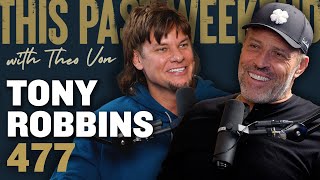 Tony Robbins on State Management: How to Rewire Your Mind2024 · 127 min · full transcriptBest for the link between emotional state, focus, and how you treat other people.
 Tony Robbins on Fulfillment and Service: Achievement Isn’t Enough2019 · 62 min · full transcriptBest for Robbins’s distinction between achievement and fulfillment, and why contribution matters in relationships.
Questions people ask
- How does Tony Robbins say you can change your emotional state?
- What did Tony Robbins say about focus and meaning?
- What did Tony Robbins say about love and suffering?
- What did Tony Robbins say about self-esteem and how it is earned?
- What did Tony Robbins say about why relationships and business partnerships fail?
- Why does Tony Robbins say blame ruins happiness?
Sources
Every quote above, word for word from the transcripts. Numbers match the text.
“People don't experience life; they experience the life they focus on.”
“You don't experience life; you experience the part of life you focus on…”
“You don't experience life; you experience the part of life you focus on, right? What's wrong is always available, so is what's right, right? And there are different kinds of focus. And my dad's focus that day was really on what he hadn't done, and I know that 'cause he kept muttering it. That he hadn't taken care of his family, there's no money for Thanksgiving, somebody had to give us charity. And then the second decision you make, about once you focus on something, is what does it mean?”
“You can't move people if you're not moved.”
“You can't touch people if you're not touched.”
“…the body will change the mind the fastest…”
“I do. I think love is life. Love is the driving force in my life for sure. There's no question about it. And that's why I can't—I hate to see suffering because it's the opposite of love. You know, if you love somebody, what do you do? Anything you can. So that's what I'm called to do. And it is, it's a calling. It's not a job. It's not a business. You—I have all kinds of businesses obviously and I enjoy business. But this is my mission. This is what I'm made for. And um, I'm just one guy. I can't do everything, but I can do a lot. And I'm always figuring how to scale more, right?”
“The past only equals your future if you live there.”
“If you're using a rearview mirror to guide yourself, you're gonna crash.”
“The one power we have is the decision to change anything.”
“You can't be grateful and angry simultaneously.”
“…trade your expectations for appreciation and your whole life changes in a moment…”
“Second of all, decide you're gonna kill that monster while it's little. You're not gonna wait till it's Godzilla taking the city. You're gonna break the pattern. You start to feel the stress, you see it as thoughts going by, and then you focus on something to appreciate, enjoy or love. Appreciation, love, and joy destroy suffering. You can't be grateful and angry simultaneously. As possible, you can't be worried and fearful and grateful simultaneously. So I tell people gratitude is one of the emotions to cultivate that'll destroy the suffering, and that's what we teach people to do.”
“So when you stack a good thing on top of a good thing on top of a good thing, your whole biochemistry changes and now you see the world through different eyes. It's not like you're guaranteed to succeed, but your probabilities of pulling it off and enjoying yourself are up about a thousand fold. Oh yeah. And like, I'll go to—I go to like AA meetings, I go to recovery meetings, right? So, and I notice if I go to a couple in a day, dude, by Friday I'm a good guy, you know? I'm like hugging people, I'm like telling blind people I'm going to heal them. I can't, but I'll do this for like 30 seconds on them, you know? It's like you just feel like— but you're right.”
“So the antidote to suffering, the underdog, loss, less than ever, is appreciation. I always tell people, trade your expectation for appreciation. Your whole life changes. So I was just doing this talk here earlier, and I shared with them experience. And I'm fortunate enough to have my own, you know, private jet now, but it's an intercontinental jet, so I can fly straight to China. It's bigger than a…”
“So one pattern is of focus. Do you tend to focus more on what you have or what's missing? I'm asking your listeners right now and you: What do you tend to focus on, what you have or what's missing? What I have. What do you have? Great. When I ask this in a room, usually about 70% are focused on what's missing. Most achievers are focused on what's missing so they can go out and achieve more, right? Yeah. Nothing wrong with that, but when you stack these patterns together, it's really hard to be happy when you're constantly focused on what's missing. There's a time notes missing, so you go to work, but if you do it all the time, yeah, you can be achieving a ton like some of these billionaires and they're still voting saying, "What's…”
“You don't have to have all your goals aligned, but on major issues like a child or not, it's got to be aligned or you're not going to sustain that relationship. So whether it's a business or whether I use business because it's easier to modulate in your head, right? >> Or a relationship, it's the critical element there. And then the last part is, is the right team fit in a business. You can relate to this, I'm sure, cuz all those businesses you run, >> you know, you can have somebody's a superstar, but they're the wrong team fit. >> Oh yeah. >> They rub against everybody else. They piss everybody else off.”
“But what you can shape is their value system, and not every individual value, but the global values that you know, that life is a balance. That, of course, you're gonna go to extremes, but balance is how the body maintains. It's how life gets imbalanced is like, look for that. It's like life is not about me; it's about we, that life is calling to you to give something. Don't ask what your country is asking for you. As you know, a democratic president once said, "What do you do for your country?" We kind of lost that theme, not only in our country but in our parenting. And so I see a lot of kids today that are like, "They're, what is my parent doing for me?" I could never imagine that thought in my life. My whole thing was like, not one of my, "What can I do for my parents?" was my focus. You know, "What can I do?" And all those little patterns lead to a life that is more meaningful and fulfilling.”
“What you get doesn't make you happy.”
“Who you become makes you really happy…”
“Life is not about me; it's about we.”
“…life's not just about me, it's about we…”
How this guide was made: drafted with AI from the full transcripts of the recordings cited, then checked: every quotation must match a transcript word for word and be the speaker's own words, and an independent review gates accuracy. Methodology and corrections.
