Tony Robbins on Self-Esteem & Identity
Tony Robbins sees self-esteem as something you build by changing your state, taking difficult meaningful action, and identifying with contribution instead of self-absorption.
- Self-esteem is earned, not handed to you through praise or approval.
- Identity is shaped by focus, story, and repeated action more than by the past.
- Doing hard, meaningful things builds real confidence because you prove something to yourself.
- The fastest way to interrupt a weak identity pattern is to change your state first.
- Caring about something bigger than yourself raises esteem and reduces suffering.

“So it's really self-esteem comes from doing incredibly difficult things, where you know you pushed yourself. It's not virtue signaling. It's not telling people about it. It's what you know inside your soul is true. And the more you do things that are incredibly difficult and especially things that are meaningful—meaning they're not just about yourself—the higher that esteem will be. I think the most important thing for self-esteem is to find something you care about more than yourself because as long as you're in your own head, the nature of the mind is reductionism, right? Good, bad, right, wrong, all those types of things. Of course, life is much more many different hues than that.”Chris Williamson interview, 2024 · 0:45
Self-esteem is earned through action, not praise
Robbins’s basic position is that self-esteem is not something other people can give you. It comes from what you know you have done, especially when you have stretched yourself and followed through under pressure. That is why he treats praise and image as weak foundations compared with lived proof.12
He ties esteem to difficulty and meaning. In his view, people feel better about themselves when they do hard things that matter, not when they get attention for looking good or sounding good. Courage matters here because acting despite fear becomes evidence that you can trust yourself.23
This also explains why Robbins cares so much about progress. If growth is what makes people feel alive, then self-esteem rises when you can see yourself moving, learning, and becoming stronger over time.4
“So it's really self-esteem comes from doing incredibly difficult things, where you know you pushed yourself. It's not virtue signaling. It's not telling people about it. It's what you know inside your soul is true. And the more you do things that are incredibly difficult and especially things that are meaningful—meaning they're not just about yourself—the higher that esteem will be. I think the most important thing for self-esteem is to find something you care about more than yourself because as long as you're in your own head, the nature of the mind is reductionism, right? Good, bad, right, wrong, all those types of things. Of course, life is much more many different hues than that.”Chris Williamson interview, 2024 · full transcript →
Identity follows focus and the story you keep telling
For Robbins, identity is not fixed. It is heavily shaped by what you habitually focus on and the meaning you attach to your experience. If your attention keeps circling around weakness, rejection, or what is missing, your sense of self will shrink around those patterns.567
He also says the narrative you tell about your life has enormous power. Beliefs can feel true simply because they have been repeated with certainty, which means identity can be built out of old stories that no longer deserve authority.89
That is why he rejects the idea that your past has to define you. Your biography may explain parts of your conditioning, but it does not have to become your identity unless you keep living there mentally and emotionally.101112
State comes before identity change you can sustain
Robbins repeatedly argues that people try to change their lives while staying in a depleted state. When your body and emotions are flat, fearful, or ashamed, you will usually create a weaker story about who you are and what is possible. That is why he says to change your state first.138
He treats physiology as one of the fastest ways to interrupt a bad identity loop. Movement, intensity, and practices that shift your nervous system can change how you think and what you believe you can do in the moment.1415
This matters for self-esteem because shame and self-attack make action harder. Robbins’s frame is not that you are broken, but that you are conditioned, and conditioning can be changed. A stronger state makes it easier to choose a stronger interpretation and then take the actions that rebuild respect for yourself.1613
Contribution is the fastest way out of self-obsession
A central Robbins theme is that self-esteem grows when life stops being only about you. He says that when people stay trapped in their own heads, they tend to overanalyze, reduce life to judgments, and intensify suffering. Finding something bigger than yourself interrupts that pattern.2
This is why contribution shows up so often in his view of identity. He pushes a shift from me to we, arguing that a healthier self-concept is built through service, usefulness, and giving, not entitlement or constant self-evaluation.171819
He connects this outward orientation to fulfillment as well. Achievement alone is not enough; people want to feel that who they are and what they do actually helps. That broader purpose gives identity more stability than success by itself can provide.2021
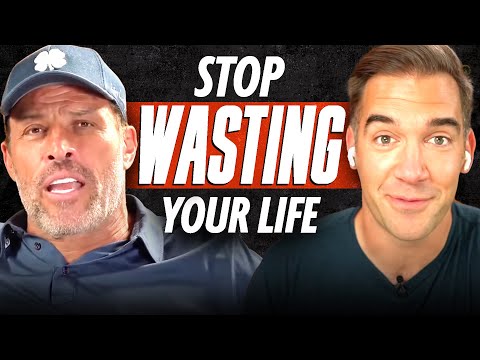
“Life is not about me; it's about we.”Lewis Howes interview, 2021 · full transcript →
Real confidence grows when you stop blaming and start deciding
Robbins is harsh on blame because he thinks it destroys agency. If self-esteem is earned, then it cannot be built by explaining your life through other people’s failures, even if they influenced you. Real pride comes from what you choose and what you do now.2223
That is why decision is so important in his model of identity. He sees choice as the moment where you stop rehearsing an old self and begin embodying a new one. Even happiness, in his framing, depends on a deep commitment rather than waiting for external certainty.2425
Practically, this means catching destructive patterns early, changing focus, and replacing suffering with appreciation and action. A person who repeatedly does that starts to trust themselves, and that trust is a major part of self-esteem.262728
“The one power we have is the decision to change anything.”Lewis Howes interview, 2021 · full transcript →
Robbins on self-esteem & identity, in his own words
“Self-esteem is earned within yourself.”
“So it's really self-esteem comes from doing incredibly difficult things, where you know you pushed yourself. It's not virtue signaling. It's not telling people about it. It's what you know inside your soul is true. And the more you do things that are incredibly difficult and especially things that are meaningful—meaning they're not just about yourself—the higher that esteem will be. I think the most important thing for self-esteem is to find something you care about more than yourself because as long as you're in your own head, the nature of the mind is reductionism, right? Good, bad, right, wrong, all those types of things. Of course, life is much more many different hues than that.”
“Life is not about me; it's about we.”
Where to watch
 Tony Robbins on Self-Esteem and Focus: Find Something Bigger2024 · 88 min · full transcriptBest single source for his direct view that self-esteem comes from hard, meaningful action and caring about something bigger than yourself.
 Tony Robbins on Parenting and State Management: Change Your Focus2021 · 146 min · full transcriptShows how he links self-esteem to service, gratitude, parenting, and refusing to let the past become identity.
 Tony Robbins on Mindset and Certainty: State Before Strategy2024 · 67 min · full transcriptBest for understanding why he says state comes before story, strategy, and any lasting identity shift.
 Tony Robbins on Negative Thoughts: Rewire Your Brain Through State2025 · 62 min · full transcriptExplains how narrative and belief systems shape identity and why changing the story changes life.
 Tony Robbins on Success and Mindset: Progress, Hunger, Change2021 · 106 min · full transcriptUseful for his inner-game view of fulfillment, progress, hunger, and self-esteem earned from within.
 Tony Robbins on State Management: How to End Suffering Fast98 min · full transcriptBest for the practical side of shifting identity fast through physiology, appreciation, and pattern interruption.
Questions people ask
- How does Tony Robbins say you can change your emotional state?
- What did Tony Robbins say about self-esteem and how it is earned?
- What did Tony Robbins say about the past and biography not being destiny?
- What does Tony Robbins say about the stories we tell ourselves?
- What does Tony Robbins say is the key to happiness?
- Why does Tony Robbins say blame ruins happiness?
Sources
Every quote above, word for word from the transcripts. Numbers match the text.
“Self-esteem is earned within yourself.”
“So it's really self-esteem comes from doing incredibly difficult things, where you know you pushed yourself. It's not virtue signaling. It's not telling people about it. It's what you know inside your soul is true. And the more you do things that are incredibly difficult and especially things that are meaningful—meaning they're not just about yourself—the higher that esteem will be. I think the most important thing for self-esteem is to find something you care about more than yourself because as long as you're in your own head, the nature of the mind is reductionism, right? Good, bad, right, wrong, all those types of things. Of course, life is much more many different hues than that.”
“Courage does not mean you're not afraid. It means you're afraid, but you do it anyway.”
“People ask me all the time, "What does it take to be happy?" And I always tell them it's really simple. One word: progress. Progress equals happiness. If you keep growing, you're going to feel alive. And if you keep growing, you're going to have more to give. And when you're growing and giving, is when life is magnificent. It doesn't matter how many statues, Oscars they give you or Emmys or how much money you have in the bank. We've all seen people had all those things, and I get the phone call because they're depressed or somebody commits suicide in that area. So it's really an inner game, and I think that's what's missing for us today.”
“People don't experience life; they experience the life they focus on.”
“…we don't experience life, none of us do; we experience the life we focus on…”
“So one pattern is of focus. Do you tend to focus more on what you have or what's missing? I'm asking your listeners right now and you: What do you tend to focus on, what you have or what's missing? What I have. What do you have? Great. When I ask this in a room, usually about 70% are focused on what's missing. Most achievers are focused on what's missing so they can go out and achieve more, right? Yeah. Nothing wrong with that, but when you stack these patterns together, it's really hard to be happy when you're constantly focused on what's missing. There's a time notes missing, so you go to work, but if you do it all the time, yeah, you can be achieving a ton like some of these billionaires and they're still voting saying, "What's…”
“Our narrative of our life controls our life more than anything else.”
“The story, we all tell ourselves stories about things. Our narrative of our life controls our life more than anything else. And all the story is is a set of beliefs. >> And beliefs are nothing but things we've told ourselves over and over again with so much certainty that now we believe them. Like, for example, for yourself, if I can ask, can you think of any belief you may have had 10, 15 years ago that you back then you would have fought for that belief but today you're almost embarrassed you had that belief? >> Yes. >> Right. Most people can. So the fact that you believe it doesn't mean it's true. It just means you're certain.”
“The past only equals your future if you live there.”
“If you're using a rearview mirror to guide yourself, you're gonna crash.”
“About your biography is not your destiny, and it doesn't matter what you've been through. What you decide now is what's going to control your life, what you decide each day going forwards inside your life. And I look at them, seeing me, I can read their minds: this big tall white rich guy is going to tell me biography doesn't matter. So I said, you know, let me tell you my story, and I told them the whole story, way more than I'm telling you. And everyone was crying their eyes up. When they're done, I said, look where I am right now, because I wouldn't assemble the story that my past equals my future. The past only equals your future if you live there. If you're using a rear view mirror to guide yourself, you're gonna crash. So what you've been through is horrific, what you've been through is unjust. I'm on your side, but if you hang on to it you have no future and you have no…”
“…the most important thing to do is change your state first…”
“…the body will change the mind the fastest…”
“If you don't use your mind, your mind will use you.”
“You don't need to be fixed.”
“Life is not about me; it's about we.”
“But what you can shape is their value system, and not every individual value, but the global values that you know, that life is a balance. That, of course, you're gonna go to extremes, but balance is how the body maintains. It's how life gets imbalanced is like, look for that. It's like life is not about me; it's about we, that life is calling to you to give something. Don't ask what your country is asking for you. As you know, a democratic president once said, "What do you do for your country?" We kind of lost that theme, not only in our country but in our parenting. And so I see a lot of kids today that are like, "They're, what is my parent doing for me?" I could never imagine that thought in my life. My whole thing was like, not one of my, "What can I do for my parents?" was my focus. You know, "What can I do?" And all those little patterns lead to a life that is more meaningful and fulfilling.”
“So I used to have these giant mission statements: change the world, all these things, and I do all those things. But now, it's like my mission statement is, "How can I help?" You know, and I get calls every day of my life. Somebody's got cancer or tumors or whatever because, you know, I've got so much expertise in they because I've interviewed the best on Earth, 150 of them. Or someone comes to me with a business thing, or it's something, a relationship, and or it's an athlete. And so along with what I do formally and what I do with my businesses, I have all this that's happening.”
“Success without fulfillment is the ultimate failure.”
“…success without fulfillment to me is the ultimate failure in life…”
“So don't get me wrong. I know some people are not a good influence; I'm not denying that. I'm just saying you're more than somebody's influence unless you obsess about it every moment and make them wrong so you can make yourself feel superior morally, psychologically, or spiritually. That's stop the pattern. We've all done it. Catch yourself because if you want joy, happiness, and freedom, and an extraordinary life, it will not come from blame. Never. There's no pride that comes from blame. I don't mean fake pride where you make to feel good; I'm talking about real pride. Pride is something you earn. Like, people tell me, "Oh, I have no self-esteem because my parents used to say this," or, "They'd say that." I'd say, "That's such—I’m not saying it's both—they didn't say that," I said, "That's why you need self-esteem. Self-esteem does not come.”
“The one power we have is the decision to change anything.”
“The most important decision of your life is deciding whether you're truly committed to being happy no matter what.”
“There was never any external certainty.”
“Second of all, decide you're gonna kill that monster while it's little. You're not gonna wait till it's Godzilla taking the city. You're gonna break the pattern. You start to feel the stress, you see it as thoughts going by, and then you focus on something to appreciate, enjoy or love. Appreciation, love, and joy destroy suffering. You can't be grateful and angry simultaneously. As possible, you can't be worried and fearful and grateful simultaneously. So I tell people gratitude is one of the emotions to cultivate that'll destroy the suffering, and that's what we teach people to do.”
“…trade your expectations for appreciation and your whole life changes in a moment…”
“We have a ninety second rule. Feel it for ninety seconds, figure it out, let it go.”
How this guide was made: drafted with AI from the full transcripts of the recordings cited, then checked: every quotation must match a transcript word for word and be the speaker's own words, and an independent review gates accuracy. Methodology and corrections.