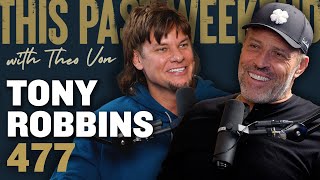
Tony Robbins on Focus & Meaning
Tony Robbins teaches that your life is shaped less by events than by the focus you choose, the meaning you assign, and the emotional state that drives your next action.
- You do not experience all of life; you experience what you focus on.
- Every moment is shaped by three decisions: focus, meaning, and action.
- Meaning creates emotion, and emotion drives behavior more than intellect alone.
- Change starts with state first, then story, then strategy.
- Lasting motivation comes from a goal bigger than yourself, especially growth and contribution.

“Our narrative of our life controls our life more than anything else.”Codie Sanchez interview, 2025 · 0:44
Focus filters reality
Robbins’s starting point is simple: people are not reacting to life in full, but to the slice of life their attention lands on. That is why two people can face similar circumstances and live in completely different emotional worlds. He treats focus as a practical filter that determines what you notice, feel, and remember.134
This is why he keeps returning to the idea that both problems and possibilities are always present. If your attention is habitually pulled to what is missing, unfair, or threatening, that becomes your emotional reality. If you can deliberately widen focus to include what is working, what is available, and what can be done now, your experience changes even before the external situation does.
Meaning turns attention into emotion
For Robbins, focus alone is not the whole story. The second step is meaning: once you notice something, you immediately decide what it means, and that interpretation produces emotion. A setback can mean proof that your life is collapsing, or it can mean a challenge, a lesson, or the start of a new phase.
This is why he puts such weight on narrative. The stories people repeat about themselves and their lives become beliefs, and those beliefs steer behavior. In his framework, people are often trapped not only by events but by the meanings they keep assigning to those events.10
Your state shapes the story you tell
Robbins argues that state comes before strategy because your mental and emotional condition changes what you see as true and possible. When your state is weak, fearful, or ashamed, your interpretations narrow and your options shrink. When your state is stronger, you become more resourceful and more capable of taking effective action.1314
That is why he does not treat focus as a purely intellectual exercise. If you do not direct your mind, your mind will direct you through old conditioning and emotional habits. He recommends actively shifting state so that your story becomes more accurate, more useful, and more empowering.151610
He also warns against trying to think your way out while staying in the same depleted condition. In his sequence, state affects story, and story affects strategy. So if someone wants better decisions, they first need a better inner condition from which to decide.
The real power is choosing focus, meaning, and action on purpose
Robbins says there are three decisions people make constantly: what to focus on, what that focus means, and what to do next. He presents these as the deepest drivers of destiny because they shape emotion in real time, and emotion drives behavior.
This idea matters because it shifts attention from blame to agency. You may not control every event, and external certainty does not exist, but you can still intervene in these three decisions. That is where Robbins locates human power: not in controlling the world, but in becoming more intentional about perception and response.192013
His well-known reframe that life is happening for you rather than to you reflects this approach. It is a meaning choice designed to create strength, responsibility, and forward motion instead of helplessness.2122
Meaning gets stronger when it serves something bigger than you
Robbins does not think the best use of focus is endless self-analysis. He argues that people become stronger when they care about something larger than themselves, because a bigger mission interrupts obsessive self-focus and creates more durable motivation.2324
This is one reason he connects fulfillment to growth and contribution. Achievement alone may satisfy some needs, but lasting meaning comes from becoming more and giving more. In his view, people need progress, and they need to feel that their lives benefit others.2627
That larger purpose also explains why pull motivation matters so much in his system. Willpower has limits, but when the aim is deeply meaningful and tied to contribution, attention and energy organize themselves more naturally around it.2429
Robbins on focus & meaning, in his own words
“Our narrative of our life controls our life more than anything else.”
“…the secret to living is giving.”
Where to watch
 Tony Robbins on Mindset and Negative Thoughts: Focus Changes Everything2022 · 94 min · full transcriptBest single overview of how focus selects experience and meaning creates emotion and action.
 Tony Robbins on Human Motivation: The Six Human Needs41 min · full transcriptShows the broader framework: emotion, decision, resourcefulness, growth, and contribution.
 Tony Robbins on State Management: Focus, Energy, and Purpose2024 · 113 min · full transcriptExplains why focus is trainable and why lasting motivation comes from meaningful pull.
 Tony Robbins on Mindset and Certainty: State Before Strategy2024 · 67 min · full transcriptBest for understanding why state must change before story and strategy can change.
 Tony Robbins on Self-Esteem and Focus: Find Something Bigger2024 · 88 min · full transcriptUseful if you want the link between self-esteem, self-focus, and caring about something bigger.
Questions people ask
- How does Tony Robbins say decisions shape destiny?
- What did Tony Robbins say about focus and meaning?
- What did Tony Robbins say about self-esteem and how it is earned?
- What does Tony Robbins say about the stories we tell ourselves?
- Why does Tony Robbins prefer pull motivation over willpower?
- Why does Tony Robbins say growth and contribution matter more than pleasure?
Sources
Every quote above, word for word from the transcripts. Numbers match the text.
“People don't experience life; they experience the life they focus on.”
“…we don't experience life; we experience the life we focus on…”
“…we don't experience life, none of us do; we experience the life we focus on…”
“Our narrative of our life controls our life more than anything else.”
“The defining factor is never resources. It's resourcefulness.”
“80% of success in life and in business is psychology…”
“If you don't use your mind, your mind will use you.”
“You don't need to be fixed.”
“There was never any external certainty.”
“The most important decision of your life is deciding whether you're truly committed to being happy no matter what.”
“…life's happening for us, not to us…”
“…life is always happening for us, not to us…”
“So it's really self-esteem comes from doing incredibly difficult things, where you know you pushed yourself. It's not virtue signaling. It's not telling people about it. It's what you know inside your soul is true. And the more you do things that are incredibly difficult and especially things that are meaningful—meaning they're not just about yourself—the higher that esteem will be. I think the most important thing for self-esteem is to find something you care about more than yourself because as long as you're in your own head, the nature of the mind is reductionism, right? Good, bad, right, wrong, all those types of things. Of course, life is much more many different hues than that.”
“But there is a limit to willpower. I got a lot of willpower too. But there's no limit to pull motivation. Pull motivation is where something that you care about more than yourself, something that's a magnificent obsession, something where you're contributing—could be kids, it could be your family—but all that ties to the aim of your values that move you forward. And so, we have a six-day process I do called Date With Destiny.”
“…the secret to living is giving.”
“But the last two, number five, you must grow. We all know the answer here. If you don't grow, you what? If a relationship's not growing, if a business is not growing, if you're not growing, doesn't matter how much money you have, how many friends you have, how many people love you, you feel like hell. And the reason we grow, I believe, is so we have something to give of value. Because the sixth need is to contribute beyond ourselves. 'Cause we all know, corny as it sounds, the secret to living is giving. We all know life's not about me. It's about we. This culture knows that. This room knows that. And it's exciting.”
“So I used to have these giant mission statements: change the world, all these things, and I do all those things. But now, it's like my mission statement is, "How can I help?" You know, and I get calls every day of my life. Somebody's got cancer or tumors or whatever because, you know, I've got so much expertise in they because I've interviewed the best on Earth, 150 of them. Or someone comes to me with a business thing, or it's something, a relationship, and or it's an athlete. And so along with what I do formally and what I do with my businesses, I have all this that's happening.”
How this guide was made: drafted with AI from the full transcripts of the recordings cited, then checked: every quotation must match a transcript word for word and be the speaker's own words, and an independent review gates accuracy. Methodology and corrections.