Tony Robbins on Health & Longevity
Tony Robbins treats health and longevity as a practical blend of physiology, focus, measurement, sleep, and purpose, with basic habits and regenerative options working best when they change how you feel and act.
- Change your body first when your mind is stuck; physiology shifts emotion and action fast.
- Sleep, daily routines, and measurable habits matter as much as advanced optimization tools.
- Your health experience is shaped by focus and meaning, not just symptoms or circumstances.
- Robbins is interested in cutting-edge options like stem cells, but not as a substitute for fundamentals.
- Long-term health change lasts better when driven by purpose and pull motivation than by willpower alone.
Health starts with state, not just symptoms
Robbins’s core health idea is that your body and mind are not separate systems. When you feel overwhelmed, depressed, foggy, or emotionally trapped, he says the fastest intervention is often physical rather than intellectual. Instead of trying to think your way out first, he pushes people to change breathing, movement, intensity, temperature, or posture so the nervous system shifts before the story in the mind does.12
That view fits his broader belief that people do not simply react to reality; they react to the state they are in while perceiving it. In practice, that means low energy, pain, poor sleep, and stress can distort judgment and make everything feel heavier than it is. If your state changes, your choices and interpretations can change with it.345
Sleep and basic physiology are the foundation
Robbins does talk about biohacking and advanced therapies, but he does not frame them as the starting point. He emphasizes that sleep, physiology, and daily routines are foundational, and he points to the costs of lost sleep for energy, hormones, desire, and cardiovascular risk. His message is simple: if the basics are broken, higher-end optimization will not solve the real problem.
This is why his health approach is less about collecting hacks and more about building a body that can produce energy consistently. He describes using training, biometrics, and tools to sustain extreme output, but the underlying principle is that energy is trainable and observable, not mysterious. You improve it by treating health as a system and tracking what affects it.6

“…you can't manage something you don't measure…”Peterson x Tony Robbins podcast interview, 2024 · full transcript →
Focus and meaning change how you experience health
Robbins repeatedly argues that people experience what they focus on, not all of life. Applied to health, that means two people can face the same setback and create very different outcomes depending on where attention goes and what meaning they assign to the event. Catastrophic focus can deepen suffering, while constructive focus can widen options and restore momentum.378
He also says meaning is the next key step after focus. A bad night of sleep, a diagnosis, pain, or a dip in motivation does not affect you only through the event itself; it affects you through the interpretation you make. For Robbins, healthier living includes training attention and choosing meanings that lead to action instead of helplessness.5910
This does not mean denying reality. It means refusing to let the mind run unchecked toward what is wrong, because unmanaged focus can consume energy and erase perspective. Gratitude and appreciation are practical tools in his system because they interrupt stress patterns and create a better biochemical and emotional platform for action.111213
Measure what affects your energy and recovery
Robbins’s health philosophy is practical and feedback-driven. He believes you cannot improve what you do not measure, which is why he values biometrics and observation rather than relying only on guesses or motivation. For longevity, that means watching patterns in sleep, recovery, energy, training, and how your body responds over time.6
He also applies this mindset to medical advice. He warns against passively accepting the first answer you hear and stresses persistence in finding the real issue when health is on the line. His stance is not anti-medicine; it is pro-agency, pro-inquiry, and willing to keep searching for better diagnosis or treatment when something does not add up.
Use advanced medicine, but keep the fundamentals and purpose
Robbins is openly enthusiastic about regenerative medicine and says stem cells changed his life after serious pain and spinal issues. That experience deepened his interest in longevity and healing, and it is a real part of his health worldview. He sees new therapies as meaningful possibilities, especially for people dealing with damage, degeneration, or conditions that standard approaches have not resolved.
At the same time, he does not present longevity as a purely medical project. Lasting change, including health change, depends on motivation strong enough to outlast discomfort and inconsistency. He argues that willpower has limits, while purpose-driven motivation can keep people moving for years when the goal matters more than immediate convenience.1516
That is why his version of longevity is not just about living longer. It is about maintaining energy, fulfillment, contribution, and emotional vitality while you live. In his framework, health supports a larger life mission, and that mission in turn helps sustain healthy behavior.171819
Robbins on health & longevity, in his own words
“…you can't manage something you don't measure…”
Where to watch
 Tony Robbins on Health Optimization: Sleep, Stem Cells, and Mindset2022 · 62 min · full transcriptBest single overview of Robbins’s health thinking: sleep, physiology, biometrics, pain, stem cells, and longevity.
 Tony Robbins on State Management: How to End Suffering Fast98 min · full transcriptShows how he uses physiology first to break stress, low mood, and mental stuckness.
 Tony Robbins on State Management: Focus, Energy, and Purpose2024 · 113 min · full transcriptExplains measurement, energy, and why purpose-driven motivation sustains long-term change.
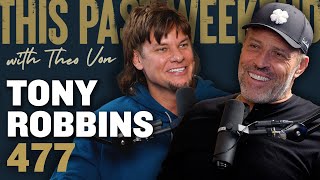 Tony Robbins on State Management: How to Rewire Your Mind2024 · 127 min · full transcriptUseful for understanding how state, gratitude, and repeated mental patterns affect energy and behavior.
 Tony Robbins on Mindset and Negative Thoughts: Focus Changes Everything2022 · 94 min · full transcriptBest for his focus-and-meaning framework, which he applies to suffering, resilience, and change.
Questions people ask
Sources
Every quote above, word for word from the transcripts. Numbers match the text.
“The first thing they should do is change their physiology…”
“…the body will change the mind the fastest…”
“People don't experience life; they experience the life they focus on.”
“…we don't experience life; we experience the life we focus on…”
“If you change these three patterns: what you focus on, what things mean, finding empowering meaning, and then what you do is controlled by how you feel.”
“…you can't manage something you don't measure…”
“You don't experience life; you experience the part of life you focus on…”
“You don't experience life; you experience the part of life you focus on, right? What's wrong is always available, so is what's right, right? And there are different kinds of focus. And my dad's focus that day was really on what he hadn't done, and I know that 'cause he kept muttering it. That he hadn't taken care of his family, there's no money for Thanksgiving, somebody had to give us charity. And then the second decision you make, about once you focus on something, is what does it mean?”
“Mean? The minute you focus on something, you gotta ask, what does it mean? So you wake up, feel like [ __ ]. What does it mean? Well, I effed up last night or it's the end of the world. It doesn't matter. The meaning creates your life. But when you said emotional home, what I learned is that people have an emotional home. Like some people, I'm sure you know, no matter what happens, they're pissed off. Ornamental happens, they're worried. They worry about other people and themselves, or you know, somebody that's not funny but they think they are, and no matter what happens, they have a good time, right? So people have emotional problems.”
“What's wrong is always available; so is what's right…”
“If you don't use your mind, your mind will use you.”
“…trade your expectations for appreciation and your whole life changes in a moment…”
“Second of all, decide you're gonna kill that monster while it's little. You're not gonna wait till it's Godzilla taking the city. You're gonna break the pattern. You start to feel the stress, you see it as thoughts going by, and then you focus on something to appreciate, enjoy or love. Appreciation, love, and joy destroy suffering. You can't be grateful and angry simultaneously. As possible, you can't be worried and fearful and grateful simultaneously. So I tell people gratitude is one of the emotions to cultivate that'll destroy the suffering, and that's what we teach people to do.”
“…there's no limit to pull motivation…”
“But there is a limit to willpower. I got a lot of willpower too. But there's no limit to pull motivation. Pull motivation is where something that you care about more than yourself, something that's a magnificent obsession, something where you're contributing—could be kids, it could be your family—but all that ties to the aim of your values that move you forward. And so, we have a six-day process I do called Date With Destiny.”
“…success without fulfillment to me is the ultimate failure in life…”
“You can't move people if you're not moved.”
“You can't touch people if you're not touched.”
How this guide was made: drafted with AI from the full transcripts of the recordings cited, then checked: every quotation must match a transcript word for word and be the speaker's own words, and an independent review gates accuracy. Methodology and corrections.