Steve Jobs on Apple Campus: Cupertino's New Headquarters Plan

What Jobs talks about
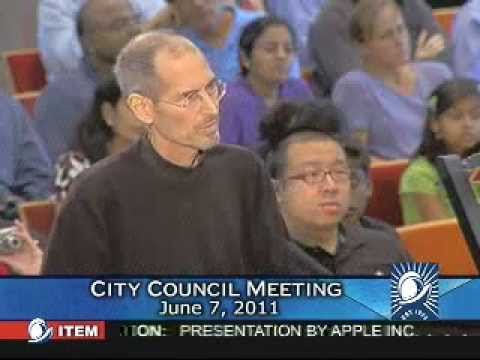
Steve Jobs presents Apple’s plan for a new campus in Cupertino, explaining that the company has outgrown its existing buildings and needs a larger home nearby. He frames the project as a way to keep Apple rooted in the city where it began.
He walks the council through the design concept: a circular, four-story building for 12,000 people, with extensive landscaping, underground parking, an energy center, an auditorium, and a fitness center. He emphasizes that the campus should feel human-scale despite its size.
Jobs also answers council questions about taxes, traffic, safety, air quality, and timelines. He argues that staying in Cupertino benefits both Apple and the city, and says the company hopes to break ground the next year and move in by 2015.
Jobs speaks throughout, with introductions and questions from Cupertino City Council members and staff.
In his words
“Apple's grown like a weed”
“We need to build a new campus.”
“It looks like a spaceship landed.”
“We want the whole place human scale.”
“We're proud to be in Cupertino, too.”
Key points
- Apple has outgrown its current Cupertino campus and needs an additional headquarters.
- The proposed campus would house 12,000 people in one large circular building.
- The design prioritizes landscaping, underground parking, and a human scale.
- Jobs stresses that Apple wants to stay in Cupertino and keep its tax base there.
- He says the campus will include backup power, an auditorium, a fitness center, and R&D space.
- He addresses concerns about safety, traffic, and air quality directly.
- Apple plans to submit plans quickly, break ground next year, and move in by 2015.
Full transcript
At this time we have ceremonial manners and presentation, and it is my honor to call, I'm going to take a little things out of order, and actually it's under oral communication, and as you know, Cupertino is very famous for Apple computer, and we're very honored to have Mr. Steve Jobs to come here tonight to give a special presentation. Mr. Jobs. Welcome, Mr. Jobs. Looks like you have a fan club here. Thanks, yeah. Thank you.
I was, Apple's grown like a weed, and as you know, we've always been in Cupertino. Started in a little office park and eventually got the buildings we are in now at the corner of De Anza and 280. But we've, and those buildings hold maybe 2,600 people, 2,800 people, but we've got almost 12,000 people in the area. So we're renting buildings, not very good buildings either, at an ever greater radius from our campus, and we're putting people in those, and it's clear that we need to build a new campus.
So we're just out of space, and that doesn't mean we don't need the one we've got. We do need it, but we need another one to augment it, and so we've got a plan that lets us stay in Cupertino, and we went out and we bought some land, and this land is kind of special to me. When I was 13, I think, I called up, Hewlett and Packard were my idols, and I called up Bill Hewlett because he lived in Palo Alto and there were no unlisted numbers in the phone book, which gives you a clue to my age, and he picked up the phone and I talked to him, and I asked him if he'd give me some spare parts for something I was building called a frequency counter, and he did, but in addition to that he gave me something way more important.
He gave me a job that summer, a summer job at Hewlett Packard right here in Santa Clara off 280, the division that built frequency counters, and I was in heaven. Well, right around that exact moment in time, Hewlett and Packard themselves were walking on some property over here in Cupertino in Pruneridge, and they ended up buying it, and they built their computer systems division there, and as Hewlett Packard has been shrinking lately, they decided to sell that property and we bought it. We bought that and we bought some adjacent property. It all used to be apricot trees, apricot orchards, and we've got about 150 acres, and we would like to put a new campus on that so that we can stay in Cupertino, and we've hired some great architects to work with, some of the best in the world I think, and we've come up with a design that puts 12,000 people in one building.
Think about that. That's rather odd, 12,000 people in a building, in one building, but we've seen these office parks with lots of buildings, and they get pretty boring pretty fast, so we'd like to do something better than that, and I'd like to take you through what we'd like to do. So this is supposed to work here. There we go. Can you see this? Yes, we can. Great. So here's where we are today, which is on Infinite Loop Drive, again at the intersection of De Anza and 280. Mr. Jobs, you can actually draw on the screen. That's how high-tech we are. Oh, good. Use your finger. So instead of pointing in the air, you can just draw.
I don't really need to draw on the screen. It's okay. You can see it clearly. And what we've done is we've bought this land right here. We tried to buy the apartments in the corner, but they're not for sale, so we couldn't buy those, but we bought everything else. And the campus we'd like to build there is one building that holds 12,000 people, and it's a pretty amazing building. Let me show it to you. It's a little like a spaceship landed. But there it is. And it's got this gorgeous courtyard in the middle, but a lot more.
So let's let's take a closer look at it. It's got her. It's it's it's a it's a circle. And so it's curved all the way around. As you know, if you build things, this is not the cheapest way to build something. There's not a straight piece of glass in this building. It's all curved and we've used our experience in making retail buildings all over the world now. We know how to make the biggest pieces of glass in the world for architectural use. And we want to make the glass specifically for this building here. We can make it curved like this all the way around the building and you can see what it will look like. It's pretty cool.
Again, today, about 20 percent of the space is landscaping. Most of it is a big asphalt parking lot, several big asphalt parking lots. So 20 percent of it is landscape. We want to completely change this and we want to make 80 percent of it landscape. And the way we're going to do this is we're going to put the most of the parking underground so that we can have. 80 percent be landscape and you can see what we have in mind. I mean, there's nothing like this on the property now. It's it's pretty bad today. There are thirty seven hundred trees in the property. We'd like to just almost double that.
We've hired one of the senior arborists from Stanford, actually, who's very good with indigenous trees around this area. So we'd like to plant a lot of trees, including some apricot orchards. And again, you see what it might be like. And this is some of the infrastructure. Main building. We want we have parking underneath the main building and that's not enough, unfortunately. And we have a parking structure here as well. The building's four stories high, as is the parking structure. So there's nothing high here at all. We want the whole place human scale.
It's actually about the same as what we have in Cupertino right now. And an energy center. We deal with people using sitting at computers all day writing software. And if the power goes out on the grid, we get to send everybody home. So we have to have backup power to power the place in the event of brownouts and stuff. And I think what we're going to end up doing is making the energy center our primary source of power, because we can generate power with natural gas and other ways that can be cleaner and cheaper and use the grid as our backup.
We think that makes more sense. We've got an auditorium because we put on presentations much like we did yesterday. But we have to go to San Francisco to do them. And a fitness center and some R&D facilities. These are just things that we do testing and we need some buildings to test in. And there's hardly any people in them. So this is roughly the kind of thing that we're thinking about. And we're thinking about 12,000 people. I put 13 on the slide just because we may get a little luckier than 12,000. So we're up roughly 40% in people versus what the site has been used for already.
And we're increasing the space to three point one million square feet. So 20 percent increase in space. The landscaping, though, increases by 350 percent, which is nice. The trees by 60 percent. The surface parking goes down by 90 percent. And so I think the overall feeling of the place is going to be a zillion times better than it is now with all the asphalt. And the building footprint actually goes down by 30 percent. So we want to take the space and in many cases making it smaller.
We're putting more. of a desirable thing on the space and that's what we'd like to do. So I just want to give you a look at it. This is a cafe. We have cafes in our facilities and this cafe will feed the better part of 3000 people in a sitting. Because that's what you need when you have 12,000 people in a campus and so that's what we're looking at. And I'd love to answer any questions if you have any. Thank you Mr. Jobs and we're really excited that you call Apple our home.
If you go to your shop at One Infinity Loop you have a t-shirt that says the mothership has landed and if you look at this picture, definitely the mothership has landed here in Cupertino. Is there any questions or comments from my council colleagues? Council Member Wang. Hi Steve. Quick question, I think people are curious as to now what this city residents can benefit from this new campus. Well, as you know, we're the largest taxpayer in Cupertino so we'd like to continue to stay here and pay taxes. That's number one. Okay. Because if we can't then we have to go somewhere like Mountain View and we take our current people with us and we give up and over years sell the land here and the largest tax base would go away.
That wouldn't be good for Cupertino and it wouldn't be good for us either. So that's number one and number two, we employ some really talented, great people across the whole age spectrum. A lot of people right out of college, hire a lot of Stanford grads, et cetera and people that are in their 50s and even 60s. Like me, I'm in my 50s. So I think that a lot of them want to live around where they work. We have a lot of people riding their bikes to work now. We also run a bus service. We've got 20 buses that run on biodiesel fuel.
They're the cleanest buses you can buy and we've got 20 of them doing routes all the way from San Francisco to Santa Cruz, bringing people in and we think that would we do very well with that here. So those are the things those are the kinds of things I think could benefit Cupertino. An influx of a tax base, an influx of very talented people who are getting paid. We put them in a fairly affluent group of people and many of them would choose to make Cupertino their personal home. As well as their professional home. I think there's a lot there. Plus a whole lot of trees and a whole lot less asphalt.
Those are great things I think could be more specific is that do we get the free Wi-Fi or something like that? See, I'm a simpleton. I've always had this view that we pay taxes and the city should do those things. If we can get out of paying taxes, I'll be glad to put up Wi-Fi. We should use our sales tax part of that to provide the IPAC or something to our residents and get a free Wi-Fi. I think we bring a lot more than free Wi-Fi. Totally agree. Thanks so much.
Sure. Customer Money? First of all, it was interesting your throwback to HP. As a 35-year HP employee, most have been on the Cupertino campus in those buildings there. Obviously felt sorry when I heard that they were consolidating and moving. Now that we've seen your plans, the word spectacular would be an understatement. I think that everybody's going to appreciate what clearly is going to be the most elegant headquarters, at least in the U.S. that I've seen. We definitely appreciate the work that's gone into it and look forward to working with you to move it through the process. Thank you. I think we do have a shot of building the best office building in the world.
I really do think architecture students will come here to see this. I think it could be that good. Appreciate it. Thank you. Mr. Job, thank you very much for coming. We met, the city manager and I met Mr. Cook and Mr. Oppenheimer and also Terry at your campus and see the concept. It's a very good one. I do have a question about, at that time they mentioned about the current Infinity Loop will remain the same. The employee will stay there, right? Yeah, we need both to hold everybody. So that one will host about 8,000, 9,000 people? No, we don't know. 20. No, about 2,600. Oh, 2,600.
Okay. And then this one will host 12,000, 13,000? 12,000. Okay. That's our current plan. All right. So then my concern is, last time I forgot to ask Terry about the safety issue. Because you have only one building, has so many people there. So all the safety will be put into consideration, like the fire, everything? Oh, of course. Okay. Yeah, no, we spend a ton of time identifying and hiring what we think are the best people in the world at doing what we do. The last thing we want is for anybody to get hurt. Okay. Yeah, of course. I mean, the whole building has to be designed with pretty precise requirements for safety.
But we'll even go beyond those. Sure. And then the second question is, because the increase of the employment, the resident is concerned also about the traffic. So you have any plan to alleviate the traffic? Well, we're not increasing the employment by much. You're not? No. Okay. It's by like 20%. So we're not increasing it by much. Okay. All right. Also, I know you care about the air quality. Yes. I understand that you do not allow any employees to smoke inside the building, right? Correct. So... Both my parents died of lung cancer from smoking. So I'm a little sensitive on that topic. Sure. I just wanted to let you be aware.
I don't know if you're aware or not. There's a Lehigh Southwest cement plant nearby that has air pollution to this area. Are you concerned about that? Are you aware of that? What is it? The cement plant is polluting the air in the entire area. The cement plant? That's the Kaiser? Yeah. 24001 Stephens Creek. I grew up about five blocks away from that. Six blocks away. Oh, okay. So I'm pretty familiar with the Kaiser plant. Okay. And, yeah, I think it would be great if the Kaiser plant wasn't there. But, you know, they bought the land fair and square. So probably they're not going anywhere. Okay. But if you kick Kaiser out, I wouldn't cry. All right.
Thank you. Thank you, Council Member Chang. Council Member Wang, you have a very quick question, right? Oh, yeah. A very quick question. Can you estimate timelines and when you plan to submit the plan and when you're going to do the groundbreaking and when we can see the real building? Yeah. Well, I ask that question to a lot of our people, too. We want to submit plans fairly quickly. We want to break ground next year. And we want to move in in 2015. 2015? Yeah. Okay. All right. Very good. Thank you so, so much. We're really honored to have you to be here. And I think your technologies really make everybody proud. And to put a Cupertino in together with Apple, now we're really proud of it.
Well, thanks. We're proud to be in Cupertino, too. Thanks. Thank you, Council Member Wang. I think she stole my question. I was going to ask you, when did you break ground so you can start collecting those sales tax dollars from you? Next year. No, exactly. Exactly. But, you know, when Chris and I met with Mr. Jobs, you know, I found out a little bit more about him Actually, he is a hometown boy. Graduated from Cupertino Middle School where my daughter is going. Went to Homestead High School. So Mr. Jobs is very well familiar with the city of Cupertino. So we're very fortunate that you founded here in Cupertino. You decided to expand here in Cupertino. There's many choices across the country. And I'm sure that many governors and many mayors said, please come to us. But you decided to stay here. And I think it's because Cupertino is such an innovative place, a diverse place, and educational-wise that we have such wonderful schools.
And later on we'll hear some other students on how they got awarded and our schools are doing so well. One thing that I want to ask you is to keep in mind is giving back to the community. And one thing that we would love to do and I'm sure that our staff will talk about is that we don't like going to Valley Fair or going to Los Gatos for an apple store. We would love to have an apple store here in Cupertino. Sure. And I can show you, I even have my iPad 2 here which I love this technology here. Operates with me. But, you know, that is a wonderful technology. And my 11 year old just loves this. I got you. Yeah. The the problem with putting an Apple store in Cupertino is there just isn't the traffic.
So I'm afraid it might not be successful. If we thought it'd be successful, we'd love to. We'll help you make a successful. Again, thank you very much for coming with me. I'm sure that you guys are very lucky to hear this very historical moment that, you know, you hear about what, five years ago, was it, Chris, that you made the announcement you bought the five acres. Then you bought another 100 acres from Hewlett Packard. And Apple is truly the technology of innovation. And our city staff and city council looks very forward to working with you and helping you succeed here in our community. Thank you very much. Let's give a big round of applause for Mr. Seedorf.
We'll get back to working on our plans. We get back to you as quick as possible. Sure. Thank you very much, Mr. Jobs. Thank you. Thank you.
Transcribed from the audio with OpenAI Whisper. Timestamps link to the video above. Errors are possible.