Satya Nadella on Open Vs Closed AI
Satya Nadella sees AI as strongest when it is broadly diffused, multi-model, and under customer control, with trust built through engineering rather than dependence on any single closed system.
- He does not view AI as a winner-take-all market dominated by one model or one lab.
- He wants customers to use many models while staying independent through their own evals and architecture.
- He argues openness matters because broad diffusion, competition, and choice help AI serve humanity.
- He thinks trust should come from external controls like identity, logging, policy, and monitoring, not from assuming a model is perfectly aligned.
- He believes value will come from deployment, workflow change, and software built on top of models, not only from model creators.
Nadella rejects the idea that one AI model should own the market
Nadella's basic market view is that AI should not become a single-lab, single-model hierarchy. He prefers a market where many models compete and where enterprises can switch, compare, and combine them instead of locking themselves into one intelligence layer.12
That view fits his broader strategic instinct that not every platform shift becomes winner-take-all. He has pointed to cloud as an example where people predicted one winner, but durable value spread across infrastructure, software, and customers building on top.34
He also separates the success of a model company from the success of the wider economy. For him, the real standard is whether AI drives broad productivity and useful outcomes, not whether one model becomes dominant.45
His practical advice is multi-model: use all, depend on none
Nadella's most concrete advice to enterprises is to use multiple models while avoiding dependence on any single one. He wants companies to define the outcomes that matter to them, test those outcomes across models, and make sure performance can be maintained even if one model is removed.26
That is why model choice and routing matter so much in his framing. If different models are better for different tasks, the right architecture is not a permanent commitment to one provider but a system that can evaluate, route, and continuously improve against the benchmarks that matter to the customer.67
This is also why he emphasizes customer-specific customization. Enterprises have different data, workflows, and security needs, so the winning AI setup is the one that can be tailored around those differences rather than forcing every company into the same closed pattern.89
Why he leans toward openness: diffusion, choice, and customer sovereignty
Nadella connects openness to a bigger moral and economic point: AI should reach people widely and remain in human control. In his view, serving humanity requires broad diffusion, real choice, and the ability for users and organizations to shape how AI is used.1011
That belief matches Microsoft's role as a platform company. He describes technology as something built so others can create more technology, which implies an ecosystem mindset rather than a model monopoly mindset.12
In enterprise settings, this becomes a sovereignty argument. Customers need meaningful control over data, prompts, weights, and evaluation standards, because those are core to how they protect their business and create differentiated value.29
He is less trusting of model alignment and more focused on engineered safety
Nadella has become more skeptical that safety or alignment will simply emerge as models scale. He now argues that organizations should assume a model or agent can malfunction and design systems that contain failures before damage is done.1314
That shifts the open-versus-closed debate in an important way. For him, the main trust question is not whether a model is marketed as safe, open, or frontier-grade; it is whether the surrounding system has identity, logging, policy enforcement, monitoring, and auditability.1415
This is consistent with his insistence on keeping humans in the loop. AI should increase capability, but it should do so inside accountable systems where people can supervise, verify, and intervene.1610
What actually wins in AI: deployment, workflows, and software on top
Nadella does not think the biggest value in AI will sit only inside the most advanced model. He repeatedly points to deployment, infrastructure, and workflow redesign as the harder and more valuable layer, especially in enterprise settings.174
That helps explain why he is comfortable with a world containing both open-weight and closed models. If the durable value is in applying AI to real business processes, then customers benefit from lower-cost models, more competition, and better routing while still investing most heavily in their own data, software, and operational change.17
His copilot framing also reinforces this point. The important thing is not a model in isolation, but a useful interface and agentic layer that helps people access knowledge, act on it, and improve how work gets done.181920
Nadella on open vs closed ai, in his own words
“I want to turn this into just a simple, straightforward software business as opposed to a network effects intelligence business.”
“…every firm will have a private eval benchmark, which is their core IP.”
Where to watch
 Satya Nadella on Open vs Closed AI Models: Who Wins2025 · 24 min · full transcriptBest single explanation of his open-vs-closed market view, zero-trust AI safety, and why enterprises should not rely on one model.
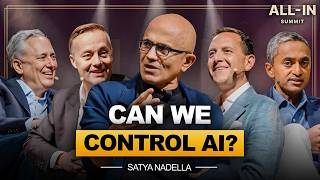 Satya Nadella on AI Competition: Safety, Openness, and Enterprise Control2025 · 37 min · full transcriptBest on diffusion, competition, human control, and why customer independence matters more than lab promises.
 Satya Nadella on AGI and Quantum Computing: Refounding the Future2025 · 77 min · full transcriptBest for understanding why he thinks value will accrue to infrastructure, deployment, and workflow change rather than one model winner.
 Satya Nadella on Copilots and Azure AI: Ignite's age of copilots2023 · 63 min · full transcriptShows how the multi-model, enterprise AI stack turns into products like copilots, routing, and customization.
 Satya Nadella on AI Phase Shifts: OpenAI, Agents, and the Next Stack2025 · 85 min · full transcriptUseful for the strategic backdrop: how Nadella thinks about platform shifts, permission to win, and avoiding envy-driven strategy.
Questions people ask
- What did Satya Nadella say about AI being in human control?
- What did Satya Nadella say about using multiple AI models?
- What did Satya Nadella say about customizing Copilot for business needs?
- What did Satya Nadella say about choosing AI models and routing requests?
- What did Satya Nadella say about who the real winners are in AI?
- What did Satya Nadella say Copilot will do for work and knowledge?
Sources
Every quote above, word for word from the transcripts. Numbers match the text.
“I want to turn this into just a simple, straightforward software business as opposed to a network effects intelligence business.”
“My advice is more like use all, but be independent of all.”
“Sometimes it's okay to fast follow, and it worked out. But you shouldn't do things out of envy. That was one of the hardest lessons, I think, we've learned. Uh, do it because you have permission to do this, and you can do it better. Like, both of those matter to me. The brand permission, like, uh, you know, Geoffrey Moore once said this to me, which I say, "Hey, why don't you go do things which your customers expect you to do?" I love that, right? Which is cloud was one such thing, which is the cust you know, in fact, when I first remember showing up in Azure, people would tell me, "Oh, it's a winner-take-all.”
“The real benchmark is, is the world growing at 10%.”
“At the end of the day, though all of this innovation will only be useful if it's empowering all of us in our careers, in our communities, in our countries.”
“My advice is more like use all, but be independent of all. So for example, my acid test is you should always eval max evals that matter to you. Right? So what's the outcome you want? You should go run that outcome through all the models. Then here's the test I would do. I would pull out a model and see whether I can retain the eval. If I can't, that means you really are dependent on something that may or may not be yours. Right. Right? That's... So so my fundamental enterprise architecture would say you should have a model system that fundamentally allows you to be able to continuously hill climb on your own on evals that are yours, while using all models, closed, open. If you want, you can even fine tune any of these models, but you can even substitute models.”
“But still, picking a model can be a bit of a chore, and you need to be able to route your queries to the right one fast. And so we are making that easier, too. Our new model router will automatically choose the best OpenAI model for the job. No more sort of those manual model selections. An approach today, though, goes from having apps that you built or agents you build only bind to one model to truly becoming multi-model.”
“GPTs are a new way for anyone to create a tailored version of ChatGPT that's more helpful for very specific tasks at work or at home. And going forward, you will be able to use both plug-ins and GPTs in Copilot to tailor your experience. And it goes beyond that. You will, of course, need to tailor your copilot for your very specific needs: your data, your workflows, as well as your security requirements. No two business processes, no two companies are going to be the same. And that's why today we're announcing Copilot Studio.”
“…every firm will have a private eval benchmark, which is their core IP.”
“…we should do what it takes to build stuff that serves humanity first, and is in human control…”
“Let's start with the common sense part first, which is we should do what it takes to build stuff that serves humanity first, and is in human control. You know, it's kinda crazy that we have to start with that level of common sense, but I think it's a good place. Then, when I think about pacing, whatever, the first thing that at least I believe is the broad diffusion of this technology is the most critical thing. Because the benefits of this tech showing up everywhere is really what it's all about. Right? So at the end of the day, if you sort of say serving humanity, let it actually reach humanity, right, in ways that it serves humanity. And that means you've got to have choice, you have to have competition, you have to have all kinds of business models, whether they're open weights, close weights, what have you.”
“We create technology so that others can create more technology.”
“…the biggest change now I have is I used to always think that alignment will just fall out. I no longer believe that.”
“…let's create an engineered zero trust environment that can contain any malfunctioning agent before it does any harm.”
“Safety is the most important feature of our AI platform.”
“It’s not about autopilot, remember, it’s about putting humans in the loop…”
“This is like lean for knowledge work in particular.”
“This is the Age of copilots.”
“Copilot will be the new UI that helps us gain access to the world's knowledge and your organization's knowledge.”
“People who use Copilot are spending less time searching for information, they're holding more effective meetings, they're able to collaborate on work artifacts, whether they are Word documents, spreadsheets, emails. All of them have richer context about their role, about their organization so that they can collaborate much more and stay in focus. And of course, we're just getting started. The way to think about this is Copilot will be the new UI that helps us gain access to the world's knowledge and your organization's knowledge. But most importantly, it's your agent that helps you act on that knowledge.”
How this guide was made: drafted with AI from the full transcripts of the recordings cited, then checked: every quotation must match a transcript word for word and be the speaker's own words, and an independent review gates accuracy. Methodology and corrections.
