Trust, Safety, Control
Autonomy requires governance, observability, and human control.
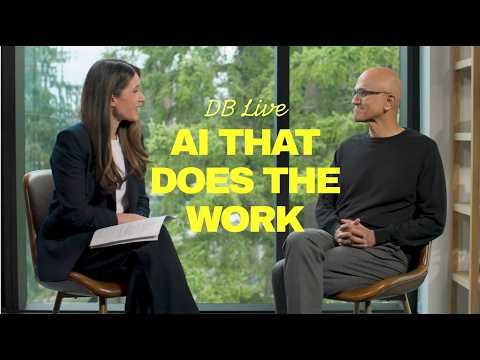
“Autopilots are fantastic until you have to do something with the output of an autopilot.”Yahoo Finance interview, 2025 · 2:55
The lesson
Nadella’s starting point on AI safety is simple: autonomy is only acceptable when humans remain in control. In these talks, he treats trust not as a marketing layer but as the condition for real enterprise adoption, especially as systems move from chat to longer-running agents that can act on their own123. That is why this chapter’s safety stack begins with governance and control, not with raw model capability.
A key shift in his thinking is that model alignment cannot be assumed to emerge automatically as systems get stronger. He says more capable models increase the need for engineered safeguards around them, and he explicitly argues for a zero-trust environment that can contain malfunctioning agents before they cause harm456. In practice, that means you do not trust the model by default; you build external controls such as identity, policy, and containment around it.
Nadella then makes the trust stack concrete: identity, logging, tamper-proof audit trails, policy enforcement, and behavioral monitoring. He frames these as practical safeguards for a world where agents create new insider-risk and observability problems, and where enterprise adoption depends on governance, auditability, security, and reliable operations52. The point is not to eliminate autonomy, but to make autonomous behavior visible, reviewable, and governable.
He also argues that enterprises need sovereignty over how AI is used inside their business. That includes independence across models, private evaluation benchmarks tied to their own core intellectual property, and the ability to compare systems against outcomes that matter to them rather than accepting a vendor’s claims789. Control, in this sense, is architectural: use many models if useful, but keep routing, evaluation, and decision rights in your own hands.
Finally, Nadella connects safety to measurement and operations. He highlights evals, AI reports, analytics, and business KPI tracking as the way organizations reason about what an AI application does and whether it is delivering value safely101112. For him, trust is not separate from ROI: if you cannot observe behavior, audit decisions, and tune usage against business outcomes, you do not yet have an enterprise-ready AI system.
5 principles from Satya Nadella
Keep humans in control
Treat human control as a design requirement, not a fallback after deployment. If an agent can take meaningful action, define where a person approves, intervenes, or reviews outputs before harm spreads.
“…we should do what it takes to build stuff that serves humanity first, and is in human control…”
Assume models can fail and contain them
Do not rely on capability gains alone to make systems safe. Build a zero-trust architecture around models and agents so that a malfunction does not automatically become a business or security incident.
“…the biggest change now I have is I used to always think that alignment will just fall out. I no longer believe that.”
Make agent behavior observable and auditable
Autonomy requires logs, audit trails, and monitoring that let you reconstruct what happened and spot risky behavior early. If you cannot inspect how an agent acted, you cannot govern it responsibly.
“I think that trust is going to be the maximum, biggest issue for us.”
Own your evals and stay model-independent
Evaluate models against outcomes that matter to your organization, and design so you can swap models without losing performance on those benchmarks. This preserves sovereignty over quality, safety, and cost decisions.
“My advice is more like use all, but be independent of all. So for example, my acid test is you should always eval max evals that matter to you. Right? So what's the outcome you want? You should go run that outcome through all the models. Then here's the test I would do. I would pull out a model and see whether I can retain the eval. If I can't, that means you really are dependent on something that may or may not be yours. Right. Right? That's... So so my fundamental enterprise architecture would say you should have a model system that fundamentally allows you to be able to continuously hill climb on your own on evals that are yours, while using all models, closed, open. If you want, you can even fine tune any of these models, but you can even substitute models.”
Tie trust systems to business outcomes
Governance is stronger when it is connected to operating metrics, not separated from them. Use analytics, reports, and eval results to tune agent usage against both safety expectations and business KPIs.
“Because when you sort of build an application at your organizational level, you want to be able to manage AI costs, performance, safety and security. And that's why we are very excited to share that we are bringing really new management capabilities to Foundry. For example, we are introducing AI Reports that will help developers document and share their applications use case and most importantly, eval results. Because I think one of the ways we are going to be able to think about and talk about, and reason about what your application does, is through the evals of the models on which it's built. Safety is the most important feature of any AI app. And we'll continue to ensure we have the best tools to build these secure AI apps, including things like Prompt Shields, so that you can detect and block manipulation of outputs, for your business content.”
Moments to watch
In his own words
The quotes behind the lesson, word for word from the transcripts. Numbers match the lesson above.
“…we should do what it takes to build stuff that serves humanity first, and is in human control…”
“I think that trust is going to be the maximum, biggest issue for us.”
“…anything that doesn't serve humans or is not in human control is not worth doing…”
“…the biggest change now I have is I used to always think that alignment will just fall out. I no longer believe that.”
“…let's create an engineered zero trust environment that can contain any malfunctioning agent before it does any harm.”
“The models are becoming more and more capable.”
“My advice is more like use all, but be independent of all.”
“…every firm will have a private eval benchmark, which is their core IP.”
“My advice is more like use all, but be independent of all. So for example, my acid test is you should always eval max evals that matter to you. Right? So what's the outcome you want? You should go run that outcome through all the models. Then here's the test I would do. I would pull out a model and see whether I can retain the eval. If I can't, that means you really are dependent on something that may or may not be yours. Right. Right? That's... So so my fundamental enterprise architecture would say you should have a model system that fundamentally allows you to be able to continuously hill climb on your own on evals that are yours, while using all models, closed, open. If you want, you can even fine tune any of these models, but you can even substitute models.”
“Because when you sort of build an application at your organizational level, you want to be able to manage AI costs, performance, safety and security. And that's why we are very excited to share that we are bringing really new management capabilities to Foundry. For example, we are introducing AI Reports that will help developers document and share their applications use case and most importantly, eval results. Because I think one of the ways we are going to be able to think about and talk about, and reason about what your application does, is through the evals of the models on which it's built. Safety is the most important feature of any AI app. And we'll continue to ensure we have the best tools to build these secure AI apps, including things like Prompt Shields, so that you can detect and block manipulation of outputs, for your business content.”
“After users start using Copilot and all of these agents, one of the fundamental things that all business leaders want to do is to figure out how do we measure ROI. And so today, we are very excited to announce Copilot Analytics. Yeah. You know, if you take, let's say, a sales territory manager, you say they can now correlate the specific Copilot usage to a business metric like their win rate over time. And it's not just Copilot, it's Copilot and all the agents that you built, you can look at their usage and start tuning even the usage, to the business KPIs.”
“Our goal is to show how Copilot usage is ultimately directly translating into business outcomes across sales, marketing, finance and more. And there are many, many more examples. This is fundamentally the process because it's really a question of change management. So this is a, think of Copilot Analytics as a tool for all of us to change how work, workflow, and work artifacts, are all getting done. That I think is ultimately how we get ROI. So that's a look at Microsoft 365 Copilot, Copiot Studio, and agents, and autonomous agents that end-to-end system for AI-driven business transformation.”
Reflect
- Where in your current AI workflow does a human still need final control, and where have you left that boundary ambiguous?
- If one of your current models failed badly tomorrow, what identity, logging, policy, or monitoring controls would actually limit the damage?
- What private eval benchmark would best capture your organization’s real definition of a good and safe AI outcome?
Check your understanding
Go deeper
 Satya Nadella on AI Competition: Safety, Openness, and Enterprise Control2025 · 37 min · full transcript
 Satya Nadella on Open vs Closed AI Models: Who Wins2025 · 24 min · full transcript
 Satya Nadella on AI in Business: Copilot, agents, and ROI2024 · 76 min · full transcript
 Satya Nadella on AI Agents: The New Interface for Work2025 · 53 min · full transcript
 Satya Nadella on Copilot and AI Products: Trust, Agents, and ROI2025 · 26 min · full transcript
 Satya Nadella on Enterprise AI: Doing More With Less2023 · 42 min · full transcript
- What did Satya Nadella say about AI being in human control?
- What did Satya Nadella say about AI safety and observability at Ignite 2024?
- Why did Satya Nadella say security matters most in the age of AI?
- What did Satya Nadella say about using multiple AI models?
- What did Satya Nadella say about choosing AI models and routing requests?