Open Partnership Playbook
Win the platform shift by partnering widely—with OpenAI, open models, and a competitive ecosystem.

The lesson
Nadella sees AI as a platform shift, and his partnership logic starts there. In a platform shift, the winning move is not to lock yourself into a single product or one company’s success, but to help many builders create value on top of the shift. That is why he frames Microsoft’s role as building an open agentic web and creating technology that lets others create more technology123.
His early bet on OpenAI fits that logic. He has said plainly that OpenAI was the defining company of this generation, which explains why partnering early mattered even when the outcome was uncertain4. But the partnership was never meant to imply dependence on one lab forever; his broader rule is to learn from what is working, avoid envy-driven strategy, and act where Microsoft has real permission to win567.
That is why Nadella pushes model choice instead of model loyalty. His advice is to use every strong model while staying independent, and to judge them by the evaluations that matter for your own outcomes89. In practice, that means Azure should help developers move from single-model apps to multi-model systems, route work to the right model, and preserve customer freedom as the model market keeps changing1011.
This openness also includes support for both closed and open models, because Nadella expects a competitive market rather than one permanent winner. He wants enterprises to own their own evaluation benchmarks and to build systems that can keep improving regardless of which model provider is ahead at a given moment129. Azure’s role, then, is to be the neutral platform where you can build any AI app or agent using your own data, with the infrastructure, tools, and platform rails needed to operate safely at scale1314.
Neutrality does not mean passivity about risk. Nadella argues that broad diffusion only works if AI remains in human control, and he no longer assumes safety or alignment will emerge automatically from stronger models1516. So the open partnership playbook requires a trust stack around models: identity, monitoring, policy, security, and zero-trust containment for malfunctioning agents. That combination—wide model access plus strong operational control—is how he tries to make openness usable for real enterprises171819.
5 principles from Satya Nadella
Partner for the platform shift, not just the product cycle
When computing shifts, the bigger opportunity is enabling an ecosystem, not just shipping one destination app. Apply this by asking how your product helps others build, extend, and create value on top of your platform.
“…building out this open agentic web at scale…”
Bet early, but avoid dependency
A bold partnership can be the right move when a new technical approach may reshape the market. But keep your architecture and strategy independent enough that one partner does not become your only path forward.
“I think the company of this generation has already been created, which is OpenAI…”
Use all models, measured by your own evals
Do not choose models based on hype or loyalty. Define the outcomes that matter to you, test multiple models against them, and make sure you can swap models without losing performance on your core tasks.
“My advice is more like use all, but be independent of all. So for example, my acid test is you should always eval max evals that matter to you. Right? So what's the outcome you want? You should go run that outcome through all the models. Then here's the test I would do. I would pull out a model and see whether I can retain the eval. If I can't, that means you really are dependent on something that may or may not be yours. Right. Right? That's... So so my fundamental enterprise architecture would say you should have a model system that fundamentally allows you to be able to continuously hill climb on your own on evals that are yours, while using all models, closed, open. If you want, you can even fine tune any of these models, but you can even substitute models.”
Compete through openness and customer choice
Nadella expects a market with many viable models, including open and closed options. You can apply this by designing systems that support routing, substitution, and customer control instead of forcing one default provider.
“But still, picking a model can be a bit of a chore, and you need to be able to route your queries to the right one fast. And so we are making that easier, too. Our new model router will automatically choose the best OpenAI model for the job. No more sort of those manual model selections. An approach today, though, goes from having apps that you built or agents you build only bind to one model to truly becoming multi-model.”
Put trust controls around every model
Do not assume a model is fully safe just because it is powerful. Build identity, logging, policy enforcement, and containment around agents so human control survives even when model behavior is imperfect.
“…let's create an engineered zero trust environment that can contain any malfunctioning agent before it does any harm.”
In his own words
The quotes behind the lesson, word for word from the transcripts. Numbers match the lesson above.
“…we're just about getting into these middle innings of another platform shift…”
“…building out this open agentic web at scale…”
“We create technology so that others can create more technology.”
“I think the company of this generation has already been created, which is OpenAI…”
“…do more of the former and less of the latter…”
“…you shouldn't do things out of envy…”
“Sometimes it's okay to fast follow, and it worked out. But you shouldn't do things out of envy. That was one of the hardest lessons, I think, we've learned. Uh, do it because you have permission to do this, and you can do it better. Like, both of those matter to me. The brand permission, like, uh, you know, Geoffrey Moore once said this to me, which I say, "Hey, why don't you go do things which your customers expect you to do?" I love that, right? Which is cloud was one such thing, which is the cust you know, in fact, when I first remember showing up in Azure, people would tell me, "Oh, it's a winner-take-all.”
“My advice is more like use all, but be independent of all.”
“My advice is more like use all, but be independent of all. So for example, my acid test is you should always eval max evals that matter to you. Right? So what's the outcome you want? You should go run that outcome through all the models. Then here's the test I would do. I would pull out a model and see whether I can retain the eval. If I can't, that means you really are dependent on something that may or may not be yours. Right. Right? That's... So so my fundamental enterprise architecture would say you should have a model system that fundamentally allows you to be able to continuously hill climb on your own on evals that are yours, while using all models, closed, open. If you want, you can even fine tune any of these models, but you can even substitute models.”
“But still, picking a model can be a bit of a chore, and you need to be able to route your queries to the right one fast. And so we are making that easier, too. Our new model router will automatically choose the best OpenAI model for the job. No more sort of those manual model selections. An approach today, though, goes from having apps that you built or agents you build only bind to one model to truly becoming multi-model.”
“I want to turn this into just a simple, straightforward software business as opposed to a network effects intelligence business.”
“…every firm will have a private eval benchmark, which is their core IP.”
“So that was a quick, comprehensive, whatever you want to call it, walk through the full stack and how we're creating new opportunity for you across the agentic web. We're taking, really, a systems approach, a platform approach, which you can expect from Microsoft across every layer of the stack, whether it's GitHub and GitHub Copilot, enabling an open ecosystem for the software development lifecycle, Microsoft 365 Copilot and Teams and Copilot Studio, enabling agents for every role and business process, and an agent factory in Foundry, enabling you to build any AI app, any agent, using any data, all running on world class infrastructure.”
“We're introducing more than 50-plus new products and partnerships to create a new opportunity for you. We’ve always been a platform company and our goal is to build the most complete end-to-end stack from infrastructure, to data, to tooling to the application extensibility so that you can apply the power of this technology to build your own applications. And so today I want to highlight our top news for this event across every layer of this Copilot stack. So let's dive right in with infrastructure. You know, we have the most complete scalable AI infrastructure that meets your needs in this AI era. We're building Azure as the world's computer. We have the most comprehensive global infrastructure with more than 60-plus datacenter regions, more than any other cloud provider.”
“…we should do what it takes to build stuff that serves humanity first, and is in human control…”
“…the biggest change now I have is I used to always think that alignment will just fall out. I no longer believe that.”
“…let's create an engineered zero trust environment that can contain any malfunctioning agent before it does any harm.”
“Safety is the most important feature of our AI platform.”
“And all of this on a robust set of rails for management, identity, and security. Ultimately, though, all of this is about creating opportunity to fuel your ambition. I think back to some of the developers I've had the chance to meet over the course of the last year. Right? A father in Spain using Foundry to help speed the diagnosis of rare diseases like the one affecting his son. A startup in South America building an app to gamify wellness. An airline in Japan using Phi to help flight attendants complete reports even when they're 30,000 feet above.”
Reflect
- Where in your work are you overly dependent on one vendor, model, or partner, and what would independence look like in practice?
- If you created your own private eval benchmark, what 3 outcomes would you measure to compare models fairly for your actual use case?
- How could you design your product or team workflow to benefit from an open ecosystem while still keeping strong controls over data, identity, and risk?
Check your understanding
Go deeper
 Satya Nadella on AI Phase Shifts: OpenAI, Agents, and the Next Stack2025 · 85 min · full transcript
 Satya Nadella on Copilots and Azure AI: Ignite's age of copilots2023 · 63 min · full transcript
 Satya Nadella on AI Transformation: Build the Future Stack2024 · 53 min · full transcript
 Satya Nadella on Open vs Closed AI Models: Who Wins2025 · 24 min · full transcript
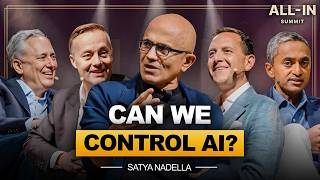 Satya Nadella on AI Competition: Safety, Openness, and Enterprise Control2025 · 37 min · full transcript
 Satya Nadella on Agentic Software Development: Build the Full Stack2025 · 119 min · full transcript