Scale and Compute
Altman's biggest AI bet was that scale would keep working.

The lesson
Altman’s core strategic bet is that scale keeps working. Across these talks, he returns to the idea that model capability continues to improve with more compute, more data, and better systems, even before researchers fully understand every detail of why that progress appears so reliable123. That is why he treats the frontier not as prestige research, but as the engine that determines what becomes possible for products, science, and the broader economy45.
From that view, compute is not just an input to research; it is a strategic necessity. Altman explains that OpenAI made unusually large compute commitments because it expected model progress and demand to keep rising together, and because staying near the frontier would matter disproportionately6. He also describes compute as a shifting bottleneck: sometimes ideas matter most, sometimes chips and infrastructure, sometimes data, but the constraint keeps moving rather than disappearing.
That is why he talks about AI like an infrastructure and energy buildout, not only a software trend. In the Senate hearing, he argues that leadership depends on the ability to build data centers, chips, electricity, and supply chains at scale, and he pairs abundant intelligence with abundant energy as the next decade’s requirement89. If intelligence becomes much cheaper and more widely available, the limiting factor becomes whether society can support that demand with physical capacity, not just clever algorithms10.
Altman also expects the frontier to become more useful, not just larger. He points to multimodality, stronger reasoning, higher reliability, personalization, and the use of personal data as the next major gains, and he argues that better scientific understanding of models should improve both efficiency and performance11. So scale is not merely about training the biggest system once; it is about repeatedly turning more compute and better understanding into intelligence that is cheaper, more dependable, and more adapted to each user10.
But he does not frame scaling as sufficient on its own. Because powerful systems can concentrate power and create real risks, he argues for iterative deployment, external testing, public input, and forms of oversight for the most powerful compute clusters12131415. In his view, the path forward is to keep building while improving control, so that the benefits of frontier systems arrive without giving up human agency over how they are used161718.
5 principles from Sam Altman
Assume frontier models will keep improving
Plan with the expectation that today’s models are not the endpoint. If your strategy depends on models staying mostly static, you may build something that gets absorbed by general model progress instead of strengthened by it.
“These are the stupidest the models will ever be.”
Treat compute as strategy, not overhead
If scale drives capability, then access to compute becomes a core competitive decision. That means securing enough capacity early and recognizing that bottlenecks can shift between ideas, chips, data, and deployment infrastructure.
“I don't, it took us a little while to realize just the new avenues of research this was going to open up and how quickly the models were likely to improve post GPT-4 and that we could do what became the chain-of-thought work and the reasoning models. And we then decided we were going to go make a very big bet on compute because we saw that we could continue to scale models and that the value of these models would be really important, but it was new and the rest of the world wasn't there yet. They hadn't even seen GPT-4. They had not internalized what it, what we thought it could do. And so we decided we would bet the…”
Build for abundant intelligence and abundant energy together
AI progress depends on physical systems as much as software. Think about data centers, power, chips, and supply chains as part of the product stack if you care about long-term capability and adoption.
“The next decade will be about abundant intelligence and abundant energy.”
Expect value to move toward reliability and personalization
Raw model capability matters, but users benefit when that capability becomes dependable, multimodal, and tailored to their context. Design around where the frontier is heading, not just what the current model can do today.
“The long term differentiation will be the model that's most personalized to you.”
Scale capability with safety and human control
Do not separate growth from governance. As systems become more powerful, pair deployment with external testing, broader input, and mechanisms that keep people in charge of important decisions.
“External testing helps us find things that we may have missed internally.”
Moments to watch
In his own words
The quotes behind the lesson, word for word from the transcripts. Numbers match the lesson above.
“Then we got the scaling results. It just kinda breaks my intuition even now. And at some point, you have to just look at the scaling loss and say, we're gonna keep doing this, and this is what we think it'll do. And it also... It was starting to feel at that time like something about deep learning was just this emergent phenomenon that was really important. And even if we didn't understand all of the details in practice yet, which obviously we didn't and still don't, that there was something really fundamental going on. It was the PG isn't for this as we had, like, discovered a new square in the periodic table. Yeah. And so it... We just... We really wanted to push on that. And we were far less resourced than DeepMind and others. And so we said, okay. They're gonna try a lot of things, and we've just gotta pick one and really concentrate.”
“When we just do our fundamental job, we're gonna steamroll you.”
“These are the stupidest the models will ever be.”
“AI can significantly accelerate the pace of scientific discovery.”
“I think this will be the greatest thus far technological achievement of human history…”
“I don't, it took us a little while to realize just the new avenues of research this was going to open up and how quickly the models were likely to improve post GPT-4 and that we could do what became the chain-of-thought work and the reasoning models. And we then decided we were going to go make a very big bet on compute because we saw that we could continue to scale models and that the value of these models would be really important, but it was new and the rest of the world wasn't there yet. They hadn't even seen GPT-4. They had not internalized what it, what we thought it could do. And so we decided we would bet the…”
“I believe this will be at least as big as the Internet, maybe bigger.”
“The next decade will be about abundant intelligence and abundant energy.”
“The cost of intelligence is about to get really really cheap.”
“The long term differentiation will be the model that's most personalized to you.”
“I still believe in iterative deployment.”
“External testing helps us find things that we may have missed internally.”
“The idea that the system represents the will of the people who are going to use it and be impacted by it, I think that's quite important.”
“Concentration of power with AI is a terrifying thing…”
“We must build, release, and use AI safely.”
“…people always should be in control of the future…”
“The only way out is through.”
Reflect
- Where in your work are you assuming model capabilities will improve slowly? How would your plan change if they improve faster than you expect?
- What is the real bottleneck in your current AI effort: ideas, compute, data, product integration, or user trust? What would you do differently if that bottleneck moved next year?
- How would you design an AI product or policy differently if you took infrastructure, energy, and safety constraints as seriously as model quality?
Check your understanding
Go deeper
 Sam Altman on AI Safety and AGI: Cambridge Union Hawking Fellowship2023 · 64 min · full transcript
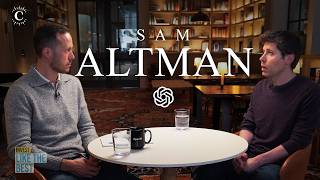 Sam Altman on AGI and Compute: Why the Frontier Matters2025 · 56 min · full transcript
 Sam Altman on OpenAI's Strategy: Models Will Steamroll Startups2024 · 53 min · full transcript
 Sam Altman on AI Competitiveness: Innovation, Adoption, and Energy2025 · 192 min · full transcript
 Sam Altman on AI Safety: Staying Human While Scaling Superintelligence2025 · 49 min · full transcript
 Sam Altman on the Future of AI: AGI, safety, and scale2024 · 33 min · full transcript