Governance and Power
The hardest questions are not only technical: who decides, who benefits, and who controls?

“Whatever. right I think we should have the same concept for AI... I think when you talk to an AI about your medical history or your... legal problems or asking for legal advice or any of these other things, I think the government owes a level of protection to its citizens there that is the same as you'd get if you're talking to the human version of this... And right now we don't have that... And I think it would be a great, great policy to adopt. So the feds or the states or someone in authority can come to you and say, I want to know what so. And so was typing into the. Right now. They could. Yeah. And what is your obligation to keep the information that you receive from users and others... private? Well, I mean, we have an obligation, except when the government comes calling, which is why we're pushing for this. And I was actually just in D.C... advocating for this. I think I feel optimistic that we can get the government to understand the importance of this and do it.”Tucker Carlson interview, 2024 · 32:18
The lesson
Altman frames AI governance as a power question, not just a product question. He argues that advanced AI could create major benefits if intelligence becomes broadly available, but that this only works if systems are built to serve people rather than narrowing control to a few institutions or automating away human judgment123. That is why his governance view tries to hold two ideas together: keep deploying useful systems, and increase caution as capabilities rise45.
A central lesson from OpenAI’s own history is that structure matters under pressure. Altman says the board crisis forced hard learning about incentives, resilience, and what kind of governance can survive future stress as AI becomes more consequential67. He suggests governance should not rest on a small group with unusual power alone; it needs broader legitimacy, better judgment, and the ability to answer to the world as stakes grow8.
On regulation, Altman supports stronger oversight for the most powerful systems, but not a one-size-fits-all clampdown on current AI. He points to testing, red teaming, external review, and safety thresholds as the practical foundation, and says governments may need licensing and testing requirements once systems cross a higher capability bar9101112. He also argues against simple calendar pauses, preferring standards that systems must meet and coordinated approaches for more advanced models1314.
He also pushes for more democratic input into AI behavior and rules. Instead of leaving key value choices only to elite rooms, he wants to learn from what users collectively want, while still preserving broad user freedom and strong privacy protections15161718. In practice, that means governance should include public feedback, careful guardrails, and protections for sensitive use cases like medical or legal conversations, where users need assurance that AI tools are not extracting power from them1817.
Globally, Altman’s position is that uncertainty is unavoidable, so the rule book has to be written iteratively and together. He emphasizes that nobody fully knows what comes next, which makes rigid, final frameworks less useful than experimentation, international coordination, and shared standards that can evolve with the technology1920. The goal is not to freeze progress or let competition justify recklessness, but to keep human control, distribute benefits widely, and build institutions that can respond as the technology changes212223.
5 principles from Sam Altman
Treat governance as a power problem
Ask who gains control, who keeps agency, and who is left out when AI is deployed. Altman’s view is that good AI governance should expand people’s freedom and access to intelligence, not centralize authority or replace human judgment by default.
“AI should give people more power over their own lives, more freedom to live lives the way they want.”
Build institutions that can withstand pressure
Governance failures often appear when stress is high, not when things are calm. Use board design, incentives, and decision processes that remain credible during crises, especially as AI systems become more powerful and politically contested.
“That was definitely the most painful professional experience of my life…”
Regulate by capability thresholds, testing, and audits
Don’t rely on vague promises or arbitrary pauses alone. A stronger model is to require evaluations, red teaming, external review, and, for the most powerful systems, licensing or similar oversight tied to capability and risk.
“For example, the US government might consider a combination of licensing and testing requirements…”
Get democratic input, not only elite consensus
AI rules and guardrails should reflect broad public preferences, not just the views of a small policy or technical class. At the same time, preserve meaningful user freedom and privacy so participation does not become surveillance or paternalism.
“Of course, but I'm much more interested in what our hundreds of millions of users want as a whole. I think a lot of the room has historically been decided in small elite summits. One of the cool new things about AI is our AI can talk to everybody on Earth, and we can learn the collective value preference of what everybody wants, rather than have a bunch of people who are, like, blessed by society to sit in a room and make these decisions, I think that's very cool. (Applause) And I think you will see us do more in that direction. And when we have gotten things wrong, because the elites in the room had a different opinion about what people wanted for the guardrails on image-gen than what people actually wanted, and we couldn't point to real-world harm, so we made that change. I'm proud of that.”
Coordinate globally and update the rules iteratively
Because the technology is moving fast and outcomes are uncertain, governance has to adapt through experimentation and shared learning. International coordination matters most as systems become extremely powerful, when fragmented rules may be too weak.
“Uh So in terms of what we'd like to see from governments, uh I think we've been like very mischaracterized here. We do think that international regulation is gonna be important for the most powerful models. Nothing that exists today, nothing that will exist next year. Uh But as we get towards a real super intelligence, as we get towards a system that is like more capable uh than like any humans. Um I think it's very reasonable to say we need to treat that with like caution and uh and a coordinate approach. But like we think what's happening with open source is great. We think start ups need to be able to train their own models and deploy them into the world and a regulatory response on that would be a disastrous mistake for this country or others. Um So the message we're trying to get across is you gotta embrace what's happening here.”
Moments to watch
In his own words
The quotes behind the lesson, word for word from the transcripts. Numbers match the lesson above.
“…the benefits to humanity of making intelligence broadly available…”
“AI should be built for people, not simply to turn the crank of the machines faster for their own sake.”
“AI should give people more power over their own lives, more freedom to live lives the way they want.”
“We believe that the benefits of the tools we have deployed so far vastly outweigh the risks…”
“This moment calls for extreme care.”
“That was definitely the most painful professional experience of my life…”
“Definitely learned a lot about structure and incentives and what we need out of a a board. And I think that is... It is valuable that this happened now in some sense. I think this is probably not, like, the last high stress moment of open AI, but it was quite a high stress moment. Like, company very nearly got destroyed. And we think a lot about many of the other things we've gotta get right for AGI, but thinking about how to build a resilient org and how to build a structure that will stand up to, like, a lot of pressure in the world, which I expect more and more as we get closer, I think that's super important.”
“I feel great about the new board.”
“However, we think that regulatory intervention by governments will be critical to mitigate the risks of increasingly powerful models.”
“For example, the US government might consider a combination of licensing and testing requirements…”
“Before releasing any new system, OpenAI conducts extensive testing, engages external experts for detailed reviews and independent audits, improves the model's behavior, and implements robust safety and monitoring systems. Before we released GPT-four, our latest model, we spent over six months conducting extensive evaluations, external red teaming, and dangerous capability testing. We are proud of the progress that we made. GPT four is more likely to respond helpfully and truthfully and refuse harmful requests than any other widely deployed model of similar capability. However, we think that regulatory intervention by governments will be critical to mitigate the risks of increasingly powerful models. For example, the US government might consider a combination of licensing and testing requirements for development and release of AI models above a threshold of capabilities.”
“Where I think the licensing scheme comes in is not with... Not for what these models are capable of today because as you pointed out, you don't need a a new licensing agency to do that. But as we as we head, and, you know, this may take a long time. I'm not sure. As we head towards artificial general intelligence Mhmm. And the impact that will have and the power of that technology, I think we need to treat that as seriously as we treat other very powerful technologies. And that's where I personally think we need such a such a scheme.”
“So first of all, we... After we finished training GPT four, we waited more than six months to deploy it. We are not currently training what will be GPT five. We don't have plans to do it in the next six months. But I think the frame of the letter is wrong. What matters is audits, red teaming, safety standards that a model needs to pass before training. If we pause for six months, then I'm not really sure sure what we do then. Do we pause for another six? Do we kind of come up with some rules then? The standards that we have developed and that we've used for GPT four deployment, we wanna build on those, but we think that's the right direction, not a calendar clock pause. There may be times... I expect there will be times when we find something that we don't understand and we really do need to take a pause, but we don't see that yet. Never mind all the benefits.”
“Uh So in terms of what we'd like to see from governments, uh I think we've been like very mischaracterized here. We do think that international regulation is gonna be important for the most powerful models. Nothing that exists today, nothing that will exist next year. Uh But as we get towards a real super intelligence, as we get towards a system that is like more capable uh than like any humans. Um I think it's very reasonable to say we need to treat that with like caution and uh and a coordinate approach. But like we think what's happening with open source is great. We think start ups need to be able to train their own models and deploy them into the world and a regulatory response on that would be a disastrous mistake for this country or others. Um So the message we're trying to get across is you gotta embrace what's happening here.”
“Of course, but I'm much more interested in what our hundreds of millions of users want as a whole. I think a lot of the room has historically been decided in small elite summits. One of the cool new things about AI is our AI can talk to everybody on Earth, and we can learn the collective value preference of what everybody wants, rather than have a bunch of people who are, like, blessed by society to sit in a room and make these decisions, I think that's very cool. (Applause) And I think you will see us do more in that direction. And when we have gotten things wrong, because the elites in the room had a different opinion about what people wanted for the guardrails on image-gen than what people actually wanted, and we couldn't point to real-world harm, so we made that change. I'm proud of that.”
“We need to give adult users a lot of freedom to use AI…”
“And we have found a lot of cases where there was an example of something that seems, that seemed to us like a fairly clear decision of what to allow or not to allow. Where users convinced us like, hey, by blocking this thing that you think is an easy decision to make. you are not allowing this other thing, which is important. And there's a difficult trade off there... in general the attention that. So a principle that I normally like is to treat our adult users like adults. Very strong guarantees on privacy, very strong guarantees on individual user freedom. And this is a tool we are building... You get to use it within very broad framework.”
“Whatever. right I think we should have the same concept for AI... I think when you talk to an AI about your medical history or your... legal problems or asking for legal advice or any of these other things, I think the government owes a level of protection to its citizens there that is the same as you'd get if you're talking to the human version of this... And right now we don't have that... And I think it would be a great, great policy to adopt. So the feds or the states or someone in authority can come to you and say, I want to know what so. And so was typing into the. Right now. They could. Yeah. And what is your obligation to keep the information that you receive from users and others... private? Well, I mean, we have an obligation, except when the government comes calling, which is why we're pushing for this. And I was actually just in D.C... advocating for this. I think I feel optimistic that we can get the government to understand the importance of this and do it.”
“…we're all writing the rule book together…”
“We need to work together to find a totally new approach.”
“We have to reject that logic even when it's convenient for any one actor.”
“We are not the heroes of the story.”
“…abundant intelligence, and closely related to that, abundant energy…”
Reflect
- Where in your work do decisions with broad social impact get made by a small group, and what would more legitimate input look like without making action impossible?
- If you were defining governance for a powerful AI system, what capability threshold would trigger outside audits, licensing, or mandatory testing?
- What privacy guarantees would you want if you used AI for medical, legal, financial, or personal advice, and how would those guarantees change product design?
Check your understanding
Go deeper
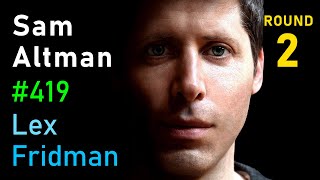 Sam Altman on OpenAI Governance: The Board Saga and AGI2024 · 115 min · full transcript
 Sam Altman on AI Risks and Governance: Human Control First2024 · 159 min · full transcript
 Sam Altman on Global AI Governance: Trust, Safety, and AGI2024 · 61 min · full transcript
 Sam Altman on Global AI Governance: Build the Rule Book Together2024 · 21 min · full transcript
 Sam Altman on AI Competitiveness: Innovation, Adoption, and Energy2025 · 192 min · full transcript
 Sam Altman on AI Safety Regulation: Licensing Powerful Models2023 · 176 min · full transcript
- What did Sam Altman say about OpenAI governance after the board crisis?
- What does Sam Altman think governments should do about AI regulation?
- What did Sam Altman say about using public opinion to set AI safety rules?
- What did Sam Altman say about privacy and government access to AI chats?
- What does Sam Altman think is the bigger AI risk than deepfakes?
- What does Sam Altman say about user freedom and privacy in ChatGPT?