The Frontier Future
Superintelligence, science, and the next platform shift.

“What I think matters though, and what people want to know is not where is this one, you know, magic moment of, “We finished.” But given that what looks like is going to happen is that the models are just going to get smarter and more capable and smarter and more capable, on this long exponential, different people will call it AGI at different points. But we all agree it’s going to go way, way past that. You know, to whatever you want to call these systems that get much more capable than we are. The thing that matters is how do we talk about a system that is safe through all of these steps and beyond, as the system gets more capable than we are, as the system can do things that we don't totally understand.”TED2025 live interview · 20:02
The lesson
Altman’s long-term view of AGI is less about a single finish line and more about systems improving along a steep, continuing curve. Across these interviews, he frames progress as iterative: models are already powerful, still limited, and likely to keep getting better through scaling, new research, and product learning from real-world use1345. That means the useful question is not exactly when to declare AGI, but how to build and govern increasingly capable systems step by step while preserving human control46.
A second theme is that frontier capability matters because it becomes a platform for many kinds of work. Altman describes AI not just as a better chatbot, but as software that can increasingly turn ideas into working outputs, especially in coding and knowledge work, and eventually act more like an assistant or agent that uses tools on your behalf789. He also argues that the frontier is driven by a combination of more compute, better data, and algorithmic improvement, with the bottleneck shifting over time rather than disappearing10.
He is especially excited about science as one of the highest-value uses of advanced AI. In these interviews, Altman says the hardest open problems include long-horizon tasks and genuine scientific discovery, but he also says newer models are already making scientists more productive11. His logic is that if AI accelerates discovery, it can improve the world indirectly through better tools, materials, medicine, and a wider frontier of what people can do1112.
At the product level, Altman expects the next platform shift to come from systems that are more multimodal, reliable, personalized, and agentic. He emphasizes continuous improvement over occasional dramatic launches, along with lower cost and latency so advanced intelligence becomes broadly useful rather than scarce139. But greater capability also raises the stakes: once systems can act online, use personal context, or handle money and data, safety and product quality start to merge into the same problem of trust146.
For builders, the practical implication is to move early, learn from deployment, and build for the world that is arriving rather than the one that is fading. Altman repeatedly supports iterative release and learning from real users, even when the first version is imperfect, because capabilities and demand are changing quickly and people often underestimate the pace of the shift15516. The opportunity is to treat frontier models as a new platform: build tools, workflows, and products that assume steadily improving intelligence, while keeping humans in control and avoiding concentrated power176.
4 principles from Sam Altman
Think in curves, not moments
Don’t anchor on one dramatic day when AGI is supposedly finished. Plan for a long sequence of capability gains, and ask what safety, product design, and human oversight should look like at each step.
“What I think matters though, and what people want to know is not where is this one, you know, magic moment of, “We finished.” But given that what looks like is going to happen is that the models are just going to get smarter and more capable and smarter and more capable, on this long exponential, different people will call it AGI at different points. But we all agree it’s going to go way, way past that. You know, to whatever you want to call these systems that get much more capable than we are. The thing that matters is how do we talk about a system that is safe through all of these steps and beyond, as the system gets more capable than we are, as the system can do things that we don't totally understand.”
Expect science to be a major payoff
AI’s importance is not only automation of today’s tasks, but also acceleration of discovery itself. Prioritize use cases where better reasoning and productivity can help experts uncover new knowledge, not just work faster on routine tasks.
“The thing that I'm personally most excited about is AI for science at this point. I am a big believer that the most important driver of the world and people's lives getting better and better is new scientific discovery. We can do more things with less, we sort of push back the frontier of what's possible. We're starting to hear a lot from scientists with our latest models that they're actually just more productive than they were before. That's actually mattering to what they can discover. CA: What’s the plausible near-term discovery, like, room temperature -- SA: Superconductors? CA: Superconducting, yeah. Is that possible? SA: I don't think that's prevented by the laws of physics. So it should be possible. But we don't know for sure.”
Ship iteratively as capabilities change
When the technology is improving fast, waiting for a perfect release can mean missing the learning that comes from real usage. Launch responsibly, observe what users actually need, and keep improving continuously.
“If you're not a little embarrassed of your first version, you're waiting too long to launch…”
Make trust part of capability
As AI becomes agentic and gains access to tools, data, and actions, safety stops being a separate box to check later. Build systems so users can rely on them with higher-stakes tasks, because usefulness depends on trust.
“I think the most interesting and consequential safety challenge we have yet faced.”
In his own words
The quotes behind the lesson, word for word from the transcripts. Numbers match the lesson above.
“…this model is quite remarkable in many ways quite limited in others…”
“These are the stupidest the models will ever be.”
“What I think matters though, and what people want to know is not where is this one, you know, magic moment of, “We finished.” But given that what looks like is going to happen is that the models are just going to get smarter and more capable and smarter and more capable, on this long exponential, different people will call it AGI at different points. But we all agree it’s going to go way, way past that. You know, to whatever you want to call these systems that get much more capable than we are. The thing that matters is how do we talk about a system that is safe through all of these steps and beyond, as the system gets more capable than we are, as the system can do things that we don't totally understand.”
“I still believe in iterative deployment.”
“…people always should be in control of the future…”
“…one piece of software that can do all of these things…”
“I definitely want that kind of vibe, which not not just like this thing that I task and it blindly does.”
“…we really wanna just provide that platform…”
“I don't, it took us a little while to realize just the new avenues of research this was going to open up and how quickly the models were likely to improve post GPT-4 and that we could do what became the chain-of-thought work and the reasoning models. And we then decided we were going to go make a very big bet on compute because we saw that we could continue to scale models and that the value of these models would be really important, but it was new and the rest of the world wasn't there yet. They hadn't even seen GPT-4. They had not internalized what it, what we thought it could do. And so we decided we would bet the…”
“The thing that I'm personally most excited about is AI for science at this point. I am a big believer that the most important driver of the world and people's lives getting better and better is new scientific discovery. We can do more things with less, we sort of push back the frontier of what's possible. We're starting to hear a lot from scientists with our latest models that they're actually just more productive than they were before. That's actually mattering to what they can discover. CA: What’s the plausible near-term discovery, like, room temperature -- SA: Superconductors? CA: Superconducting, yeah. Is that possible? SA: I don't think that's prevented by the laws of physics. So it should be possible. But we don't know for sure.”
“I think the world will most likely keep getting much better.”
“We may release it in a different way than we've released previous models.”
“I think the most interesting and consequential safety challenge we have yet faced.”
“If you're not a little embarrassed of your first version, you're waiting too long to launch…”
“I think one of the many lessons to take away from this SVB thing is how much... How how fast and how much the world changes and how little I think our experts, leaders, business leaders, regulators, whatever understand it. So the the speed with which the SVB bank run happened because of Twitter, because of mobile banking apps, whatever, was so different than the two thousand eight collapse where we didn't have those things, really. And I don't think the kind of... The people in power realize how much the field had shifted, and I think that is a very tiny preview of the shifts that AGI will bring.”
“Concentration of power with AI is a terrifying thing…”
Reflect
- What are you building or learning that would become much more valuable if models keep improving every year? How would your plan change if you assumed that curve continues?
- Where in your work could AI help with deeper discovery or reasoning, not just speed up routine output?
- If you released an AI-powered product in the next month, what safeguards would users need before trusting it with higher-stakes actions or personal data?
Check your understanding
Go deeper
 Sam Altman on GPT-5 and Superintelligence: What's Next2024 · 65 min · full transcript
 Sam Altman on AI Progress: Superintelligence, Scale, and Risk2025 · 68 min · full transcript
 Sam Altman on Agentic AI: Safety, Power, and the Next Leap2025 · 48 min · full transcript
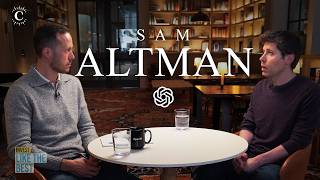 Sam Altman on AGI and Compute: Why the Frontier Matters2025 · 56 min · full transcript
 Sam Altman on AI Safety: Staying Human While Scaling Superintelligence2025 · 49 min · full transcript
 Sam Altman on the Future of AI: AGI, safety, and scale2024 · 33 min · full transcript
 Sam Altman on OpenAI Strategy: Agents, Safety, and Scale2023 · 103 min · full transcript