Bold Reinvention
Great companies move before the old model collapses.
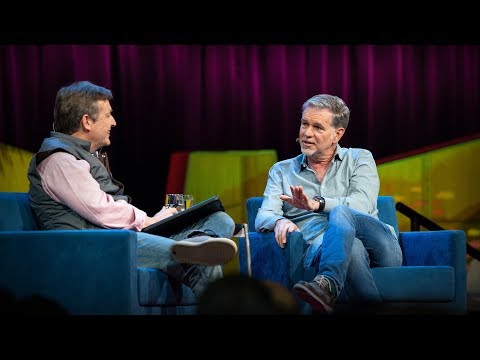
“Yeah, absolutely. We did have one advantage, which is we were born on DVD, and we knew that that was going to be temporary. No one thought we'd be mailing discs for 100 years. So then you have a lot of paranoia about what's coming next, and that's part of the founding ethos, is really worrying about what's coming next. So that's an advantage. And then in terms of the culture, it's very big on freedom and responsibility. I pride myself on making as few decisions as possible in a quarter.”TED talk, 2017 · 4:56
The lesson
Hastings’s view of reinvention starts with a simple premise: if your current model is obviously temporary, you should be worrying early about what replaces it. In his telling, Netflix was never built to mail discs forever; DVD was a bridge to a future shaped by internet delivery, so the company’s job was to keep looking ahead rather than defend the bridge itself1. That is why bold moves were not optional extras at Netflix. They were part of the founding logic of the business.
This helps explain why Hastings favors aggressive bets even when they feel uncomfortable. He argues that fast-moving technology punishes hesitation, and he describes the company’s mindset as needing to be aggressive enough to feel unsettling because the environment changes so quickly23. But the point is not recklessness for its own sake. The deeper idea is that a company can be too attached to its current success and miss the next wave unless it deliberately acts before the old model fully breaks.
The move into originals fits this pattern. In the recordings, originals are presented not just as new product inventory, but as a way to build a stronger brand and create real differentiation for a curated service45. Hastings says this bet was scary, and he also connects creative work with being near the edge where some things fail, which means the company had to accept misses as part of making distinctive shows rather than only distributing everyone else’s content6.
At the same time, Hastings does not treat every bold move as a success. Qwikster became the warning case: the same bravery that drives innovation can also produce serious mistakes if a company gets ahead of what customers are ready to follow7. The lesson is not to stop moving. It is to pair strategic boldness with customer-centered judgment, remembering that the company’s primary responsibility is to entertain customers, not to prove its own courage8.
That balance depends on culture as much as strategy. Hastings ties bold reinvention to freedom and responsibility, broad context, and leaders making fewer decisions so talented people can respond quickly to change91011. In practice, that means building an organization that can debate, adapt, and recover from mistakes without becoming rigid. Reinvention is not one heroic pivot; it is a repeatable way of operating before circumstances force your hand.
5 principles from Reed Hastings
Treat the current model as temporary
Do not assume today’s successful format is the final form of the business. If you know a model is a bridge, organize your thinking around what comes next and start building toward it before decline is obvious.
“Yeah, absolutely. We did have one advantage, which is we were born on DVD, and we knew that that was going to be temporary. No one thought we'd be mailing discs for 100 years. So then you have a lot of paranoia about what's coming next, and that's part of the founding ethos, is really worrying about what's coming next. So that's an advantage. And then in terms of the culture, it's very big on freedom and responsibility. I pride myself on making as few decisions as possible in a quarter.”
Make big bets before you feel fully safe
In fast-changing markets, waiting for certainty can be its own risk. Bold moves should feel uncomfortable, but they should still come from a clear view of where the market is headed rather than from ego or novelty-seeking.
“That's the bitch about the internet -- it moves fast, you know?”
Use originals to create distinction, not just supply
A stronger brand comes from offering something meaningfully different, not merely carrying other companies’ content. Creative differentiation requires accepting that some bets will miss if you are truly pushing into new territory.
“We're a curated service versus a platform like Facebook and YouTube.”
Do not outrun customers
A brave strategy can still fail if the customer experience becomes too confusing or too abrupt. Move aggressively, but test every major shift against whether it actually serves customers better.
“…the same bravery that allows us to be innovative is the bravery that almost killed us…”
Build a culture that can reinvent repeatedly
Reinvention is easier when talented people have context, freedom, and responsibility instead of heavy control. Leaders should create the conditions for adaptation rather than centralize every important decision.
“It's very big on freedom and responsibility.”
In his own words
The quotes behind the lesson, word for word from the transcripts. Numbers match the lesson above.
“Yeah, absolutely. We did have one advantage, which is we were born on DVD, and we knew that that was going to be temporary. No one thought we'd be mailing discs for 100 years. So then you have a lot of paranoia about what's coming next, and that's part of the founding ethos, is really worrying about what's coming next. So that's an advantage. And then in terms of the culture, it's very big on freedom and responsibility. I pride myself on making as few decisions as possible in a quarter.”
“That's the bitch about the internet -- it moves fast, you know?”
“…we had to be so aggressive that it should make the hair on the back of our neck stand up…”
“We're a curated service versus a platform like Facebook and YouTube.”
“…we want to have a difference, right?”
“…the sign that you're right at the edge of chaos, the edge of creativity, is that some stuff doesn't work.”
“…the same bravery that allows us to be innovative is the bravery that almost killed us…”
“Our primary responsibility is to our customers to entertain them…”
“It's very big on freedom and responsibility.”
“I take pride in making as few decisions as possible as opposed to as many as possible…”
“Yeah, up until 2002, all we focused on was survival. And then once we got public and, and we're profitable we started thinking, wow, this thing might last. And the, the cruelest irony would be to not want to work there. You know to let it become a place we didn't want to be. And so we tried to think through what do we really care about? We realized what we really care about is working with incredible people on hard problems and that, that was the essence. So we should organize everything around supporting that of working with, you know, just incredibly talented people. And so that led us to freedom and responsibility, because incredible people don't wanna be micro managed.”
Reflect
- What part of your current work looks successful now but is probably a temporary bridge rather than a lasting model?
- Where might you be under-betting because you are waiting for more certainty than a fast-changing environment will ever provide?
- Think of a recent change you wanted to push. How could you keep the strategic ambition while making sure customers or stakeholders are ready to move with you?
Check your understanding
Go deeper
 Reed Hastings on Netflix Culture: Freedom, Candor, and Bold Bets2017 · 21 min · full transcript
 Reed Hastings on Leadership & Culture: Big-Hearted Champions2023 · 59 min · full transcript
 Reed Hastings on Freedom & Responsibility: Building Netflix2014 · 59 min · full transcript
 Reed Hastings on Life After Netflix: From Streaming to Skiing2025 · 41 min · full transcript
 Reed Hastings on Internet TV: The Future of Television2015 · 53 min · full transcript
 Reed Hastings on Company Culture and Leadership: Honesty, Creativity, Risk2017 · 7 min · full transcript