Founders and Conviction
A company needs a mission strong enough to resist the crowd.

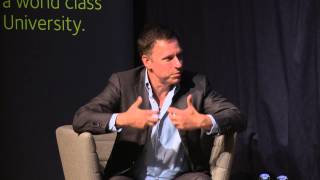
“What great company is nobody starting?”Oxford talk with Peter Tufano and interviewer, 2015 · 3:45
The lesson
Thiel’s starting point is that strong companies are not built by following the crowd. He thinks the founder’s job is to see something important that others miss, then organize a company around that insight. That is why he returns to contrarian questions like what great company nobody is starting, or what true idea few people agree with; founder judgment matters because consensus usually points toward crowded, copycat markets rather than original ones123.
This connects to his view that a business should not aim for head-to-head competition. In his framework, great companies are distinct enough to escape sameness and capture value, which is why he treats capitalism and competition as opposites rather than partners. A founder with conviction should therefore avoid being the hundredth version of an existing business and instead try to build something meaningfully different and one of a kind4567.
The same logic shapes how Thiel thinks about investing. He prefers backing companies where there is a specific reason to believe the market is missing something, not just broad exposure to many mediocre bets. Conviction comes from seeing concrete signs of differentiation and hidden strength, then being willing to lean in when others do not yet agree89.
Inside the company, conviction has to become a shared mission. Thiel argues that teams work best when they are aligned on the purpose of the company while individual responsibilities stay sharply differentiated; people should be rowing in the same direction without blurring who owns what. That kind of internal clarity helps a startup resist imitation and crowd pressure, especially when the broader culture rewards looking different while thinking alike103.
He is also skeptical of romanticizing failure. On his view, failure often teaches less than people claim because many failed businesses were flawed in multiple ways at once, making the lesson hard to isolate. It is better to think carefully at the start, pursue real secrets, and build toward a better future with enough conviction to endure social pressure, rather than treat failure itself as the main teacher111213.
5 principles from Peter Thiel
Ask contrarian questions before you commit
Start by looking for a truth or opportunity that is real but unpopular. If your plan sounds obviously good to everyone, you may be entering a crowded space instead of finding an original one.
“What great company is nobody starting?”
Build to escape competition
Do not aim to be slightly better than many similar rivals. Try to create a business so differentiated that it is effectively in a category of its own and can capture value.
“I believe that capitalism and competition are antonyms.”
Invest with concentration and reasons
Back a company because you see something specific others do not, not because you want generic exposure. The test is whether you can explain the non-obvious strength that justifies conviction.
“I always have a preference to push back on making luck too all-powerful.”
Unite on mission, divide on roles
A startup should have strong alignment on why it exists, but clear ownership over who does what. Shared mission without role clarity creates confusion; role clarity without mission creates politics.
“…you don't have real diversity when you just have a group of people who look different and think alike…”
Do not treat failure as wisdom by default
A failed company often collapses for many reasons at once, so the takeaway can be noisy or misleading. Put more effort into first-principles judgment and better design upfront.
“…there are many great secrets left to be unlocked…”
In his own words
The quotes behind the lesson, word for word from the transcripts. Numbers match the lesson above.
“What great company is nobody starting?”
“…tell me something that's true that nobody agrees with you on.”
“Think Different. That's the Silicon Valley 2018: Think the Same.”
“I believe that capitalism and competition are antonyms.”
“You do not want to start the one hundredth online pet food company or the five thousandth restaurant in San Francisco.”
“One of the critical things in starting businesses is this need to do something new, different, fresh, strange.”
“…every great company is one of a kind…”
“There were sort of a number of different things that checked out. I'm always as an investor, I always like to ask the contrarian question. So the contrarian question for investors, why is it that this is a great company that and what do other people not see in this? Why do other people not see this? So certainly Facebook was was a great company since, you know, it was it was growing like crazy. The valuation was reasonable, and the... And they only needed money to buy more computers because there was so much demand. I think people were missing it in the 2004 to 2006 period. One of the biases investors have is always to just, invest in things they themselves use. And so since Facebook at the time was a college site and there are basically no investors who are attending college, it was systematically underestimated.”
“I always have a preference to push back on making luck too all-powerful.”
“…you don't have real diversity when you just have a group of people who look different and think alike…”
“…there are many great secrets left to be unlocked…”
“We're all gonna live in it, and we wanna make it a better future than the present, not a worse one.”
“And there are things that are in between that are hard; it takes a lot of work, but if you apply yourself, you could figure those out, and I call those secrets. And I think there are many, uh, secrets left. Now, there's certain areas where it's not that promising to look. So, you know, if you were growing up in the 17th or 18th century, there were some empty spaces on the map and you could become an explorer and discover some more secrets about geography. Or in the 19th century, there were still some empty spaces left on the periodic table of elements, and you could go into chemistry and discover some, some…”
Reflect
- What belief about your field do you hold that is both important and unpopular, and what project would follow from taking it seriously?
- Where in your work are you competing in a crowded market instead of building something clearly differentiated?
- Does your team have both a shared mission and clear role ownership, or are you missing one of the two?
Check your understanding
Go deeper
 Peter Thiel on Contrarian Innovation: Why Crowds Miss Big Ideas2015 · 60 min · full transcript
 Peter Thiel on Thinking For Yourself: Q&A on The Tim Ferriss Show2014 · 24 min · full transcript
 Peter Thiel on Contrarian Thinking: Why the Tracks Stop Working2017 · 131 min · full transcript
 Peter Thiel on Zero to One: Why Startups Must Be Different2014 · 77 min · full transcript
 Peter Thiel on Zero to One: Why Progress Means Doing New Things2014 · 18 min · full transcript