Peter Lynch on Market Declines
Peter Lynch treats market declines as normal and unpredictable, and says prepared investors can use them to buy understandable businesses at better prices.
- Declines are inevitable, so investors should expect them rather than act shocked when they arrive.
- Trying to predict the next market move is a waste; focus on companies instead.
- A falling stock is only attractive if the business is still strong and you understand it.
- Sell or hold based on the company story and facts, not because the price moved.
- Lower prices can create bargains and better risk-reward in good businesses.
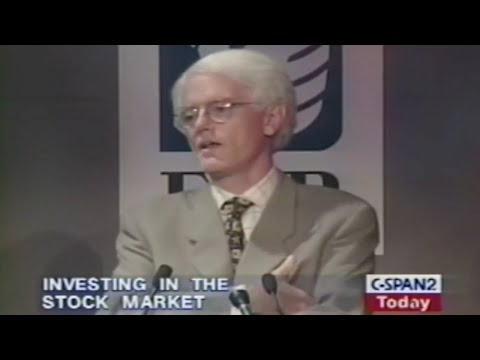
“When you sell a stock is exactly the reason you buy it. You write down the reason you bought it. I bought Subaru. Subaru was a distributor. They didn't... They didn't make any... They didn't actually make the cars. I think it was Fuji Heavy Industries made the cars. They distributed uh Subarus in the United States. The stock was uh, I think the stock was 80. It was up from 6 to 80. I was a little late on this, but it didn't bother me and I should never let that bother you. I didn't let it bother me. They had $40 a share in cash. They had a very low price car. It was well liked. It did well for about 5 or 6 years and I think the stock went from 80 to 320. The reason I sold Subaru, thank you. The reason I sold Subaru is Hyundai came in with a low cost car.”Stock market lecture, 1997 · 39:25
Market declines are part of investing, not an exception
Lynch's starting point is emotional realism: stock investing comes with stomach-churning drops, and investors need to expect that experience instead of treating every selloff as a surprise. He frames temperament as central because volatility is built into the process of owning stocks.12
That is why he talks about taking advantage of declines rather than wishing them away. When prices fall, he does not describe that as proof that stocks are broken; he describes it as something that happens and that prepared investors can use.345
Do not try to forecast corrections or bear markets
Lynch is blunt that predicting the economy, interest rates, or the stock market is not a productive edge for investors. He repeatedly says he does not know what the next big market move will be, and he treats confident forecasters with deep skepticism.6789
This matters during market declines because fear creates a huge temptation to wait for a perfect signal. Lynch's answer is that nobody reliably knows when the drop will start, how far it will go, or when it will end, so portfolio decisions should not rest on market forecasts.310
A decline helps only if you know what you own
Lynch does not think a lower price alone makes a stock safe or attractive. A stock can keep falling, so the right question is whether the business is understandable, the balance sheet is sound, and the company is still doing fine.311
That is why his basic rule becomes more important in a selloff, not less important. If you can explain the business simply and still see the original reason for owning it, then volatility can be something to use; if you cannot explain it, the decline only exposes that you were depending on the market rather than on business facts.13
Use lower prices to improve your odds, not to chase wreckage
Lynch likes the idea of buying strong businesses when a temporary decline gives you a better entry price. He ties that to earnings, fundamentals, and the payoff-versus-loss tradeoff rather than to excitement about a rebound.141516
His way of thinking is practical: if you liked the company before and the underlying business remains sound, a lower price can increase the upside and improve the risk-reward. But that only works when the stock was not already priced for perfection and when the business case is still intact.31614
This is also why he became more interested after prices came down in a volatile market. Lower prices can restore bargains that were not available when stocks were stretched.45
During declines, judge the business story, not the pain on the screen
Lynch's discipline is to buy a stock for a reason and then revisit that reason when conditions change. A market decline by itself is not a reason to sell, just as a rising price by itself is not a reason to own something.1713
He also warns against getting mentally trapped by prices and missed opportunities. The stock does not care who owns it, and investors only lose money in stocks they actually buy, so the useful work is to evaluate what is in the portfolio now and why it belongs there.11192021
That mindset helps during declines because it shifts attention away from panic and toward company-level judgment. Instead of asking where the market goes next, Lynch asks whether the business can earn more over time.2214
“When you sell a stock is exactly the reason you buy it. You write down the reason you bought it. I bought Subaru. Subaru was a distributor. They didn't... They didn't make any... They didn't actually make the cars. I think it was Fuji Heavy Industries made the cars. They distributed uh Subarus in the United States. The stock was uh, I think the stock was 80. It was up from 6 to 80. I was a little late on this, but it didn't bother me and I should never let that bother you. I didn't let it bother me. They had $40 a share in cash. They had a very low price car. It was well liked. It did well for about 5 or 6 years and I think the stock went from 80 to 320. The reason I sold Subaru, thank you. The reason I sold Subaru is Hyundai came in with a low cost car.”Stock market lecture, 1997 · full transcript →
Lynch on market declines, in his own words
“If we get a real bear market, I'll have to get out my drool bucket to catch my excitement.”
“If you like a stock at 14 and it goes to 6, that's great. You understand the company, you look at the balance sheet, and they're doing fine. You're hoping to get to 22 with it. 14 to 22 is terrific. 6 to 22 is exceptional. So, you take advantage of these declines. They're going to happen. No one knows when they're going to happen. It'll be very—People tell you about it after the fact that they predicted it, but they predicted it 53 times. And, uh, so, you can take advantage of the volatility in the market if you understand what you own.”
Where to watch
 Peter Lynch on Market Volatility: Bargains, Growth, and Inflation1994 · 27 min · full transcriptBest single watch for how Lynch emotionally and practically responds to a market pullback, including why falling prices can excite him.
 Peter Lynch on Investing Basics: Know What You Own1994 · 61 min · full transcriptBest overview of why declines are normal and how investors can use volatility if they understand the company.
 Peter Lynch on Stock Picking: Know What You Own1997 · 47 min · full transcriptStrongest statement of his anti-forecasting view and why market prediction is the wrong focus during declines.
 Peter Lynch on Value Investing: Buy Great Businesses on Sale1997 · 13 min · full transcriptShows how Lynch connects temporary price declines to better entries in strong businesses and better risk-reward.
 Peter Lynch on High Stock Prices: What To Do When Valuations Run Hot1990 · 15 min · full transcriptUseful for understanding when lower prices matter: only in relation to earnings, valuation, and what is already discounted.
Questions people ask
- How does Peter Lynch think about risk and reward when buying stocks?
- What did Peter Lynch say about buying during market drops?
- What did Peter Lynch say about predicting the stock market?
- What did Peter Lynch say about when to sell a stock?
- What did Peter Lynch say about whether the rules of investing change over time?
- Why does Peter Lynch say it is futile to predict the economy and the stock market?
Sources
Every quote above, word for word from the transcripts. Numbers match the text.
“The key organ in your body in the stock market is your stomach.”
“I think the same rules applied 50 years ago, applied five years ago, apply 20 years from now.”
“If you like a stock at 14 and it goes to 6, that's great. You understand the company, you look at the balance sheet, and they're doing fine. You're hoping to get to 22 with it. 14 to 22 is terrific. 6 to 22 is exceptional. So, you take advantage of these declines. They're going to happen. No one knows when they're going to happen. It'll be very—People tell you about it after the fact that they predicted it, but they predicted it 53 times. And, uh, so, you can take advantage of the volatility in the market if you understand what you own.”
“I started to salivate the last week with all these stocks coming down.”
“If we get a real bear market, I'll have to get out my drool bucket to catch my excitement.”
“It's futile to predict the economy, interest rates, and stock market.”
“I have no idea what the next thousand points going to do.”
“I have no idea what the next thousand points gonna do.”
“What it's going to do next one or two years, I don't have any idea. And if somebody in this room knows about it, they're not telling anybody. Or they're not in this room. They're down in Palm Springs somewhere, you know, at the... they made a billion dollars. Or if they know anything about interest rates, 'cause if interest rates you can be right five times in a row on 10 grand, you can have two billion. It's not that many people with two billion. There's a lot of people predicting interest rates. Did you ever think about that one? The uh... Just five times right in a row on 10 grand. Two billion. It uh, if you're right seven times in a row, you can have the GNP of uh, you know, the United Kingdom, you know, it's a big number. At the uh... So, I don't worry about that. I know we've had uh, 96 years, a century, and the market's fallen 53 times.”
“So, that's the kind of stocks I like to buy. But, I'm telling you, people don't do this. And I'm talking sophisticated people, unsophisticated people, they don't know what the company is. What's the story? And it's very important to know it because it doesn't always work. And you have to keep posted. Uh, now, here's a big point. Remember this one. It's futile to predict the economy, interest rates, and stock market. I mean, people keep trying to do this. I mean, this would be useful. I would love to know when we get every recession. I'd love to know when interest rates are going to go up and down. I'd love to know when the stock market's going up. That would be helpful. I would like to get next year's Wall Street Journal. Uh…”
“The stock doesn't know you own it.”
“I think the same rules applied 50 years ago, applied five years ago, apply 20 years from now. Yeah, first of all, you have to know what your own—whether it's a fund or stock—and have to have a reason for it, and you oughta be, I'll explain to an eleven-year-old in two minutes or less why own it. And "this sucker's going up" is not a good reason. I've tried that one; that doesn't work.”
“…stock market price ought to be dictated by earnings and earnings performance…”
“If I'm right, how much am I going to make? If I'm wrong, how much am I going to lose?”
“But let's say if a company—just think of this as being—you say to yourself, "I think this company's gonna earn something in the future." If it's already discounting that, if it's selling at a huge multiple, you say it's already, it has to work, and then it's only going to stay even. So you have to say yourself, "If I'm right, how much am I going to make? If I'm wrong, how much am I going to lose?" That's the risk-reward ratio in stock shop. We talk about, if I'm right, I hope I'm going to double, triple my money. If I'm wrong, maybe I lose 30, 40 percent. That's a favorable ratio. You say, if I'm right, the stock's not going to go up, it's already discounting terrific things.”
“When you sell a stock is exactly the reason you buy it. You write down the reason you bought it. I bought Subaru. Subaru was a distributor. They didn't... They didn't make any... They didn't actually make the cars. I think it was Fuji Heavy Industries made the cars. They distributed uh Subarus in the United States. The stock was uh, I think the stock was 80. It was up from 6 to 80. I was a little late on this, but it didn't bother me and I should never let that bother you. I didn't let it bother me. They had $40 a share in cash. They had a very low price car. It was well liked. It did well for about 5 or 6 years and I think the stock went from 80 to 320. The reason I sold Subaru, thank you. The reason I sold Subaru is Hyundai came in with a low cost car.”
“The stock does not know you own it.”
“You cannot lose money in a stock you don't own.”
“One of my books listed on two pages. In the 13 years I ran Magellan, I listed, uh, I think about 200 stocks A through L on the New York Stock Exchange. They went up tenfold or more that I didn't own. While I ran Magellan, I had owned lots of stocks. I listed 200 stocks in April. I stopped at letter L. And I didn't own any of the shares. They went up tenfold or more, and I was able to do okay with Magellan. And people worry all the time about missing Microsoft, missing Western Digital, missing, uh, United Airlines. They spend all their time worrying about stocks they missed. You cannot lose money in a stock you don't own. That's very important. You have—the only way to lose money is buy stock, have it go down, and sell it. That's the only way.”
“Corporate profits will be a lot higher ten years from now.”
How this guide was made: drafted with AI from the full transcripts of the recordings cited, then checked: every quotation must match a transcript word for word and be the speaker's own words, and an independent review gates accuracy. Methodology and corrections.
