Kobe Bryant on Focus
For Kobe, focus is ruthless presence: commit fully, prepare so deeply that actions become automatic, and return to what is in front of you under pressure.
- Focus starts with commitment: choose what matters most and give it everything.
- Preparation sharpens focus by turning game moments into something your body already knows.
- Under pressure, narrow attention to the next action, not the emotion around it.
- Curiosity strengthens focus because it helps you study details, weaknesses, and better ways to improve.
- Focus also means discipline: keep your standards and do not bargain with yourself.
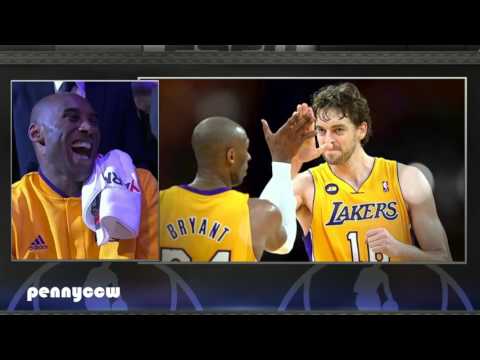
Focus begins with deciding what gets your full commitment
Kobe’s version of focus is not casual concentration. It starts with a choice to give yourself completely to a craft and to hold a very high standard for what counts as success1.
That commitment creates clarity. When the standard is excellence, distractions matter less because they do not fit the mission. He ties this kind of seriousness to refusing internal compromise and to solving the puzzle in front of you instead of making excuses34.
“I gave my soul for this game…”Final game coverage, 2016 · full transcript →
Preparation is how focus becomes automatic
Kobe did not treat focus as a feeling you hope to have on game night. He built it through repetition, especially repetition that matched real conditions. His account of summer work shows a mind training attention by rehearsing exact spots, exact actions, and exact situations until the response becomes natural56.
That matters because scattered practice creates scattered performance. He contrasts generic work with training that mirrors the game, so that in pressure moments the mind does not have to search for answers. The body already knows what to do, and that frees attention for the moment itself6.
In pressure moments, reduce everything to what is right in front of you
Kobe’s clearest idea about focus under pressure is simple: narrow attention to the immediate task. He describes the zone not as drama or emotion, but as staying with the present possession, the present action, the next thing that must be done.
That is why leadership in big moments requires emotional control. He says a leader has to suppress nervousness, which means not letting fear spread through the group or pull attention away from execution8. Even in a playful coaching moment, his instinct is the same: keep the instruction simple and direct attention to one concrete action910.
Curiosity keeps focus sharp and growing
For Kobe, focus is not only intensity. It is also curiosity. He says curiosity is the most important part of the mindset because it pushes you to ask why something worked, why it failed, and what can be learned from it11.
That is what makes focus sustainable over time. Instead of staring harder at the same thing, you widen your sources of learning in service of the craft. He describes using books, television, conversations, and other fields so that the world becomes a resource for getting better.
Real focus is disciplined enough to stay in its lane
Kobe applies focus beyond basketball by stressing patience, structure, and honesty about what you actually know. In business, he argues for staying with areas you understand rather than pretending expertise or chasing quick results13.
That same discipline shows up in how he thinks about innovation and growth. You can improve and evolve, but the improvement has to serve performance and purpose rather than random novelty. Focus is not doing everything; it is knowing what matters and building around it.

“You have to rely on others in order to have success as a group…”Wall Street Journal interview · full transcript →
Kobe on focus, in his own words
“I gave my soul for this game…”
Where to watch
 Kobe Bryant on Prototyping and Winning: From the Game to Business2017 · 13 min · full transcriptBest for seeing how Kobe connects presence, repetition, and the zone into one practical model of focus.
 Kobe Bryant on Mamba Mentality: Curiosity, Standards, and Purpose2019 · 55 min · full transcriptBest for understanding how curiosity, standards, and calmness under pressure support sustained focus.
 Kobe Bryant on Obsession and Focus: The World Becomes Your Library2019 · 64 min · full transcriptBest for seeing how Kobe’s obsessive learning style turns focus into a daily way of studying and improving.
 Kobe Bryant on Injury, Leadership, and Legacy: Playing Fearlessly2013 · 29 min · full transcriptBest for how a leader manages nerves and keeps attention steady in high-stakes moments.
 Kobe Bryant on Surprise Free Throw: Coaching a Fan to $25,0002016 · 9 min · full transcriptA quick, concrete example of Kobe simplifying attention to one action: form, arc, and calm.
Questions people ask
Sources
Every quote above, word for word from the transcripts. Numbers match the text.
“I gave my soul for this game…”
“I don't negotiate with myself.”
“Sounds like excuses to me. I mean, you gotta figure it out, right? If you really have an obsession to figure it out, you will figure it out, right? And every puzzle is constructed differently. A situation when he came into the league was different than mine. Mike's situation in Chicago was different than mine, right? Everybody has a different puzzle, man. You just gotta figure out your own puzzle.”
“…it was 1,000 makes a day in the summertime…”
“Well, it was 1,000 makes a day in the summertime, you know, and going through things just as I would during the game. So, you know, I knew exactly where my positions were within the triangle, where the shots would be coming from. So everything that I did throughout the course of my training was literally simulating that. So it was all game shot. So when they came into game, things were just automatic because I'd put my body through before. You know, sometimes you get in a gym, you work out and you work on ball-handling, you work on shooting, but none of it's really within a structure of which you will be doing in the game. For me, it wasn't like that. It was literally carbon copy of what I'd be doing. So it, by the time a season came around, was all just muscle memory.”
“…as a leader, you have to be able to suppress whatever nervousness you may be feeling…”
“Put an arc on it, and just push it.”
“Get enough arc on that ball.”
“The most important thing about it is curiosity.”
“You have to rely on others in order to have success as a group…”
How this guide was made: drafted with AI from the full transcripts of the recordings cited, then checked: every quotation must match a transcript word for word and be the speaker's own words, and an independent review gates accuracy. Methodology and corrections.


