Reinvent in Public
Bodybuilder, actor, businessman, governor: each ladder was built from the last.

“And the more entertaining it is for the audience to watch, the more miserable it is for us actors to go through this whole experience of filming and making the film. It was a very torturous experience in many ways because, uh, whenever you do a film in the jungle, uh, you know already ahead of time what you're going to get into. You get into a lot of heat, humidity, very tough terrain, uh, doing, uh, strange stunts that, uh, going over waterfalls and swimming with your gear on and climbing up trees and repelling down from helicopters and stuff like that. So, you really have to prepare yourself physically really well.”Dallas promotional interview, 1987 · 0:45
The lesson
Schwarzenegger’s reinventions look dramatic from the outside, but he describes them as one continuous path driven by vision. Bodybuilding was not separate from the rest of his career; it was his route to America and the first platform he used to build something bigger12. Later shifts into acting and politics followed the same pattern: he focused on the next target and kept moving rather than trying to solve his whole life at once34.
A key part of that movement was turning supposed disadvantages into usable material. In Hollywood, his body, accent, and unusual image were treated as reasons he would not fit, but he says those very traits became strengths when matched to the right roles, especially in films like Conan and The Terminator56. The lesson is not that every weakness magically helps you; it is that you can often reposition a trait so it serves a different game.
He also carried methods from one field into the next. The bodybuilding mindset of repetition, experimentation, and discipline became his template for learning acting, adapting his body for screen roles, and staying effective across decades78. Reinvention, in his telling, is less about becoming a different person than about reapplying the same work ethic under new demands.
Another constant is his response to resistance. He repeatedly frames criticism, pressure, and doubt as fuel rather than as a signal to stop, whether the resistance came from other people, harsh early experiences, or difficult productions91011. That helps explain how he could move into areas where he was not the obvious choice, including comedy, which he wanted to pursue even when he thought others would not cast him for it1213.
Finally, his reinventions were public because each step built on visible results from the last one. Pumping Iron made him recognizable beyond bodybuilding, then signature film roles expanded that recognition, and later opportunities followed from that platform. The broader idea is practical: do the next reinvention in a way that uses your current reputation, skills, and audience instead of discarding them.
5 principles from Arnold Schwarzenegger
Build the next ladder from the current one
Use your current field as a platform for the next move instead of treating reinvention as starting from zero. Schwarzenegger used bodybuilding as a route to America and then as an entry point into acting, showing that one success can create access to the next.
“I've got to get to America.”
Turn liabilities into assets
When a trait seems to disqualify you, ask where it would be valuable instead. Schwarzenegger’s physique and accent were seen as obstacles in Hollywood, but became advantages once he found roles that fit them.
“All this became an asset rather than a liability.”
Carry your methods across domains
Reinvention works better when you keep the same operating system: repetition, discipline, and steady practice. What he learned in bodybuilding about reps and consistency became his model for succeeding elsewhere.
“It's all about reps. Reps, reps, reps.”
Use resistance as fuel
Doubt and difficulty do not have to be verdicts; they can become motivation. Schwarzenegger repeatedly describes criticism, pressure, and hardship as things that intensified his drive rather than reduced it.
“But Howard, I live off this pressure. It makes me tick. I love pressure. I love risks. I love when people say it can't be done or it's difficult, you know. And that's why I'm on this environmental crusade because everyone says it can't be done. And I know and I can see a world where we have renewable energy and where we have created a green, uh, you know, uh, world in the future and it would take time, but we can do it if we all pull together. So that's what I like: when people say it can't be done, that's when I go in and want to do it.”
Follow vision, then focus on one move at a time
A long-term dream is useful, but execution still happens in sequence. He emphasizes both having a clear vision and addressing one step at a time, which keeps ambition from turning into distraction.
“I always think of one at a time, you know?”
Moments to watch
In his own words
The quotes behind the lesson, word for word from the transcripts. Numbers match the lesson above.
“I've got to get to America.”
“I was much more attracted to America. I felt that, you know, maybe even at an early age, at a very early age, it was almost kind of like, uh, it was one of those weird things, you know? This maybe I'm the child of some American soldier of some sort. You know, there was something, something going on, you know, that somehow I belonged to America. And, um, so I don't know why, but that's just the way it was. And, um, and so I had this urge of coming to America. I just couldn't figure out how. And so that's why I think I started to be bodybuilding also, because it was a very American sport, and it felt like, well, you know, if I really do well in bodybuilding and if I could become like—…”
“I always think of one at a time, you know?”
“I just was going after my vision.”
“All this became an asset rather than a liability.”
“…you have to really discipline yourself to not listen to the naysayers and to just have your vision and your goal and your dream and you chase that.”
“It's all about reps. Reps, reps, reps.”
“In life, everything is about reps.”
“It put fuel on the fire in my belly.”
“But Howard, I live off this pressure. It makes me tick. I love pressure. I love risks. I love when people say it can't be done or it's difficult, you know. And that's why I'm on this environmental crusade because everyone says it can't be done. And I know and I can see a world where we have renewable energy and where we have created a green, uh, you know, uh, world in the future and it would take time, but we can do it if we all pull together. So that's what I like: when people say it can't be done, that's when I go in and want to do it.”
“It was a very torturous experience in many ways…”
“No one will hire me for comedy…”
“I would like to do comedy, for instance…”
Reflect
- What part of your current work could become a platform for your next field, rather than something you leave behind?
- Which trait of yours feels like a liability right now, and in what context could it become an asset instead?
- What is one reinvention you say you want, and what would the next concrete step be if you took Schwarzenegger’s one-at-a-time approach?
Check your understanding
Go deeper
 Arnold Schwarzenegger on Iconic Characters: How Each Role Became Bigger2018 · 34 min · full transcript
 Arnold Schwarzenegger on Career Reinvention: Bodybuilding to Hollywood to Politics2023 · 66 min · full transcript
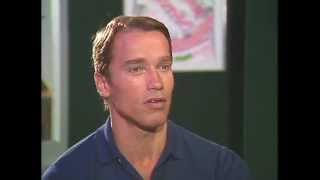 Arnold Schwarzenegger on Predator Production: Stunts, Effects, and Risk1987 · 12 min · full transcript
 Arnold Schwarzenegger on Bodybuilding and Reinvention: Rep by Rep2024 · 66 min · full transcript
 Arnold Schwarzenegger on Bodybuilding and Reinvention: From Conan to Terminator2019 · 44 min · full transcript
 Arnold Schwarzenegger on Fitness And Family: T2, marriage, and exercise1991 · 18 min · full transcript
 Arnold Schwarzenegger on Action Sequels: Vision, Reps, and Fan Demand2013 · 26 min · full transcript