Arnold Schwarzenegger on Iconic Characters: How Each Role Became Bigger

What Schwarzenegger talks about
Arnold Schwarzenegger gave this interview with GQ in 2018, revisiting the film roles that defined his screen career and explaining the lines, physicality, and creative choices behind them.
Also known as: Arnold Schwarzenegger Breaks Down His Most Iconic Characters; Breaks Down His Most Iconic Characters.
Arnold Schwarzenegger breaks down the roles that defined his screen career, explaining how each one became iconic for different reasons. He revisits the lines, physicality, and creative choices behind films like Pumping Iron, Conan the Barbarian, The Terminator, Twins, and True Lies.
He emphasizes that many of his biggest successes came from turning supposed drawbacks into strengths: his accent, his bodybuilder build, and his unusual screen presence. Across the interview, he credits directors like James Cameron, Ivan Reitman, John Milius, and Joel Schumacher for helping him find the right material and the right way to play it.
Schwarzenegger speaks most of the time, with brief interviewer prompts and occasional movie dialogue inserts.
In his words
“Never listen to the naysayers and always just plow ahead and do exactly what is your vision”
“I think that this movie has its life, has its own life, and it will go on forever”
“All this became an asset rather than a liability.”
“No one will hire me for comedy”
“Hasta la vista, baby.”
Key points
- Pumping Iron made him recognizable by showing both bodybuilding and his personality.
- Conan the Barbarian turned his accent and physique into assets rather than liabilities.
- He says The Terminator was initially treated like a B movie, but became a major hit because audiences embraced it.
- "I'll be back" was not intended as a catchphrase, but it became one because of the way he delivered it.
- He values Terminator 2 for turning the machine into a protector and adding humor and human behavior.
- Twins and Kindergarten Cop let him succeed in comedy and prove he could work beyond action roles.
- He describes roles like Predator, Total Recall, True Lies, and Dark Fate as examples of strong writing and memorable characters.
Full transcript: Arnold Schwarzenegger, GQ iconic characters interview (2018)
- When I read the "I'll be back line," I said to Jim Cameron, I said, "To me it sounds weird "when I say I'll be back." Then he says, "Well, how would you say it?" And I said, "I will be back." And he says, "No." [upbeat music] "Pumping Iron." Interestingly enough, "Pumping Iron" was a documentary about explaining body building. It was not about me, because you never know who is going to win. During "Stay Hungry, " the film that I did before "Pumping Iron," I had to reduce my body weight down to 210, so the question was really can I come back again with 240 pounds and then win the Mr. Olympic. So there was question was so therefore no one really focused on me, per se, but they focused more on body building itself.
I just happened to emerge as the personality in the body building field. And so that's why the cameras were then more on me. I happened to win the competition against some tough competitions, against Lou Ferrigno, for instance, and Serge Nubret and Franco Columbu and guys that like that were really tough competitors. I think it also lent itself for me being myself, so I think that people didn't only just see me in "Stay Hungry" as an actor but they saw all of a sudden what I'm really like. So I got "Conan The Barbarian" because of "Pumping Iron." It was like the movie where I showed my personality, and Ed Pressman saw that movie, "Pumping Iron," and just said finally we found the guy that has the personality and has the acting ability and has the body that he is able to play Conan the Barbarian.
Franco's pretty smart, but Franco's a child. And when it comes to the day of the contest, I am his father, he comes to me for advices. So it's not that hard for me to give him the wrong advices. The saying, "milk is for babies, and I drink beer," that is because of my Munich days. So when I moved from Austria to Munich to train between the age of 19 and 21, other gyms always would have milk bottles all over the windows that were empty or half-full or full that body builders would be drinking. In our gym we had downstairs a restaurant, and we always got huge steins of beer.
So we had just beer all around the windows and around the gymnasium. I refused to drink any milk because I hated milk, and so beer was really for me to drink to have while I was working out. - [Man] You drink skim milk, don't you? - [Arnold] No, I drink no milk. - [Man] You don't drink any milk at all? - [Arnold] No milk, no. Milk is for babies, when you grow up you have to drink beer. "Pumping Iron" is being shown just about in all the gyms around the world 24 hours a day. So it doesn't matter which generation you talk about, the new generation that is walking in now into the gym still see "Pumping Iron" and they still see me winning, and so when they come to Gold's Gym here in Venice, they know everything about me. I think that this movie has its life, has its own life, and it will go on forever, I think.
And I think that it is really one of those great documentaries that really has established body building in a big way, because body building was kind of like a hidden kind of a sport, no one really understood it, no one really could explain what it is about. And I think that "Pumping Iron" did all of that, it explained that. "Conan the Barbarian." My goal was to be a leading man. And I was told many times by managers and agents and studio executives that this would never happen, that someone with an accent like me has never become a real leading man and a big star in America, that Americans like to hear people sound like John Wayne or Clint Eastwood, but not like me.
That I may be good for "Hogan's Heroes" if they ever make a remake or something like that, but definitely not for any other movie. And also that my body is way too big, that I'm too large. So here all of a sudden is "Conan the Barbarian," where my accent was welcomed because I talked different than everyone else and it looked like from some pre-historic time, and the body looked like an action hero, something like Frank Frazetta when he drew the Conan characters in the comic books, he always drew him with the huge muscles and very defined and ripped. But in those days there was no actor around that ever could play that role, so here was me. So all of a sudden there's two things that they always were complaining about and said that that will never make you a star because you have too big of a body.
Guys like Dustin Hoffman and Al Pacino and Woody Allen, those are the in guys in the '70s, not the big body like that, and the accent doesn't work. All this became an asset rather than a liability. So I proved to the world again never listen to the naysayers and always just plow ahead and do exactly what is your vision. My vision was to become a big star and to become not only a big star, but become the highest paid entertainer in that field, which I eventually then became when I did "Batman and Robin." Almost 20 years of pitiless cumber. No rest, no sleep like other men. And yet the spring wind blows, Subotai. This was really the only movie where I had more responsibility of doing my own stunts than any other movie, because there was no one around, no stunt guy, that had the same body.
So Terry Leonard did some of the wide shots, when from far away when you see Conan riding on the horse or something like that, he would do that, because with the war paint and with the camouflage paint on and all that stuff, we got away with it. But in closeups there was no way because he had an ordinary kind of athletic body, but not a body builder's body like I had or like the Conan body. So I had to end up doing a lot of the falls, a lot of the sword fights, a lot of the things on horses, the big battles on horses, all this crashing together with horses, falling off the horse, all of this stuff I had to do myself. And luckily I was young enough to sustain the punishment, because there were a lot of injuries at that time. I remember the first day I shot I had to get stitched up. I had 12 stitches in my back because some wolf pulled me down from the rocks and I fell with my back on my rocks.
It was all the way from the beginning that I had really wild and the great experience. And John Milius, the director, loved it. He said, "This is exactly what it's all about. "This is a tough movie to shot, this is a Conan era, "and this is exactly the way we wanted." He really got off on all those kind of things. "The Terminator." When I was hired to do "Terminator," I really think, I mean the day maybe the studio executives that were around then and various different people would tell you differently because they always say, "I told you so" type of thing, but the reality of it was I think they treated it as like a B movie, as a B action movie. Here's just another one because the year before came out "Exterminator," now it was "Terminator," and what else is gonna be next, type of thing, right?
But when I shot the film and Jim Cameron showed me some of the footage, and then when he had like 20 minutes edited and I saw the film, I said to myself, "'Wait a minute, "this is really intense, this is wild. "I mean, I don't think we've ever seen "anything like this before." The way it was shot, the way it was lit, the way it was directed, everything, the way it was written, it just was really very, very special. And so I thought then, "I think this could "be bigger than we all think." And then sure enough when it came out, it was a huge hit, and even "Time Magazine" listed it amongst its top 10 movies of the year. So no one expected that. In those days, for instance, when you open up a film, do $4 million a weekend, that was big time, especially in the fall.
And then the next weekend it was again $4 million. And then the next weekend it was again four million, so it didn't have any drop. So the people said, "Oh my God, what's going on here?" So the movie was highly successful, lot of people saw it, and it was actually, in this particular case it was the audience that demanded a sequel. Nice night for a walk. - Wash day tomorrow, nothing clean, right? - Nothing clean, right. - I think this guy's a couple cans short of six pack. - You're close, give them to me, now. [knife clicking] - You asshole. [knives clicking] - When I read the "I'll be back" line I said to Jim Cameron, I said, "To me it sounds weird when I say I'll be back."
Then he says, "Well, how would you say it?" And I said, "I will be back." And he says, "No, I think it sounds better I'll be back." I said, "But it's more machine-like if you say, "I will be back." He says, "Look, I don't correct your acting, "don't correct my writing, okay?" And that was it. And so he says, "Look, we just say it 10 times in a row. "If we just say it and say it and say it and say it, "and then we get it right and then we can "pick one or the other. "I understand that you don't feel comfortable "with the I'll and all this, but let's just shoot it." And so that's what we did. But not, first of all, I thought it was a clumsy role of mine, and number two, I of course had no idea that anyone would ever repeat it, period. When the movie came out, people coming up to me and says, "Say the line, say the line, Arnold."
And I said, "What line?" He says, "I'll be back." And I said, "I'll be back." And he said, "No, no, no, the way you say it in the movies, "the way you say it in the movie." So I said, the way I say it in the movie, okay, "I'll be back." And he said, "Yeah, yeah, oh my God." And it was like amazing the excitement that you saw amongst people when I said this line. And then more and more they start picking up and other people started using it, and now I think it became the most used line ever in the movie history. - Look, it may take a while. If you wanna wait, there's a bench over there. - I'll be back. I think that we don't know ahead of time, even when I said, "Hasta la vista, baby," I think that maybe the way I say it that makes it then kind of unique, because it's like also when we did the movie "Kindergarten Cop" and I said to the kids, "It's not a tumor, it's not a tumor at all," it's like the way I say tumor and all this.
It's pronounced choppa, I don't pronounce the ers and all this kind of stuff. I think that it is a lot of times the way I say it, but I don't think you ever know when you look at a script that this line will be repeated very often. "Terminator 2." Jim Cameron is just a genius writer. Because to come up with this idea to make the terminator become a protector that hangs out with this kid, and because of that relationship he starts learning human behavior, how to be more cool, and how to high-five and how to say certain things, certain sayings and all this, made it very, very precious, I think, because he was trying very hard.
When the kid says, "For instance, you never smile, "you never smile, smile, just smile." And I would go like this. He says, "Oh my God, all right, that was a good try." - You gotta listen to the way people talk. You don't say affirmative, or some shit like that. You say, no problemo. And if someone comes up to you with an attitude, you say, eat me. And if you wanna shine them on, it's hasta la vista, baby. - Hasta la vista, baby. - It really lent itself to some funny moments. So I think that was really important in the movie and I think this is why the movie really was so successful, because it was a totally different spin. Here's Terminator all of a sudden not the killing machine, but a protector, what an interesting spin.
He was programmed differently. And I think that people really enjoyed that, even though I never killed anybody in "Terminator 2." I only shot people at the knees or just broke their backs or whatever and blew up the police cars, but I didn't really kill anyone because I promised the kid that I would not kill anybody. - Just put up your hand and say I swear I won't kill anyone. - I swear I will not kill anyone. [gun shooting and man groaning] - What the hell are you doing? - You son of a bitch! - He'll live. "Twins." The movie "Twins," which was originally called "The Experiment," was developed specifically for me. Because when I met Ivan Reitman, I said to him, "I want you to direct me, I want to get into comedy.
"No one will hire me for comedy because "everyone is making a lot of money off me "with action movies, so it's very hard for me "to cross over, because people don't want to tale the risk." So he said, "I think that you're very funny, "and I think that we should develop some stuff for you." So he developed five scripts, and one of them was "The Experiment." I fell in love with the idea, and then we changed it to "Twins" and came up with the idea to have Danny DeVito play not only someone that behaves opposite of me, but also looks totally the opposite. I thought that it was very, very funny, because all he had to do was kind of show the poster of Danny leaning against me and saying, "Only their mother can tell them apart." I mean, it made everyone laugh. So it was hugely successful, it was unbelievable.
And I was so happy because it was actually my first movie that made domestically over $100 million, and it was a comedy, not an action movie. So from then on, of course, I got offered a lot of action movies, but Danny and I, we rehearsed those scenes, but we just had so much fun on the set rehearsing those scenes and doing all those same things and having the same mannerisms, and the scratching our butts at the same time and doing all this kind of stuff. So I think it was great, and it was brilliantly written. - [Danny] Really? - [Arnold] Were you nervous the first time? - I was 12 years old, and she was a nun. Talk about pressure.
- [Arnold] Whoa! - Whoa! - "Kindergarten Cop." Whenever someone says to me, "This is difficult, "you can't do it," that motivates me twice as much. There's nothing that we do that should really be scary, because I'm not afraid of failure. So to me it was like okay, if people think that it is difficult to work with kids and animals, I want as many animals on the set as possible and as many kids as possible, and I'm gonna show them that it can be done. And of course it's difficult, but we do it. Ivan was just a genius director, and he knew how to control the kids, and he had asked me that when it was down time and it was time for setting up the new shot, to hang with the kids. And I think it was the smartest thing, because I was not an expert with kids.
I haven't had my own kids yet. This was kind of really a great way of learning how to deal with kids and how to entertain them and how to make them trust you. And then just like out of nowhere out of all of this kind of commotion, fun with the kids, all of a sudden I saw Ivan going like this, that he's rolling, and we just continued on having the fun with the kids. So we kind of were very successful with the children. They were great actors, and some of them became the great actors later on and so on. [children laughing and yelling] Shut up! Shut up, shut up, shut up! But what I liked about "Kindergarten Cop" was that it was a very brutal movie in the beginning, to hunt down this drug lord and this no good guy.
It gave me the opportunity to come in as the toughest cop and then have to develop this other side of me, because I'm now stuck with the kids, I have to now deal with the kids, I cannot deal with them like I did in the beginning like I would deal with the grownup. But I realized that's not really the way to deal with the kids, that you have to understand them, you have to communicate with them. Also you then grow a certain love for them and a certain heart for them. I was able to show the softer side, or the more feminine side of me. So that I think made it really work well in the movie. - What's the matter? - Oh, I have a headache. - It might be a tumor. - It's not a tuma! "Batman and Robin." Interestingly enough, my motivation there was originally to work with Joel Schumacher.
I thought that his style of directing was just so brilliant, and there was a certain kind of intensity there always in his movies, but also certain casualness. So I watched him one time on the set directing, and I saw his style, and I loved it when he always said to the actors in the end, he says, "Let's do one for the artists." Meaning, do your own take, whatever you want to do. And I thought that was just fantastic, because every actor always wants to do kind of his own way, a take, rather than being directed or controlled. And Joel Schumacher provided that. And the other thing was that George Clooney was a upper coming star, international star. He was brilliant to work with, he was very, very nice and sweetheart of a guy to work with. So we had a great time. The only thing was that being Mr. Freeze, I had to sit for five hours in makeup and getting all these outfits on and everything like this every single day, so it took a lot of discipline and a lot of hard work.
I was successful nevertheless. - Absolutely, boss. - One more giant diamond of this size, and my freezing engine will be complete. I just finished a movie, "Eraser," for Warner Brothers, and they were so happy with my performance in "Eraser" that they came to me and says, "Would you play opposite of George Clooney "and play the main villain, that Jack Nicholson "has played, that Danny DeVito has played, and so on. "We have a long list of great stars "that have played this kind of role." And I said yes, I read the script, I thought it was a very entertaining, and great script and I said yes. "Jingle All The Way." Again, I was very heavily into the idea of doing one action movie where we used the biggest guns and the biggest actions and the biggest amount of killings and stuff like that, but then again to come back with something totally opposite, which is a very entertaining movie because of its comedy.
The Christmas movie "Jingle All The Way" was one of those great scripts that was offered to me, and I thought the world of it, me just running after this toy and then running and having someone trying to do the same thing and all of a sudden it creates a huge fight between us. So there was action there, but very comedic action and very touching also because I'm trying to satisfy my son that I've promised this Turbo Man toy. And so it was all about the craziness of chasing, that Christmas is around the corner and I have to get it now and they're sold out and all this kind of stuff. I just had a great time doing that. And it is still today the favorite Christmas movie that people are playing. Every single December this movie's being played on television, and overseas also did extremely well.
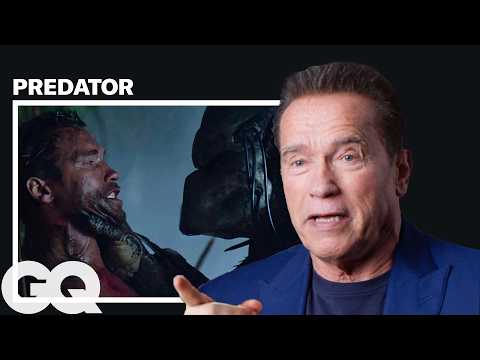
On your way out, just tell her I will be a few minutes late, but she shouldn't worry. - Oh, she won't worry. I mean, I'm here, and mm, oh, these cookies! I gotta get the recipe from Liz. - Put that cookie down, now! A lot of times people have me repeat the line, "Can you say that line?" But it's again one of those things. You say it and you have no idea. But I remember just standing there and screaming, "Put the cookie down, now!" People just loved it. "Predator." "Predator" was an interesting project because it read really well, it was very intense, but it was an ensemble piece.
It was very clear that there would be five, six guys going into the jungle and the screen time would be split up amongst all of us. To me I think that in the beginning I was hesitant about that idea, and then when I was actually in Mexico and shooting in the jungle, as it was unfolding the story, I enjoyed it more and more because it's so much fun to work with a bunch of guys like that. They were all really cool guys and they were easy to work with. And there certain dynamics that everyone had and developed. And I thought it was brilliantly written. John McTiernan, who directed the film, has only directed one other film beforehand, which I think was called "Nomads." And so it took a lot of faith from the studio and from all of us, but he pulled it off. He was so good in directing.
He was so thoughtful with the way he moved the camera to make it suspenseful and all this, the atmosphere created in the jungle with that fog all the time, that was kind of scary. And never to show the predator until the very end. I thought that was just brilliantly done. And it was just unbelievable the amount of action that they allowed me to do. This is where, of course, where we had this line, "Stick around," where a guy came up on the right side of me and I saw him in my peripheral vision and I took my knife, nailed him through the heart and he got stuck in this pole, and I said to him, "Stick around." So it was just another one of those really cool lines that I liked, that I made up in this particular case. [machine guns firing] Stick around.
It was really amazing when we finally showed the predator, and it was created by Stan Winston, who was one of the most brilliant makeup special effects guys. I think that he won the Academy Award twice, and stuff like that, but he built that and he created that, and it was so well done. It was really tall, they had a basketball player that was like seven foot two that was carrying this mask and its outfit. It looked scary, it looked slimy, it looked weird. It looked so bad that it came natural to me to say, "You are some ugly mother" [muted]. That came kind of natural. It was kind of improvised, that line.
And then they kept it in the movie. [dramatic, suspenseful music] [creature growling] You're one ugly mother [muted]. [dramatic music] [creature roaring] "Total Recall." I was after "Total Recall" for many, many years. Dino DeLaurentiis owned the movie, and he was going to do it with Jeff Bridges. So I was very happy when Dino DeLaurentiis had financial troubles at one point and had to sell some of the projects. And one of the projects he sold was "Total Recall." I called Andy Vajna and Mario Kassar immediately and I said, "You've got to buy this project for me."
That afternoon when I called them, they bought the project from Dino, and then I ran into Paul Verhoeven a few days later. It was all like meant to be. I ran into Paul Verhoeven a few days later in a restaurant and I said, "Paul, I just saw RoboCop, "it's unbelievable," I said, "what a great job you did." I said, "Would you ever want to work with me?" And he says, "Absolutely." I said, "Well, I maybe have a project for you, "can I send it to you?" So then in the afternoon I had Karrar get in touch with him, sent to his agent the script. He fell in love with it, he came on board, and that's how the whole thing came about. It was smart also to take it to Mexico because Mexico City has, it's a fantastic location. Very futuristic kind of buildings and looks to it that you can use, and also you're very free to use the city, and there were great, great benefits there.
And great workmanship also. And I think the film came out fantastic. It was $53 million or whatever, the budget was. For those days it was a lot, but today it isn't really that much. And it opened up to a huge box office success. It almost did $30 million opening weekend, and it made $130 million domestically and worldwide almost $300 million. So it was really very, very successful and we were very happy with the way it came out. And they tried to copy it, someone tried to do remake of it. How stupid is that? I mean, Jesus. Come on, go ahead, you got what you want. Give these people air. - My friend, in five minutes you won't give a shit about the people. Fire it up, doc. - Excuse me, doctor.
Is he gonna remember any of this? - Not a thing. - Oh really? [grunting] - Sharon Stone was a hard working actress. She really made me shine in the movie. She played this wife of mine that was doing evil things to me, and I couldn't wait to get rid of her. Then it was the famous scene where I finally shot her and I said, "Consider this a divorce." That was one of my favorite lines [chuckling]. - Sweetheart, be reasonable. After all, we're married. [fires gun] - Consider that a divorce.
"True Lies." Again, we were very fortunate to have Jim Cameron. I showed him a French movie, "La Totale," which was a million dollar movie, was made for a million dollars in France. But the concept that was there was so brilliant. Jim saw it and he says, "Let's do it," which is very hard to do for Cameron to commit to a movie. He fell in love with it, he went out and wrote the script, and he wrote it, of course, huge, as you can see. It took us six months to film. We were all over the place, from Los Angeles, Washington and Miami and the Keys, I mean everywhere. But it was wonderful to work with Jamie Lee Curtis, because I knew Jamie Lee Curtis and skied with her in Sun Valley, we have a home up there in Sun Valley, so we knew each other very well.
So when she was hired, I was very excited about it because I thought that she was a really, she's a really good actress. So it was great to work with her on this film. And I think that she's also very, very funny, pulls off the comedy in the movie. Because the whole thing was a very intense movie, but it had these funny moments because the very fact that my wife did not know what my job was and that I as the husband did not know that her desire is to do something similar like that, to be a secret agent, so I think that's what made it really funny. Helen, Helen, wait, wait, wait! - Harry? - Yes, it's Harry. I know it looks bad, but I can explain.
[men yelling] - [Interviewer] Where you actually riding a horse in those scenes when you're running through the mall and everything? - Yes, I would say there was only one horse scene, which was a jump over a fountain, which I'm happy I didn't do because the professional horseback rider wiped out and that and smashed his head in and had like 20-some stitches on his face because of it. I saw right away there is something off there because it was so wet, and horses then slip when it's wet, and so I said, "I'm not going to do that. "Let someone else do that particular thing." But every other scene, in the elevator, on top of the rooftop, through Georgetown in Washington, through the park, all of those scenes were done, I rode the horse. "Terminator: Dark Fate."
In "Terminator," I can do those Terminator movies from here to eternity. The trick of it is, and I think it's very smartly done, the body underneath in the skeleton, the metal skeleton, all that stuff, stays the same. So it's his abilities that stay the same. But the outside, the flesh, ages just like any other human flesh does. So that makes me get away with looking older and that you can do a movie like that 30 years later. That's the great thing about the writing. And I love doing the Terminator movies. Especially when there is continuous growth in the character. And what you will see in this "Terminator" is that he has been, just like in "Terminator 2" where there's a little bit of human behavior that he starts adopting, in this one is even much more.
That has a certain kind of a effect. The way he was programmed, at what point does he override his own program, all of those kind of issues we're dealing with in this movie. So it's really fascinatingly well written. Again, Cameron was involved with that. And as you know, I think the world of his creativity and his thinking and his talent. So he's very passionate about Terminator, got involved with it, got Linda Hamilton to come back to the project, wrote her into the project as a main, main character. And so we had a wonderful time with Tim Miller directing it. [dramatic music] Stop! - I can see you're very upset. I'm going to help you protect the girl.
You know, it really doesn't make any difference to me. I think each one has advantages and disadvantages. I think that the advantage of playing a hero obviously is that you're the heroic guy that wins in the end and all that stuff. As a villain, you have the advantage that you can go all out and do things that you normally cannot do as a hero, because it would not be a certain thing. You can be a certain cruelty or the way you kill people and all of that stuff, so that's why this was attractive about being the Terminator, because he doesn't give a [muted], he's a machine. So he just steps up with toys, he just goes and rips out your heart, as I've shown in "Terminator 1."
So he will just tear your head off and wouldn't think twice about blood squirting around or anything like that. That's not his concern. As a matter of fact it doesn't even show in his face any satisfaction whatsoever when he kills five people within one second. And people really enjoy watching villains and watching kind of nasty things being done, where they say, oh my God, I have to close my eyes. I love that, there's nothing that I love more than when I do a film, and we've seen it in "Terminator," we've seen it in "Total Recall," where there are certain things where people just close their eyes and says, "I cannot take it." Because that is then really entertaining. It has been a great honor for me to be involved in a movie where you get voted as one of the top 10 heroes, but at the same time one of the top villains.
I don't think there's anyone out there that has been put in that kind of a category before. I don't really have a favorite because I don't know really what the definition of that is. For everyone it's different. I think undoubtedly that my favorite of making of the movie was "Twins" and "Kindergarten Cop." We were laughing the whole day, it was entertaining being with Danny DeVito in "Twins" or being in "Kindergarten Cop" with a bunch of kids that always kind of throw you off because they always say don't work with kids and don't work with animals. But I had the greatest time working with those kids. It was really fantastic. And it gives you then a lot of space for improvisation because the kids are improvising, they're not staying with the script. They wouldn't even know how to stay with the script. So I think it makes it very lively. So I had the greatest time doing those two movies. But when it comes to my favorite to the outcome, then you have to add also of course "True Lies" or "Terminator," some of the Terminator movies that I have done, if it's one or two or the last one, "Dark Fate."
There's a whole bunch of movies then that come into that field, but it's very hard always to just say this is my favorite. Thanks very much for listening to my schpiel about my iconic characters that I've played. If I missed any of the movies, we're gonna talk about it maybe in the future, okay? Hasta la vista, baby. [upbeat music]
From the video's published captions. Timestamps link to the video above. Errors are possible.
Cite this recording
Arnold Schwarzenegger, “GQ iconic characters interview (2018)”, Major media outlets, 2018. Transcript and video: Thinkers Archive, https://thinkersarchive.com/arnold-schwarzenegger/iconic-characters-gq-2018/
Quoting a passage? Link to its exact moment: every timestamp above has its own anchor (for example https://thinkersarchive.com/arnold-schwarzenegger/iconic-characters-gq-2018/#t-153).