Arnold Schwarzenegger on Acting & Movies
Arnold Schwarzenegger treats movie stardom as a vision executed through discipline, turning supposed weaknesses into assets and meeting each role with physical preparation, risk, and a willingness to surprise the audience.
- Have a clear vision and ignore naysayers when choosing your path.
- Turn what looks like a liability—accent, body, name—into part of your screen identity.
- Movie acting is physical work: preparation, endurance, and repetition matter.
- Range matters: he pushed beyond action into comedy and more human characters.
- Big hits are not manufactured by force; audiences decide what lives on.
Start with vision, not permission
Schwarzenegger’s basic rule for a film career is to decide what you want and keep moving toward it, even when the industry says you do not fit. He describes his rise as the result of holding onto a clear picture of where he wanted to go and refusing to be redirected by other people’s doubts. That mindset shaped not just how he entered movies, but how he chose roles and opportunities.123
This matters because his acting career was not built on matching the accepted model of a leading man. He was repeatedly told that his body, accent, and name were wrong for Hollywood, yet he treated those judgments as noise rather than verdicts. For him, success in movies begins with self-definition before the industry agrees with you.25
Use your differences as screen advantages
One of Schwarzenegger’s clearest ideas about acting is that what makes you unusual can make you memorable. He says the traits that looked like barriers—especially his accent and bodybuilder physique—eventually became assets once the right roles framed them correctly. That is a practical lesson in casting: do not always sand down the thing that makes you distinct; sometimes you build the part around it.65
He points to Conan and Terminator as breakthroughs because those films did not fight his presence. They leaned into it. His delivery, physicality, and larger-than-life image gave those characters a specific identity that audiences could instantly recognize, which is part of why lines and roles endured far beyond their original release.8
“All this became an asset rather than a liability.”GQ interview, 2018 · full transcript →
Acting on film is physical labor and repetition
Schwarzenegger does not talk about acting as something separate from physical preparation. He approaches performance the way he approached training: through reps, conditioning, and adaptation. His view is that screen work improves through repeated doing, not just talk or theory.910
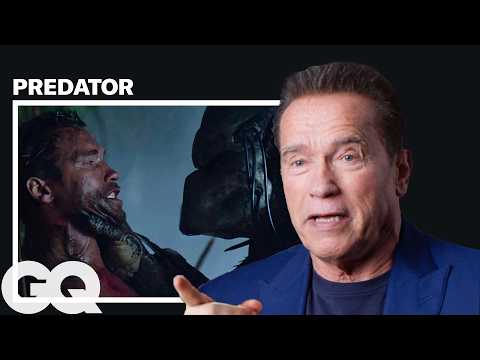
That becomes especially clear in action filmmaking. He describes shoots like Predator as punishing, with heat, humidity, stunts, gear, explosions, and real physical stress. His point is that the more entertaining the result is for the audience, the harder the process may be for the actors, so a performer has to prepare seriously and endure discomfort without losing focus.1112
He also carried this training mentality into later returns to famous roles, adjusting his body to fit the screen image audiences remembered. Even after long success, he still thought in terms of rebuilding, sharpening, and getting back into performance shape.1314

“And the more entertaining it is for the audience to watch, the more miserable it is for us actors to go through this whole experience of filming and making the film. It was a very torturous experience in many ways because, uh, whenever you do a film in the jungle, uh, you know already ahead of time what you're going to get into. You get into a lot of heat, humidity, very tough terrain, uh, doing, uh, strange stunts that, uh, going over waterfalls and swimming with your gear on and climbing up trees and repelling down from helicopters and stuff like that. So, you really have to prepare yourself physically really well.”Dallas promotional interview, 1987 · full transcript →
Range comes from taking risks outside your type
Schwarzenegger did not want to stay boxed into one mode. Even while known for action, he kept pushing toward comedy and roles that exposed a different side of him. That impulse came partly from resistance: when people thought he could not do comedy, he treated that as a reason to try it.151617
His comedy choices were not just detours; they were a way to expand his usefulness as a performer. In films like Kindergarten Cop, he saw the role working because the hard exterior had to give way to warmth, communication, and a softer emotional register. Working with kids also forced spontaneity and improvisation, which made performances more alive.1819
This helps explain why some of his most durable screen work is not only about toughness. He valued contrast: machine-like presence in one film, vulnerability or playfulness in another. For him, range grows when a star image is challenged instead of simply repeated.2018
“It gave me the opportunity to come in as the toughest cop and then have to develop this other side of me, because I'm now stuck with the kids, I have to now deal with the kids, I cannot deal with them like I did in the beginning like I would deal with the grownup. But I realized that's not really the way to deal with the kids, that you have to understand them, you have to communicate with them. Also you then grow a certain love for them and a certain heart for them. I was able to show the softer side, or the more feminine side of me. So that I think made it really work well in the movie. - What's the matter? - Oh, I have a headache. - It might be a tumor. - It's not a tuma!”GQ interview, 2018 · full transcript →
Movies become iconic when the audience takes ownership
Schwarzenegger’s attitude toward movie success is less controlling than people might expect. He notes that catchphrases and iconic moments are not always planned as cultural events; sometimes a line lands because of the final delivery and because audiences decide to keep it alive. That is how he talks about one of his most famous lines: it was not designed as a grand slogan, but it became one once people embraced it.8
He applies the same logic to films and sequels more broadly. A movie has to earn a life of its own, and sequels should come from real audience demand rather than studio assumption. In his view, enduring franchises are sustained by genuine connection, not by forcing repetition for easy profit.
That is also why he respected strong filmmakers and strong concepts. He credits directors and writing for elevating material, and he understood that a sequel works when it adds something fresh, such as making a formerly cold machine feel more human.20
“Then he says, "Well, how would you say it?" And I said, "I will be back." And he says, "No, I think it sounds better I'll be back." I said, "But it's more machine-like if you say, "I will be back." He says, "Look, I don't correct your acting, "don't correct my writing, okay?" And that was it. And so he says, "Look, we just say it 10 times in a row. "If we just say it and say it and say it and say it, "and then we get it right and then we can "pick one or the other. "I understand that you don't feel comfortable "with the I'll and all this, but let's just shoot it." And so that's what we did. But not, first of all, I thought it was a clumsy role of mine, and number two, I of course had no idea that anyone would ever repeat it, period. When the movie came out, people coming up to me and says, "Say the line, say the line, Arnold.”GQ interview, 2018 · full transcript →
Schwarzenegger on acting & movies, in his own words
“…never listen to the naysayers and always just plow ahead and do exactly what is your vision…”
“All this became an asset rather than a liability.”
“It was a very torturous experience in many ways…”
Where to watch
 Arnold Schwarzenegger on Iconic Characters: How Each Role Became Bigger2018 · 34 min · full transcriptBest overview of how his major roles worked, including Conan, Terminator, comedy, catchphrases, and turning liabilities into strengths.
 Arnold Schwarzenegger on Bodybuilding and Reinvention: From Conan to Terminator2019 · 44 min · full transcriptBest short explanation of how discipline, bodybuilding, and ignoring doubters carried him from outsider to movie star.
 Arnold Schwarzenegger on Predator Production: Stunts, Effects, and Risk1987 · 12 min · full transcriptBest look at what action acting demanded physically during Predator and how he thought about risk and entertainment.
 Arnold Schwarzenegger on Fitness And Family: T2, marriage, and exercise1991 · 18 min · full transcriptBest for his view of Terminator 2 as a bigger, more human sequel shaped by strong writing and directing.
 Arnold Schwarzenegger on Bodybuilding and Reinvention: Rep by Rep2024 · 66 min · full transcriptBest for understanding his reps-and-discipline mentality, which also explains how he approaches performance.
 Arnold Schwarzenegger on Action Sequels: Vision, Reps, and Fan Demand2013 · 26 min · full transcriptBest for his thinking on sequels, fan demand, and why vision matters more than listening to naysayers.
Questions people ask
- How did Arnold Schwarzenegger come up with the line 'I'll be back'?
- How did Arnold Schwarzenegger turn his accent and body into strengths?
- What did Arnold Schwarzenegger say about failure and doing hard things?
- What are Arnold Schwarzenegger's favorite movies he made, and why?
- What did Arnold Schwarzenegger say about playing villains and why audiences like them?
- Why did Arnold Schwarzenegger think Kindergarten Cop worked so well?
Sources
Every quote above, word for word from the transcripts. Numbers match the text.
“…never listen to the naysayers and always just plow ahead and do exactly what is your vision…”
“…you have to really discipline yourself to not listen to the naysayers and to just have your vision and your goal and your dream and you chase that.”
“I just was going after my vision.”
“Guys like Dustin Hoffman and Al Pacino and Woody Allen, those are the in guys in the '70s, not the big body like that, and the accent doesn't work. All this became an asset rather than a liability. So I proved to the world again never listen to the naysayers and always just plow ahead and do exactly what is your vision. My vision was to become a big star and to become not only a big star, but become the highest paid entertainer in that field, which I eventually then became when I did "Batman and Robin." Almost 20 years of pitiless cumber. No rest, no sleep like other men. And yet the spring wind blows, Subotai. This was really the only movie where I had more responsibility of doing my own stunts than any other movie, because there was no one around, no stunt guy, that had the same body.”
“All this became an asset rather than a liability.”
“Then he says, "Well, how would you say it?" And I said, "I will be back." And he says, "No, I think it sounds better I'll be back." I said, "But it's more machine-like if you say, "I will be back." He says, "Look, I don't correct your acting, "don't correct my writing, okay?" And that was it. And so he says, "Look, we just say it 10 times in a row. "If we just say it and say it and say it and say it, "and then we get it right and then we can "pick one or the other. "I understand that you don't feel comfortable "with the I'll and all this, but let's just shoot it." And so that's what we did. But not, first of all, I thought it was a clumsy role of mine, and number two, I of course had no idea that anyone would ever repeat it, period. When the movie came out, people coming up to me and says, "Say the line, say the line, Arnold.”
“It's all about reps. Reps, reps, reps.”
“In life, everything is about reps.”
“It was a very torturous experience in many ways…”
“And the more entertaining it is for the audience to watch, the more miserable it is for us actors to go through this whole experience of filming and making the film. It was a very torturous experience in many ways because, uh, whenever you do a film in the jungle, uh, you know already ahead of time what you're going to get into. You get into a lot of heat, humidity, very tough terrain, uh, doing, uh, strange stunts that, uh, going over waterfalls and swimming with your gear on and climbing up trees and repelling down from helicopters and stuff like that. So, you really have to prepare yourself physically really well.”
“I had to gain 10 pounds to kind of have the same kind of a build again, the same frame that I had in 1984.”
“It's like riding a bicycle, you get right back into it.”
“No one will hire me for comedy…”
“I would like to do comedy, for instance…”
“Whenever someone says to me, "This is difficult, "you can't do it," that motivates me twice as much. There's nothing that we do that should really be scary, because I'm not afraid of failure. So to me it was like okay, if people think that it is difficult to work with kids and animals, I want as many animals on the set as possible and as many kids as possible, and I'm gonna show them that it can be done. And of course it's difficult, but we do it. Ivan was just a genius director, and he knew how to control the kids, and he had asked me that when it was down time and it was time for setting up the new shot, to hang with the kids. And I think it was the smartest thing, because I was not an expert with kids.”
“It gave me the opportunity to come in as the toughest cop and then have to develop this other side of me, because I'm now stuck with the kids, I have to now deal with the kids, I cannot deal with them like I did in the beginning like I would deal with the grownup. But I realized that's not really the way to deal with the kids, that you have to understand them, you have to communicate with them. Also you then grow a certain love for them and a certain heart for them. I was able to show the softer side, or the more feminine side of me. So that I think made it really work well in the movie. - What's the matter? - Oh, I have a headache. - It might be a tumor. - It's not a tuma!”
“I think undoubtedly that my favorite of making of the movie was "Twins" and "Kindergarten Cop." We were laughing the whole day, it was entertaining being with Danny DeVito in "Twins" or being in "Kindergarten Cop" with a bunch of kids that always kind of throw you off because they always say don't work with kids and don't work with animals. But I had the greatest time working with those kids. It was really fantastic. And it gives you then a lot of space for improvisation because the kids are improvising, they're not staying with the script. They wouldn't even know how to stay with the script. So I think it makes it very lively. So I had the greatest time doing those two movies. But when it comes to my favorite to the outcome, then you have to add also of course "True Lies" or "Terminator," some of the Terminator movies that I have done, if it's one or two or the last one, "Dark Fate.”
“I think everyone has that dream to just be maybe for one day a Terminator.”
How this guide was made: drafted with AI from the full transcripts of the recordings cited, then checked: every quotation must match a transcript word for word and be the speaker's own words, and an independent review gates accuracy. Methodology and corrections.
