Arnold Schwarzenegger on Discipline
Arnold Schwarzenegger treats discipline as building fixed routines around a clear goal so hard work becomes automatic instead of negotiable.
- Make important habits automatic so you do not waste energy deciding every day.
- Discipline works best when it serves a specific vision or goal.
- Progress comes from repetition: do the work, keep doing the reps, and do not expect shortcuts.
- Mindset drives execution; the mind has to direct the body.
- When life changes, adapt fast, avoid self-pity, and keep moving forward.
Routine is how discipline becomes automatic
Schwarzenegger’s basic idea is simple: do the most important things on a routine so they stop depending on mood. He sees routines as essential because they remove constant negotiation with yourself and make action more automatic. That is why he speaks so directly about the importance of routine rather than treating discipline as occasional willpower.1
In practice, this means turning training, eating, and daily work into regular habits. His own examples point to a stable pattern: morning workouts, frequent biking, and a consistent approach to food and supplementation rather than random effort. The point is not rigidity for its own sake; it is to make good choices easier to repeat.
A clear vision makes discipline easier
For Schwarzenegger, routines are not enough by themselves. They work best when you know exactly what they are for. He returns again and again to the idea that you need a vision, because a goal gives direction to the daily grind and keeps discipline from feeling meaningless.456
This is why he connects hard work to purpose. When you know where you are going, the repetitions feel like steps toward something concrete rather than punishment. His approach to discipline is not just to endure effort, but to organize effort around a destination.478
Discipline is repetition, not drama
Schwarzenegger’s view of progress is intensely practical: results come from doing the reps over and over. He frames success as repeated execution, whether in training, recovery, or any other craft. That is why he reduces the formula so bluntly to work and repetition.9107
He also ties this repetition to fundamentals, not hacks. In bodybuilding he emphasizes discipline, diet, mental attitude, and hard training rather than shortcuts. The same logic carries over to food: supplements can help, but they should support solid basics, not replace them.11
The mind leads the body
A major part of Schwarzenegger’s discipline philosophy is that execution starts mentally. He says motivation and control begin in the mind, which then drives the body. That means routines are not just external schedules; they are expressions of an internal decision about who is in charge.1213
This is also why he respects intelligent training rather than mindless effort. He talks about being smart about proportion, symmetry, and how the body develops, and he urges people to train the brain as well as the muscles. Discipline, in his view, is not blind toughness. It is mentally directed consistency.15
When setbacks hit, keep moving and adjust
Schwarzenegger does not present discipline as something that only matters when life is smooth. He stresses the opposite: when circumstances change, you should avoid self-pity, accept that there may be no return to some old normal, and focus on what you can do next. That is his answer to disruption.1617
His recovery mindset shows what this looks like. After major health setbacks, he focused on immediate, measurable action and rebuilt step by step. He treats pain and adversity as part of growth, not as a reason to stop.1819
This makes his discipline philosophy resilient rather than perfectionist. If the exact old routine is impossible, the answer is not to quit; it is to shift gears, keep the goal in view, and resume the work in whatever form is possible.17188
Schwarzenegger on discipline, in his own words
“You gotta know where you're gonna go.”
Where to watch
 Arnold Schwarzenegger on Routines and Discipline: Make It Automatic2019 · 51 min · full transcriptHis clearest explanation of why routines matter and how automatic habits support discipline.
 Arnold Schwarzenegger on Work and Purpose: Be Useful and Go All Out2023 · 137 min · full transcriptBest for understanding how vision turns hard work into purposeful discipline.
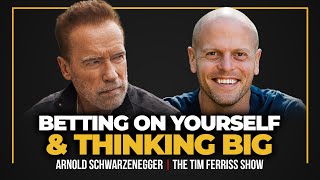 Arnold Schwarzenegger on Thinking Big: Build Your Own Ladder2023 · 77 min · full transcriptShows how he applies discipline during recovery and sudden setbacks.
 Arnold Schwarzenegger on Fitness and Nutrition: What He Eats, Lifts, and Believes2019 · 9 min · full transcriptUseful for seeing how routine applies to training, biking, food, and supplementation.
 Arnold Schwarzenegger on Bodybuilding Discipline: Mind Over Muscle1977 · 9 min · full transcriptStrong on the mental side of discipline and why mindset drives performance.
 Arnold Schwarzenegger on Bodybuilding and Reinvention: Rep by Rep2024 · 66 min · full transcriptBest short lesson on repetition and why mastery comes from endless reps.
Questions people ask
- What does Arnold Schwarzenegger say about reps and repeated practice?
- What does Arnold Schwarzenegger say about supplements and food?
- What does Arnold Schwarzenegger think makes a great bodybuilder?
- Why does Arnold Schwarzenegger say he never looks back?
- Why does Arnold Schwarzenegger say work is his relaxation?
Sources
Every quote above, word for word from the transcripts. Numbers match the text.
“I believe that routines are very important.”
“You got to have a vision because as soon as you have a vision and as soon as you have a goal...”
“You gotta know where you're gonna go.”
“Without a vision, there is just nowhere to go.”
“Well, you know, after you have the vision, you have realized that you need to put the work in it. And then it's all about reps or what they also call mileage. You know, in skiing we call it mileage, right? That means how many miles did you ski every day? Mocha stand, going up and down and up and down and going through the gates, or going fast if you're downhill racer. How many attempts to go 60, 90, 60 miles, 80 miles at 90 miles an hour and practice that. I mean, it's, it's, it's, it's all about reps, reps, reps. And I think if you have a clear vision, it is easy to do the reps, you know? Because you don't worry so much about, "Oh my God, after swimming there's ice," till the day.”
“It's just I always like to look forward. It's kind of like, do I want to look at the windshield or do I want to look through the rearview mirror when I drive a car? Yeah, I'd rather look forward because I know where I'm going than rather than always looking in the back. And so that's the way it is with my life. So the only time that they really think about the past is when we do an interview like that, or when I write a book like Being Useful or Total Recall, the book that came out around 10 years ago, or when we did the documentary for Netflix where I had to sit down like for 40 some hours and answer questions.”
“Work works. That is the bottom line.”
“It's all about reps. Reps, reps, reps.”
“The three important things are a lot of discipline, good mental attitude, good diet, and very hard training.”
“The mind is the most important thing that motivates the body.”
“It's a shame for the mind to give up when the body is still going…”
“Don't just train your muscles, just train your brain…”
“The key thing is not to fall into this trap about feeling sorry for yourself…”
“There is no normal, you know?”
“Only through pain you can grow.”
“We need to get stronger. We need to get tougher.”
How this guide was made: drafted with AI from the full transcripts of the recordings cited, then checked: every quotation must match a transcript word for word and be the speaker's own words, and an independent review gates accuracy. Methodology and corrections.


