Arnold Schwarzenegger on Predator Production: Stunts, Effects, and Risk

What Schwarzenegger talks about
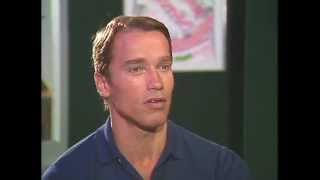
Arnold Schwarzenegger gave this promotional interview for Predator in 1987, discussing the film’s punishing jungle shoot, dangerous stunts, injuries, and John McTiernan’s approach to balancing action and violence.
Also known as: Predator interview; Arnold Schwarzenegger [Predator / interview]; Schwarzenegger and Kevin Peter Hall (Predator interview).
Arnold Schwarzenegger explains how physically punishing it was to make Predator, from jungle heat and dangerous stunts to injuries, dehydration, and constant explosives. He stresses that the audience’s enjoyment often comes at the cost of a miserable shoot for the actors.
He also talks about his creative input on films, saying he wants to do comedy, produce, and direct in the future. On Predator, he praises John McTiernan’s judgment in balancing violence, action, and restraint so the film does not simply exploit gore.
An interviewer asks the questions; Schwarzenegger answers throughout.
In his words
“The more fun it is for the audience to watch and the more entertaining it is for the audience to watch, the more miserable it is for us actors”
“It was a very torturous experience in many ways”
“I would like to do comedy, for instance”
“We don't want to do in this film is to exploit violence”
“This is why you show the hanging bodies, skinned alive, and all those kinds of things”
Key points
- The Predator shoot was extremely difficult because of jungle conditions, stunts, heat, and dangerous effects.
- Schwarzenegger did some of his own stunts, including one waterfall fall, while stunt doubles handled repeated takes.
- There were injuries on set, including burns, dehydration, and a stuntman breaking his knee.
- He says he wants to keep doing action films but also move into comedy, producing, and directing.
- He argues parents, not actors, should decide whether children should see an R-rated film.
- He says he has substantial input on films, including script choices, directors, stunt coordinators, and scene violence.
- He praises the film’s special effects, especially the Predator’s camouflage and heat-vision imagery.
Full transcript: Arnold Schwarzenegger, Predator promotional interview (1987)
All right. Well, Arnold, let me be about the umpteenth person to welcome you to Dallas this morning. It's good to see you. Well, you are actually one of the first people that is welcoming me to Dallas. I mean, this is early in the morning. We just arrived here. Um, I've seen the film and, uh, I would venture that it's going to do very well because it has a tremendous amount of action and fantastic stunts. But as I sat there watching it, Arnold, I couldn't help but think this was not a fun movie for you to make. How could it be? Um, the way it always works in films is that the more fun it is for the audience to watch
and the more entertaining it is for the audience to watch, the more miserable it is for us actors to go through this whole experience of filming and making the film. It was a very torturous experience in many ways because, uh, whenever you do a film in the jungle, uh, you know already ahead of time what you're going to get into. You get into a lot of heat, humidity, very tough terrain, uh, doing, uh, strange stunts that, uh, going over waterfalls and swimming with your gear on and climbing up trees and repelling down from helicopters and stuff like that. So, you really have to prepare yourself physically really well and then, uh, also do a lot of the work for the
acting, the rehearsals, and so on. So, it wasn't an easy shoot, and it's very dangerous when you shoot with those explosives that we have in the film and all this action. And then, uh, being attacked by those weapons that this alien creature has. So, it was not easy. You're absolutely right. I heard you say that you did your own stunt where you go over the waterfall. Mhm. Now, uh, first of all, how big and how high was the waterfall? The waterfall was about 40 to 50 ft high, and, uh, what you do is if the director wants to do one close-up shot of you being in front of the camera actually going over so it makes it look more believable. You do that one take and then the rest of the takes, when it is not necessary to see you in it, uh
you can let your stunt double do those scenes. So, I did one fall, and the stunt double did four falls. And as a matter of fact, the fourth fall he, uh, injured his knee, broke his knee because he landed strange. I mean, it was not planned this way by any means, but he landed strange, and then he had to fly home. Did you have other injuries during the shoot? Well, we had injuries like burns and then stuff like that. Um, I got dehydrated one time at one point, and I was in bed for four or five days, and, um, you know, I had intravenous feeding. And those are the kind of things that will creep up on you and will happen throughout, you know, but there were a lot of injuries. There was no one of the stunt men that came home without injuries.
But as far as serious injuries, nothing just debilitating? It is sometimes you really feel lucky that nothing happened to you because the things that you do, one little mistake and it could be, you know, fatal. I mean, you could really wipe out from it, and, uh, so you have to really be careful and concentrate and have enough rest and so on in order to do some of the things that we do. What is it that you maybe say 5, 10 years from now aspire to do because it seems like you everything you've ever wanted to do or dreamed of doing, you have done. So, 10 years from now, what do you think you'll be doing?
Well, I have not done everything that I set out to do because there's a lot of different types of films that I still would like to do. I like to do, besides doing more action adventure films, I would like to do comedy, for instance. I love doing humorous things in films, and, as you have seen in this film in Predator, I tried to put some humorous stuff in there, some comic relief throughout the film. Of course, it's not the kind of a film that lends itself to do a lot of fun things. But I would like to do one straight-through comedy one time. I also like to get more into producing and into directing in the future. So, those are the kind of things that I see in
the next 5 or 10 years. This film has, um, a lot, as I said, a lot of action, adventure, stunts. It also has a lot of violence and gore and then turns into, by your own admission, a horror film. Now, um, would you take the little Kennedy Shriver kids to see this movie, like the 6 to 10-year-olds? Would you take them to see this? Well, it doesn't really matter whose kids they are. The fact of the matter is that each kid should go and listen to what their parents have to say. That's really the bottom line. I'm not out there to tell kids of any age that
they go and must see this film because I think that the parents are responsible to let the kids know if they want them to see the film. And this is why after we have done a film like Predator, you give it to a rating board, and the rating board says to you this is an R-rated movie or this is a PG-rated movie or whatever it may be. And so then the parents then this is on a poster and this is on a trailer and so on and in the commercials, in the on television, and the parents then make up their own mind. Now, the most kids are the way I was, and that is that when the parents said don't do something, then I went ahead and did it. And it's just simply because the parents said don't do it. I mean, whatever my parents said, I always go and do the opposite thing. You go through a stage
Like that. And then, when you grow up and get to the age I'm in, you look back and you say, "How right my parents were. Everything they said to me and that I should do was absolutely right," you know? And sometimes you regret you haven't done the things that they've told you to do. But that's the way it is. As you looked at the film, Arnold, um, a- and the—I'm talking about the raw footage. Um, w- were there any things that you said, "No, wait a minute. That's too much. That's too violent. That's too gory?" Uh, did you have any of that kind of input? Uh, every film that I do, I have a tremendous amount of input. If it is choosing which script we're going to film, which director we're going to hire,
uh, which, uh, kind of changes we're going to make in the script, uh, who are—who are the stunt coordinators and on and on and on and how gory a scene is going to be or not. But I tell you, in this situation in Predator, we have had the fortune of having a very smart director by the name of John McTiernan, who is a—he's a genius. He's like another Jim Cameron, who did The Terminator. And guys like that have such a sense of what is too much and what is not enough. They come up with a real good middle ground. They shoot much gorier than you actually see on the screen, but then when it comes to the editing, they will cut most of it out because one of the things we don't want to do in this film is to exploit
violence. We show enough of what, for instance, the Predator has done to human beings in order to create and establish him as the villain, as the ultimate villain. And if we don't do something against him, he's going to do the same to us and let the audience feel like, "Oh my God, you know, what is he going to do now with the rest of the guys that are in the jungle?" So, this is why you show the hanging bodies, skinned alive, and all those kinds of things. But other than that, you don't want to really exploit the violence at all. And this guy, I think he did a—did a great job. The special effects are absolutely marvelous. Um, do you know if any new ground was broken in the effects that are done? Well, I think in this film, in Predator, um, everything that has been done was
kind of new grounds because this was the first time that I've been part of a film where we—where we, for instance, shot all of the, uh, the action, the whole ambush on this village, on a gorilla village—all of that was shot second unit. So, they had all the time in the world to prepare themselves for the stunts, because as you could see, there's a tremendous amount of fire continuously in that village, and that becomes very dangerous. If you don't prepare that well, you're in deep trouble and you lose people left and right because when those guys are on flame like that, uh, full of flames running around, they only can do that for around 15 seconds or so. Then that stuff that you put on, that gel—gel burns off and the body starts burning.
So, they have to then jump into a hole. Be the—the sand has to be piled on top of them so the flames go out, and then you dig them out again. So, each guy has to have someone to protect them there. So, those things, when—the first time I've seen that. Number two, the special effects in the way of making the Predator kind of camouflage against the background of the jungle. And then you look at the jungle and there's nothing there and all of a sudden the jungle itself becomes alive and it rushes towards you and it hits you. You know? And so to get the feeling what it is like being the soldier getting hit and also getting the point of view of the Predator, the way he sees us. Not with normal human eyes, but with heat-seeking vision. He sees the heat of the body.
And so then for that, we hired a—a camera team. That was also the first time we ever used that, a camera team that has cameras that really can film heat. So, we had to, for instance, go and and cover ourselves with bags, uh, with with suits that will create heat inside. Then we take it off quickly when the body is in tremendous heat, like if you would come out of a jacuzzi or a sauna or something like this and you run into the action in front of the camera, and then the camera will pick it up. You—it will pick up just the heat, not the actual—the—the—the body, but the heat of the body. And so, all this new technology has been used, and this is why I think the film has the impact that it has had when we screened the film to various different
audiences. It has had the most positive impact. Is that the infrared, then? It's kind of like an infrared, yes. Yeah. Well, Arnold, it—it ought to do very, very well. It really should. Well, thank you. I tell you that we always test films. And you're always nervous before you test the film. You know, you have a good film, but you don't know how it's going to, you know, what effect it's going to have on the audience if they love it. And this film has had over 90% approval rating, and that means that you must have—women like it, the older people like it, the young kids like it. So, we're very fortunate with this film. One last question. At any point when Maria saw the movie, did she go like this?
I think that Maria knows enough about films, uh, that she knows that to only look at the performance and not think that I really am about to get killed by this creature, by this predator, and stuff like that. I mean, and she likes action movies, you know? And maybe she likes them because when I'm in it, she likes it. I don't know. But she always enjoys the films, and she always takes her friends to see the films, and you know, she's a real big fan of mine, and really gets carried away. Now, Jesse Ventura, his wife went to see the film, and when he got killed in the film, she started crying. So, it has different effects on people, you know? And he couldn't, he could not let his children
see the movie because when they see their father the first time in the film and the father getting killed in the film, that's too much, you know, for a seven or eight-year-old kid or whatever the age is. I think it's seven or eight years old, his son. Okay. Well, Arnold, thanks for coming to Dallas. It was fun to talk with you. I love coming to Dallas. I tell you, I have come to Dallas so many times in book promotions and in movie promotions and bodybuilding promotions and all those kinds of things, and also just for fun, that I always felt that I was treated very well by the media in Dallas, and I have a lot of fans, so I enjoy coming back. Thanks.
From YouTube captions, lightly punctuated for readability. Timestamps link to the video above. Errors are possible.
Cite this recording
Arnold Schwarzenegger, “Predator promotional interview (1987)”, Film promotion, 1987. Transcript and video: Thinkers Archive, https://thinkersarchive.com/arnold-schwarzenegger/predator-production-dallas-interview-1987/
Quoting a passage? Link to its exact moment: every timestamp above has its own anchor (for example https://thinkersarchive.com/arnold-schwarzenegger/predator-production-dallas-interview-1987/#t-133).