Turn Liabilities
Accent, size, name, and doubt became part of the brand.
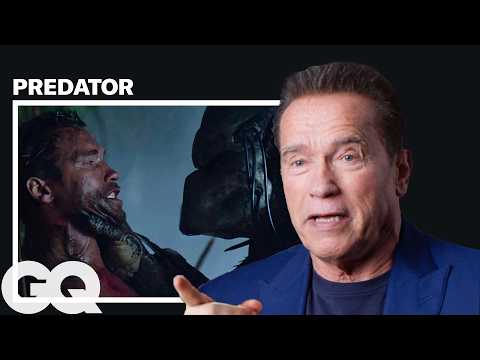
“…never listen to the naysayers and always just plow ahead and do exactly what is your vision…”GQ interview, 2018 · 5:01
The lesson
Schwarzenegger’s pattern is simple: he did not wait for supposed disadvantages to disappear. He chose goals first, then kept moving even when others treated his accent, physique, and background as reasons he would not fit. Across the recordings, he presents progress as a result of vision plus persistence, not permission from gatekeepers123.
In acting, this became especially visible because the very traits that looked wrong for a conventional leading man became the traits people remembered. He explains that his build and accent, which clashed with the dominant model of movie stardom, eventually made him distinctive rather than interchangeable45. The lesson is not that every weakness is automatically useful; it becomes useful when it is matched to a role, a market, or a style where it creates contrast and memorability.
He also shows that conversion requires repetition and tolerance for discomfort. Some moments that later became iconic were not recognized as special while he was making them, and he kept working through awkwardness rather than stopping until everything felt perfect6. That fits his broader rule that failure, criticism, and difficulty are part of the path, not evidence that the path is closed78.
Another part of turning liabilities is refusing to let other people define your category. When people assumed he could not do comedy or could only play one type, he treated that doubt as a challenge rather than a verdict910. The practical takeaway is to test the edge of how others see you: the trait that seems limiting in one frame may become valuable in another.
Schwarzenegger’s approach is not just personal branding; it is a working method. He emphasizes having a clear vision, taking the next step, and building through reps instead of overthinking every objection111213. If you keep asking how to remove every flaw before you begin, you stay generic and stalled; if you learn how to use what is unusual about you, you become harder to ignore.
5 principles from Arnold Schwarzenegger
Choose vision before approval
Start with a clear picture of where you want to go instead of waiting for others to validate you. When criticism comes, measure it against your vision rather than letting it replace your judgment.
“…never listen to the naysayers and always just plow ahead and do exactly what is your vision…”
Turn difference into distinctiveness
A trait that seems like a mismatch in one context can become your signature in another. Look for roles, projects, or formats where what makes you unusual also makes you memorable.
“All this became an asset rather than a liability.”
Use doubt as fuel
Instead of reading discouragement as a stop sign, treat it as extra energy to prepare and perform. This works best when the response is concrete action, not just defiance.
“…you have to really discipline yourself to not listen to the naysayers and to just have your vision and your goal and your dream and you chase that.”
Expand beyond the box people put you in
If others assume you can only do one kind of work, test that assumption deliberately. Trying a different mode can reveal strengths that your existing reputation hides.
“No one will hire me for comedy…”
Build through reps, not perfection
Iconic results often come from repetition, adjustment, and staying in the work through awkward moments. Don’t require full confidence before acting; let practice create the result.
“Then he says, "Well, how would you say it?" And I said, "I will be back." And he says, "No, I think it sounds better I'll be back." I said, "But it's more machine-like if you say, "I will be back." He says, "Look, I don't correct your acting, "don't correct my writing, okay?" And that was it. And so he says, "Look, we just say it 10 times in a row. "If we just say it and say it and say it and say it, "and then we get it right and then we can "pick one or the other. "I understand that you don't feel comfortable "with the I'll and all this, but let's just shoot it." And so that's what we did. But not, first of all, I thought it was a clumsy role of mine, and number two, I of course had no idea that anyone would ever repeat it, period. When the movie came out, people coming up to me and says, "Say the line, say the line, Arnold.”
In his own words
The quotes behind the lesson, word for word from the transcripts. Numbers match the lesson above.
“…never listen to the naysayers and always just plow ahead and do exactly what is your vision…”
“…you have to really discipline yourself to not listen to the naysayers and to just have your vision and your goal and your dream and you chase that.”
“I just was going after my vision.”
“All this became an asset rather than a liability.”
“Guys like Dustin Hoffman and Al Pacino and Woody Allen, those are the in guys in the '70s, not the big body like that, and the accent doesn't work. All this became an asset rather than a liability. So I proved to the world again never listen to the naysayers and always just plow ahead and do exactly what is your vision. My vision was to become a big star and to become not only a big star, but become the highest paid entertainer in that field, which I eventually then became when I did "Batman and Robin." Almost 20 years of pitiless cumber. No rest, no sleep like other men. And yet the spring wind blows, Subotai. This was really the only movie where I had more responsibility of doing my own stunts than any other movie, because there was no one around, no stunt guy, that had the same body.”
“Then he says, "Well, how would you say it?" And I said, "I will be back." And he says, "No, I think it sounds better I'll be back." I said, "But it's more machine-like if you say, "I will be back." He says, "Look, I don't correct your acting, "don't correct my writing, okay?" And that was it. And so he says, "Look, we just say it 10 times in a row. "If we just say it and say it and say it and say it, "and then we get it right and then we can "pick one or the other. "I understand that you don't feel comfortable "with the I'll and all this, but let's just shoot it." And so that's what we did. But not, first of all, I thought it was a clumsy role of mine, and number two, I of course had no idea that anyone would ever repeat it, period. When the movie came out, people coming up to me and says, "Say the line, say the line, Arnold.”
“Work like hell, trust yourself, break some rules, don't be afraid to fail, ignore the naysayers, and stay hungry.”
“…don't be afraid to fail…”
“No one will hire me for comedy…”
“Whenever someone says to me, "This is difficult, "you can't do it," that motivates me twice as much. There's nothing that we do that should really be scary, because I'm not afraid of failure. So to me it was like okay, if people think that it is difficult to work with kids and animals, I want as many animals on the set as possible and as many kids as possible, and I'm gonna show them that it can be done. And of course it's difficult, but we do it. Ivan was just a genius director, and he knew how to control the kids, and he had asked me that when it was down time and it was time for setting up the new shot, to hang with the kids. And I think it was the smartest thing, because I was not an expert with kids.”
“I always think of one at a time, you know?”
“All you have to do is have a vision and go.”
“In life, everything is about reps.”
Reflect
- What trait in your background, style, or personality have you mostly treated as a liability, and in what context could it become an advantage instead?
- Where are you waiting for approval from others before pursuing a clear vision of your own?
- What is one area where people have typecast you, and what experiment could you run to prove you can work outside that box?
Check your understanding
Go deeper
 Arnold Schwarzenegger on Iconic Characters: How Each Role Became Bigger2018 · 34 min · full transcript
 Arnold Schwarzenegger on Success and Service: Stay Hungry, Help Others2010 · 26 min · full transcript
 Arnold Schwarzenegger on Six Rules of Success: USC Commencement2016 · 26 min · full transcript
 Arnold Schwarzenegger on Bodybuilding and Reinvention: From Conan to Terminator2019 · 44 min · full transcript
 Arnold Schwarzenegger on Action Sequels: Vision, Reps, and Fan Demand2013 · 26 min · full transcript