Steve Jobs on Computer Animation: Pixar's future

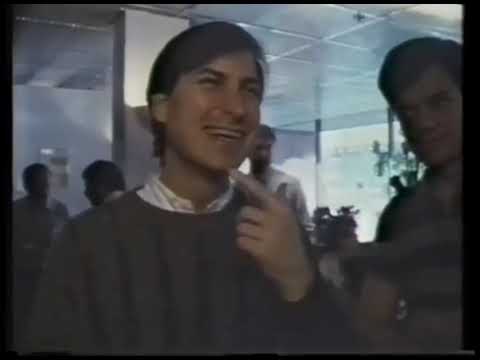
What Jobs talks about
Jobs talks about Pixar’s first anniversary, the Oscar nomination for Luxo Jr., and why it matters that a truly computer-animated film has been recognized. He sees it as a sign that computer animation has a serious future.
He argues that the key challenge is rendering speed: the algorithms are too complex to wait for general-purpose computers to catch up, so Pixar is pushing hardware solutions. He says the goal is to make image creation dramatically faster and more cost-effective.
Jobs also describes animation as a chain of modeling, animating, and rendering, and says the human creative work should live in the look, motion, and design rather than in the mechanics of rendering. That idea defines Pixar’s direction.
An interviewer speaks briefly; Jobs answers throughout.
In his words
“I think that's great.”
“This promises a lot more in this way for the future.”
“We have to bring it into the hardware now.”
“So the rendering is now cost-effective.”
“Our business is visualization.”
Key points
- Luxo Jr.'s Oscar nomination signals a turning point for computer-animated film.
- The future of animation depends on making complex algorithms fast enough in hardware.
- Rendering should become cheap and fast enough that machines are no longer the bottleneck.
- The expensive part of animation is becoming the human work: animators and model making.
- Pixar’s work is about visualization, complex processes, and the artistry of motion and look.
- Jobs believes the least human part of animation is the rendering step.
Full transcript
All the best for your birthday, Pixar, and happy birthday to the first anniversary. Come forward and take a piece of cake with you and a drink. And please mix a little among the people. And introduce yourself to the new colleagues. Ed Catmull, Pixar's vice-president, celebrates the first year of the company's independence by selling computers. You also learned today that you had something else to celebrate. Luxor Jr. was nominated for the Oscar award in 1987. The company's owner is Apple founder Steve Jobs. What did he think of the nomination? I think it's the first and second time that a computer-animated film has been nominated. And the first one was not really completely computer-animated. The computer probably only calculated the intermediate images.
Yes, the computer calculated the intermediate images. So it's the first time that a really computer-animated film has been nominated. I think that's great. And I think that this promises a lot more in this way for the future. The future. I mean, the reason why we want to implement things in hardware and computer graphics is that the basic algorithms are very, very complex. In order to achieve something in our lifetime, we have to increase the speed now, instead of waiting for all-purpose machines to catch up with us at some point. I believe, by the way, that they will catch up with us around 2000 or 2010. In a cost-effective way. So we have to bring it into the hardware now. Rob Cook and I, one of the leading scientists here, have invented a method for this kind of things. And that is somewhat radical.
We finally wrote it down for the SIGGRAPH this year, after we had thought about it for four years. But we are currently working on it in hardware. And it should enable us to create images about 100 to 1000 times faster than with a wax. Which means for the first time that the costs for the machines are no longer a problem and are not the driving factor in the production of an animated film. So the rendering is now cost-effective. What is becoming more expensive is the time of the people, the animators, the model making. And that is why I will concentrate on it in the future. Animation. At a high degree of perfection, it is no longer economically feasible. Just like in the heyday of Disney, when thousands of artists could be set up very cheaply.
That was wonderful. Maybe not for the artists, but for Disney. And now this is the only way to do it at all, namely with a computer. So it would be nice to get rid of all these inferior animations and get back to a quality like in Phantasia. Our business is visualization. And the animation of complex processes results from it. There are several steps in animation. First you have to model what you want to move. You have to animate it, i.e. add time to the model. And then you have to render the result. The rendering of the result is the part that has occupied the best minds in the last 15 years. But it is the least human part. I mean, it's physics. You say, here are the light sources, here are the colors, here are the textures that we want to have on the surface.
And this kind of shiny or matte finish that we want. Go, render the machine. You want it to happen as soon as possible. So that the actual work is in a work of art or a scientific teaching in design, in the creation of actions, in the look and again in the human part. That's the direction we're moving in.
Transcribed from the audio with OpenAI Whisper. Timestamps link to the video above. Errors are possible.