No Boundary
What if the universe has no edge in time?

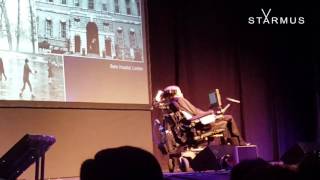
“Space and time were no longer absolute, no longer a fixed background to events.”Hong Kong UST Stellar Lecture, 2009 · 15:11
The lesson
Hawking’s no-boundary proposal starts from a shift in how we think about the beginning of the universe. In relativity, space and time are not a fixed stage outside the universe; they are part of the universe itself and are defined within it, so asking what happened before the universe can be the wrong kind of question12. That is why Hawking compares “before the Big Bang” to asking for a location beyond a natural endpoint in a coordinate system, rather than to asking about an earlier event in an already existing timeline3.
This idea becomes sharper in Hawking’s claim that time began with the Big Bang in the ordinary sense used in cosmology4. If time itself begins there, then the search for an earlier moment assumes the very thing under debate: a preexisting temporal background. The no-boundary proposal replaces that assumption with a self-contained universe whose behavior is governed by the laws of science all the way to its earliest stage, instead of requiring an external starting trigger or a breakdown of law at the beginning567.
Imaginary time is Hawking’s mathematical tool for expressing this picture. He says our theories use two kinds of time, and imaginary time lets the universe be described in a way that avoids a sharp edge or boundary at the beginning. In this framework, the universe can be finite yet unbounded, which is what Hawking means when he says the universe has no boundary condition in the ordinary sense of an edge where physics stops and something else must take over89.
Hawking ties this proposal to a broader scientific method. A good cosmological model is not judged by whether it matches some direct picture of ultimate reality, but by whether it gives a simple account of many observations and makes testable predictions10. That is also why he argues that understanding the universe’s origin requires combining general relativity with quantum theory, using approaches such as sum over histories, because classical relativity alone points toward singular behavior while quantum ideas may smooth out that apparent edge11.
The practical lesson is intellectual: be careful with questions that smuggle in assumptions. Asking what came before the Big Bang may assume that time existed independently of the universe, which Hawking denies in this context24. A better question is whether our best laws can describe the universe in a self-contained way from its earliest state onward, and Hawking’s no-boundary proposal is his attempt to answer yes56.
4 principles from Stephen Hawking
Do not treat time as a backdrop outside the universe
In Hawking’s view, space and time belong to the universe rather than existing independently of it. When thinking about origins, first ask whether your question assumes an external timeline that the theory itself rejects.
“Space and time were no longer absolute, no longer a fixed background to events.”
Question whether “before the Big Bang” is a meaningful question
If time begins with the Big Bang, then asking what happened earlier may be like asking for a location beyond a coordinate limit. Apply this by checking whether a question is physically meaningful within the model, not just grammatically easy to ask.
“…time began at the big bang.”
Use no-boundary thinking to replace edges with lawful description
The no-boundary proposal aims to describe the universe without a special edge where explanation stops. In practice, favor models that extend regular lawfulness into places where older pictures expected a breakdown.
“…the boundary condition of the universe is that it has no boundary…”
Judge models by explanatory power and testability
Hawking’s standard is not whether a model feels intuitive, but whether it organizes observations simply and yields predictions. Use that standard when comparing big-picture explanations, especially in areas where direct intuition is unreliable.
“…we live in a world, governed by rational laws that we can discover and understand.”
In his own words
The quotes behind the lesson, word for word from the transcripts. Numbers match the lesson above.
“Space and time were no longer absolute, no longer a fixed background to events.”
“Space and time were no longer absolute, no longer a fixed background to events. Instead, they were a dynamical one that was warped by the matter and energy in the universe. They were defined only within the universe, so it made no sense to talk of a time before the universe began. That would be like asking for a point south of the South Pole.”
“There is nothing south of the South Pole…”
“…time began at the big bang.”
“…the universe ought to be self-contained and determined completely by the laws of science…”
“…the laws of science may hold even at the beginning of the universe…”
“…the laws of physics would hold even at the beginning of the universe…”
“…the boundary condition of the universe that it has no boundary…”
“…the boundary condition of the universe is that it has no boundary…”
“I shall deal with these by adopting what is called the positivist approach. In this, the idea is that we interpret the input from our senses in terms of the model we make of the world. One cannot ask whether the model represents reality, only whether it works. A model is a good model if first it interprets a wide range of observations in terms of a simple and elegant model, and second, if the model makes definite predictions that can be tested and possibly falsified by observation.”
“In order to understand the origin of the universe, we need to combine the general theory of relativity with quantum theory. The best way of doing so seems to be to use Feynman's idea of a sum over histories. Richard Feynman was a colorful character who played the bongo drums in a strip joint in Pasadena and was a brilliant physicist at the California Institute of Technology. He proposed that a system got from a state A to a state B by every possible path or history.”
Reflect
- What questions in your own work sound deep but may hide a bad assumption, the way “what came before the Big Bang?” may assume an external time?
- When you evaluate a theory or explanation, do you favor intuition or testable explanatory power? How would Hawking’s standard change your judgment?
- Can you think of a problem where replacing a sharp boundary with a change of description would lead to better reasoning?
Check your understanding
Go deeper
 Stephen Hawking on Cosmology and Time: The Universe, No Boundaries, and Time Travel2014 · 47 min · full transcript
 Stephen Hawking on Big Bang and God: The Universe, Time, and Science1988 · 52 min · full transcript
 Stephen Hawking on the Origin of the Universe2009 · 67 min · full transcript
 Stephen Hawking on Black Holes: Do Black Holes Have No Hair?2007 · 30 min · full transcript
 Stephen Hawking on Origin of the Universe: No-Boundary Cosmology1988 · 60 min · full transcript
 Stephen Hawking on Cosmology and Black Holes: From Big Bang to Future Humanity2016 · 25 min · full transcript