Black Holes
The simplest objects in nature are also the strangest.

“A black hole is a region where gravity is so strong that light cannot escape.”Roger Penrose Lecture, Oxford, 2017 · 11:30
The lesson
Black holes are not fantasy objects but a consequence of gravity taken seriously. Hawking describes them as regions where gravity becomes so strong that light cannot escape, which gives the basic definition to start from12. He ties their formation to the collapse of massive stars after they run out of the support provided by nuclear fuel, so a black hole is best understood as the end state of extreme gravitational collapse.
The key boundary of a black hole is the event horizon. Hawking explains it as the place where gravity is just strong enough to pull light back so that escape is no longer possible, which means the horizon matters more than any solid surface, because a black hole has no ordinary surface at all3. Once something crosses that boundary, it cannot send information back out in the usual way, and that is why black holes became central to questions about causality, information, and what physics allows us to observe.
One of Hawking’s most important teaching points is that black holes are surprisingly simple in description even if they are extreme in behavior. After collapse, a black hole settles into a stationary state characterized only by mass, angular momentum, and electric charge, while other details of the original object are not preserved in its outward description45. This is the logic behind the no-hair idea: black holes hide complexity behind a very small set of measurable properties, which is why they can be described so economically.
That simplicity does not mean black holes are inert. Hawking connected black holes with thermodynamics by arguing that the area of the event horizon behaves like entropy and that the horizon area increases when matter or radiation falls in, linking gravity to the logic of heat and disorder6. He then went further and showed that quantum effects make black holes emit radiation like hot bodies, so they are not perfectly black after all78.
This creates the deeper puzzle that makes black holes so important in modern physics. If black holes radiate and can eventually shrink, what happens to the information about what fell in? Hawking’s later view in these recordings is that information is not simply destroyed, but it is not returned in a clean, useful form either, which turns black holes into a testing ground for how gravity, quantum theory, and information fit together910.
5 principles from Stephen Hawking
Define a black hole by escape, not appearance
A black hole is identified by what gravity prevents: even light cannot get out. When thinking about one, focus on the causal boundary it creates rather than imagining a dark object sitting in space.
“A black hole is a region where gravity is so strong that light cannot escape.”
Treat the event horizon as the essential feature
The event horizon is the physically important boundary because it marks the limit beyond which signals cannot escape. This is why black hole physics is about what outside observers can in principle detect and infer.
“We are the product of quantum fluctuations in the very early universe.”
Expect simplicity after collapse
However complicated the collapsing star was, the final black hole is described externally by only mass, spin, and charge. Apply this as a model of physical compression: many details can disappear from the outside description while a few conserved parameters remain.
“It goes like this: when a black hole is created by gravitational collapse, it rapidly settles down to a stationary state, which is characterized by only three parameters: the mass, the angular momentum, and the electric charge. Apart from these three properties, the black hole preserves no other details of the object that collapsed.”
Connect gravity with thermodynamics
Hawking’s work shows that black holes are not outside the logic of entropy and temperature. Horizon area behaves like entropy, and quantum effects make black holes radiate, so gravitational systems must also be understood thermodynamically.
“My calculations predicted that a black hole creates and emits particles and radiation just as if it were an ordinary hot body…”
Use black holes to test ideas about information
Black holes matter not only as astronomical objects but as stress tests for fundamental theory. The question is not merely whether matter falls in, but how information is encoded, hidden, or recovered when quantum effects are included.
“Information is not lost but it is very hard to read.”
In his own words
The quotes behind the lesson, word for word from the transcripts. Numbers match the lesson above.
“Black holes are stranger than anything dreamed up by science fiction writers, but they are firmly matters of science fact.”
“A black hole is a region where gravity is so strong that light cannot escape.”
“We are the product of quantum fluctuations in the very early universe.”
“It goes like this: when a black hole is created by gravitational collapse, it rapidly settles down to a stationary state, which is characterized by only three parameters: the mass, the angular momentum, and the electric charge. Apart from these three properties, the black hole preserves no other details of the object that collapsed.”
“We showed that the universe couldn't bounce.”
“I was expecting that part of an incident wave would be absorbed and the remainder scattered. But to my great surprise, I found there seem to be emission from the black hole itself. At first, I thought this must be a mistake in my calculation. But what persuaded me that it was real was that the emission was exactly what was required to identify the area of the horizon with the entropy of the black hole that is summed up in this simple formula which expresses the entropy in terms of the area of the horizon.”
“My calculations predicted that a black hole creates and emits particles and radiation just as if it were an ordinary hot body…”
“…black holes, which ain't as black as they are painted…”
“Information is not lost but it is very hard to read.”
“Information is not lost, but it is very hard to read.”
Reflect
- Where in your own field do complex systems become describable by just a few variables, and what gets lost when that compression happens?
- How does thinking in terms of boundaries like an event horizon change the way you analyze what can or cannot be observed in a problem?
- What would it mean in your work for information to survive in principle but be practically unreadable?
Check your understanding
Go deeper
 Stephen Hawking on the Origin of the Universe2007 · 68 min · full transcript
 Stephen Hawking on Black Holes: Information, Entropy, and Escape2017 · 57 min · full transcript
 Stephen Hawking on Black Holes: Baby Universes and Time2004 · 70 min · full transcript
 Stephen Hawking on Cosmology and Time: The Universe, No Boundaries, and Time Travel2014 · 47 min · full transcript
 Stephen Hawking on Cosmology and the Future: Live Q&A2017 · 89 min · full transcript
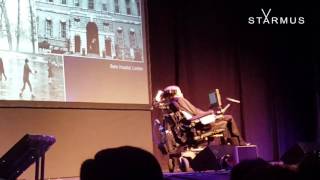 Stephen Hawking on Cosmology and Black Holes: From Big Bang to Future Humanity2016 · 25 min · full transcript