Reid Hoffman on Social Media Responsibility: Truth, Trust, and Jobs

What Hoffman talks about
Reid Hoffman appeared in this panel interview at Code Conference in 2016, discussing social media responsibility, public trust, truth, and how tech companies should address the social effects of their products.
Also known as: Full interview: Marc Andreessen and Reid Hoffman | Code 2017; Live interview: Marc Andreessen and Reid Hoffman | Code 2017; On with Kara Swisher at Code 2017.
In this panel at Code Conference, Reid Hoffman argues that the internet and social platforms are broadly a huge step up for most people in the world, especially those without access to strong schools, rich communities, or local intellectual resources. He says the deeper issue is not autoplay or platform mechanics, but how society restores trust, discernment, and shared standards of truth.
He also pushes back on the idea that Silicon Valley lacks social conscience, saying the region is more politically polarized and self-critical than outsiders assume. Hoffman says tech companies should take responsibility for the social effects of their products and invest in bridge-building, better discourse, and tools that help people navigate contested information.
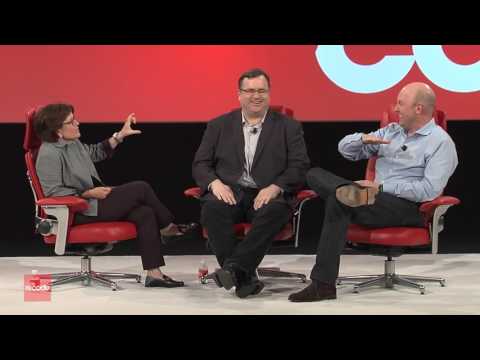
Hoffman speaks alongside an interviewer and Marc Andreessen in a panel conversation.
In his words
“The internet represents a giant level up on all those topics for most of the world”
“I think that the question is that we had presumed that broad brush that most people could kind of make assert a s-sin of truth”
“I don't think there is any such thing as an alternative fact.”
“I think it's definitely a good idea for businesses to have social conscience”
“Technological change causes productivity growth.”
Key points
- The internet is a major upgrade for people who lack access to strong educational and social resources.
- Commercial incentives can bias platforms, but the bigger issue is truth, trust, and misinformation.
- Hoffman rejects the idea of absolute access to truth by any one cultural group or coast.
- He believes tech companies do have social responsibility and should help improve discourse.
- He warns that political polarization and fragmented media make democracy harder to sustain.
- On jobs, he argues technological change usually creates new industries and opportunities over time.
- He thinks tech should focus on lowering costs in slow-changing sectors like health care and education.
Full transcript: Reid Hoffman, Code Conference panel interview (2016)
Let's bring them out: Marc Andreessen and Reid Hoffman. Hello. So, you know, Marc Andreessen has this habit of texting me really rude things almost continually, and while I was sitting backstage within 10 feet of him, he was tweeting at me about that last talk. So, what did you—I think it's very important because I think Facebook is sucking the life out of us. So what do you think? That's the opening question. Outstanding. So, it's a sitting Facebook director. I think I'd pull it with the client answer, but I'll meet let.
Me, let me generalize out. So this is something that one hears about the Internet, a very sunnis, it hears about the Internet a lot. So we start by saying that gentleman, I'm sure he's doing fantastic work, and he clearly means well. I really, really deeply disagree with everything he just said. And the reason is because not just because I had some role in creating the whole thing, but a friend of mine, O'Cronin, who works in VR and is the advanced thinker on these things, has a term he uses called "reality privilege." And so it's a view from the box seats. It's the view from—it's a view from places in the world. That's exactly the kind of view you get from places in the world in which there are super rich real world experiences to have, right? And so you grow up in an upper-middle class community, probably on
the coast. You have these incredible schools, you have these incredible and rich activities, you have all these after-school activities. You always have incredible people to talk to; you go to a college campus, you get to, you know, you get to hang out with all these incredible super geniuses for the point zero zero one percent of the population of the world who gets to do all those things. Then it's internet thing, it's a big step down for everybody else. The internet is a giant step up, right? Most people don't have that level of reality privilege. Like most people grew up in places where there's a much higher level of what you might call intellectual deprivation. There's just not that many people around to talk to. There's just not that many interesting things being discussed. There's not that many great experiences to have. It's hard to learn new things. The schools aren't good. I mean, all kinds—no, most kids in the world don't even go to school, like go to school up to grade four, grade six, grade eight. It just can't progress beyond that point because there's—there's nothing locally.
There's no local system, infrastructure, or community to be able to engage on ideas. And so the internet represents a giant level up on all those topics for most of the world, and I think it's a fantastic thing. Alright, okay, well then find Snapchat for everybody. So three would you like to— Oh, well, so look, I think that it's correct that there's various forms of kind of, call it, commercial system biases to come out, which is companies try to say, look, when you want to occupy a bunch of time, so we try to figure out how to have that time be occupied. And this is similar, true, this ranges everything from the agriculture industry, which says, well, eat more sugar, but you have these commercial biases the whole way through, and we adjust them. Now that being said, the overall system is better, and we can tune
it, right? And so I think that one of the other things frequently is not realizing there's things you can do to change for more of the kind of the good and night and the bad and these things. And obviously, I am less focused at the moment on questions around autoplay or kind of equivalent, and I'm more focused on questions about like how do we get to discernment of truths and how do we get, like, you know, truth in the media, and what is this whole fake news and all, you know, facts and all that kind of stuff. And that is, I think, a much more deep issue that I'm focused on at the moment. Well, I think one of the things that one of the reasons I wanted to have these two with one because you make investments, you change companies, you just thought, you make a lot of decisions that impact other people too. You're super argumentative and debating
about what, where that's going, you know, where it happened. And I wanted people to get a sense from both of you of how where innovation is going, how it's going because you are not in charge of it but very influential to the process, both of you in different ways. So let's start on that idea that you just talked about, which brings in all of socially. I'm not going to pull up Facebook but at all social media, the idea is something I've been railing on recently for some reason is the responsibility, the social responsibility, the, the civil responsibility of social media companies and other companies in Silicon Valley to not to stop pretending these platforms are benign. So as someone who's created these platforms, each of you, each of you is done your part. How do you look at them now? Because I think they've morphed
in ways. Some people think social media's become weapon, some people think other things. But that, that take mark and Mark Zuckerberg has been talking about this a lot—the idea of the responsibility. So how do you look at where we are right now for Silicon Valley? Why don't we start with you, Mark III? How do you look? Okay, great, I'm happy. Okay, look, so I think that the question is that we had presumed that broad brush that most people could kind of make assert a s-sin of truth within their kind of normal set, and I think actually in fact it is somewhat hackable. Its filter bubbles is one of the things that people talk about a lot in the valley, and how do you make sure that you're not blinded by it? You have communications that go across. That there's questions about.
Assertion of, you know, what is the most relevant fact, or, you know, I don't think there is any such thing as an alternative fact. I mean, I think that's— that's George Orwell and Aldous Huxley speak. But I think that the question is, okay, how do we help people figure out better guideposts to the truth? Because simply being as part of the feed on the screen sometimes is treated as, "Too much of that must be true." And so what I think is good is— I think the whole industry, and I've been part of a number of conversations about, okay, what are the right ways to do that? And part of the reason why they try to say it's more platform— I don't know if it's trying to say it's benign— is they're trying to say, "We're not trying
to impose a point of view; we're trying to help you get to truth." It's kind of classic, like, what is the algorithm part of it? And so I think that there's a lot of thinking now about, like, what are the different ways you can do that. One of the things that I think is important is perhaps building that out of the kinds of things we trust, like, we trust other people, and can we get to some kind of version of, "Okay, I know this kind of information is much more contentious; there's a lot of people who disagree with it. This kind of information is something that I can rely upon more." And I think we need to get to that kind of scoring system, and I think we need to make it simple enough that it helps unify discourse across country. How do you look at this? So I think truth has become shorthand for things that people
on the coasts believe, okay, and fake news or false, whatever, alternative fact has become shorthand for the things that people in the center of the country believe. I think this whole topic is gone completely off base in the wake of the election. So if you read the coastal press, which is generally spectacular job—I think of covering the election last year—but if you just read the press in aggregate, where all the stories, the overwhelming thing that you were carried away with was, "There's no way on earth that Donald Trump can win this election, right? It's impossible." You did your, the fantastic editor of The Times up here on stage today—they had the day of the election they had Hillary that morning at ninety-two, ninety-two percent. Not to me, like, I think ninety-two percent US. So it actually turned out if you actually wanted to—if you actually wanted last year and 2016 to read the story of the election, actually get the truth, you read Breitbart. Now, nobody wants to hear that because we
all like have concluded that, right, Breitbart is like absurd right-wing propaganda and that somehow, you know, the traditional, the coastal press is somehow the truth. But like, it's just like demonstrable last year that was not true. So I just think we all just need to take a step back on this idea that there's absolute truth and that somehow we somehow have some sort of monopoly or preferential access to it and the rest of these people kind of don't understand anything. By the way, it's a surefire way to lose elections because Democrats are ever going to lose elections, are ever going to win elections again in the center of the country—that's out of the country—they have to show up the some message other than, "You're all a bunch of morons." That's not going to work. That's not—that's like the point is are these you can let element that is the message? Yes, I think that's what's being heard. Yes, but that's an easy shorthand way of saying no matter what they say on the left though either coast is untrue. You can say untruth to people and get them
to vote a certain way. I mean, it's very, you know— you know, if you want, if you want—if you like your health care plan, you can keep it, right? Right, Obama, 2008, right? I don't care, like how's that? How's that? Well, I'm going to come in a close. I'm going to quote, I'm going to close Guantanamo my first year in office. You do it, like, for some reason. Well, the fact that politicians break promises to us is not—it's not a very big—if you read the press coverage of those promises at the time they were presented, it's truth. They're presented as, yes, these are absolutely things that are going to happen. Like there was, there were reams of coverage around Obamacare of how well it was going to work. All right. News coverage. What is the responsibility these platforms do they have any? Because Dean would say no. He did. He said no. They're just there as platforms. He didn't, he thought the New York Times that our responsibility they necessarily don't. Do you imagine all these technology platforms have any social responsibility?
Mark has been talking about it a lot. He's been visiting lots of the country. He's been petting livestock quite a bit, which is nice. Do you know how fluffy cows are? That they are apparently—hells are super-high. I have been around many cows. I am aware of cows. But how do you—how do you look at that response? Because everyone seems to be visiting limits, doing that kind of thing, they aren't spoken about. How do you look at—is there a social responsibility for this technology now? They're all going where I grew up. I know it's amazing thing. I've ever seen. Oh, many left. They're not going back. So I'm going to frustrate, I'm going to, I'm going to frustrate, I'm just not going to— I can't. I'm sitting back for Facebook. I need a website or talk about my next page, but just in general, like, as technology evolved, do you think that Silicon Valley needs to have more of a
Social conscience, so I think it's definitely a good idea for businesses to have social conscience. And I begin, it's where I would say I believe there is much more, but it's become very trendy to claim that Silicon Valley doesn't have a social conscience, and it's just the default assumption is that all these companies are doing horrible things all the time. And I just don't think it's true. Okay, alright. I don't think the situation is anywhere near as polarized as people are presenting it. Well, people liked it, but by the way, Silicon Valley. To Silicon Valley people, people need to bear in mind good. And you will. So, two years ago, two years ago, two years ago, the conventional wisdom right around, or much of the rest of the country that you read, actually frankly in a lot of the press coverage in Silicon Valley was it's this hotbed of like these crazy libertarians, like it makes crazy extreme outlier, like, you know, fringe elements. And of course, our friend Peter is kind of... I kind of held up a good friend Peter. Thank you very.
Good friend Peter actually was held up. It's kind of representative of the valley, right? A funny thing happened last year, which was it turns out that was fake news. Okay. It turns out that was not true. In fact, it turns out the opposite is true, which is the 99.999% as of last year voted for Hillary Clinton, supported Hillary Clinton, donated to Hillary Clinton. Like, it was over, it was like the money difference. I don't... I was like some giant multiple, any money difference base, because nobody, nobody, nobody. Get your trumpet. So the valley not wholly plays it. It is not, by the way... May I point out you tweeted, "I'm with her," correct? That is, if it is, right? Well, I will concede to that. Okay. I subsequently believe it. Subsequently deleted all my tweets including that one. I will cop to that. So what about it? I think Silicon Valley not only has it, has a real sense of social responsibility. If anything, Silicon Valley is all the way over on the other side.
So Valley is extremely left-wing, extremely liberal, and actually think this is now... This has become part of the problem. Kits now, you have the other version of the problem, which is actually, I think it's really hard for a lot of people in Silicon Valley even to articulate the other side at this point. It's hard to even articulate the case for voting for Donald Trump. I think it's hard to articulate what people in the Midwest and the South were thinking. And I think this polarization thing, it's the general problem that I was talking about earlier, but I think that I think the Valley is part of the coast polarizing from the center of the country to a much greater extreme than we've ever seen in our lifetimes. Alright, now, and it just does not left unchecked. This does not have to go places. Okay, this is great if you didn't want to talk about politics at all, but great. Okay, so you have been very active in that left-wing cabal, apparently, and that's a way, you know.
It's, it's like, it's like nearly everybody. No? It took a ball. So you talk about what you're doing because I think people are, people are looking to you a lot. Everyone says we've got to get Reid as the leader of this goal. Yes. That I do. I do. I don't know. So talk about what you're doing brilliantly with Mark Pincus and others. Yeah, so Mark, who's here in the audience, he and I started talking years ago about how do you essentially try to create consumer net technologies to help shape a kind of pro-business and also pro kind of social values future, and how do you put that together into a moment. Because I actually think part of the whole thing is to get the bridge building, to make the right thing. And I think part of the social responsibility for these growing strength of tech platforms is to make.
That happen. So I think there is, I think there is responsibility, I think it's a growing sense of it, and I think people are trying to figure out what it means and how to operationalize it the right way. And then personally, you know, it's everything from obviously part of the question that, that, that led to the election of Donald Trump, is there's a lot of people in a number of states that are feeling in pain. They worry that their children have less good features than they had. There is, you know, kind of serious opioid epidemics in a number of different states and regions, and they say, look, these need to be fixed. Don't tell us more of the same. Tell us how we have opportunity. Tell us how we make that happen. And I think, you know, part of the thing about being inventive, being problem solvers, you know, because that's part of what we try to do with technology and businesses. And so it is, we should do more of that now, I think.
Another part of it, the earlier thing is I do think we have a problem. I think the fake news thing is actually leveled both ways. Like, I don't think it's a the coast saying mid Midwest. I mean, you've got your the president saying CNN is fake news, etc., etc. I mean, you know, you have the erosion of these kinds of institutions, and we have to be able to talk. But if you can't have some basis for conversation which says, okay, this is what we think truth is, this is where we think we should be going, it's very difficult for democracy to work. So you know, it's everything from the kind of Win the Future. This is this organization, yes. That WTF, WTF with a deliberate, you know, kind of on e. I see what you're doing. Yes. Yeah, uh, I find it juvenile, but go right ahead.
So, what we specialize in German—I know that, I will believe me—after many years covering all of you, I come—and so, I'm, as a matter of fact, actually one of my most favorite theories of the evolution humanities: neoteny, right? We were born early, and that plasticity and ability to learn is key. So, I think there's a whole stack of things, and I think some of it is like, what does the future work look like? I think some of it is the question of how do we get communications channels? How do we get to a rebuild of just some kind of communication? Like one of the projects that I've funded at the MIT Media Lab's called Quattro Co, which has done an analysis through the Twitter firehose of how fragmented the discourse is, or how do we get that discourse somewhat—
—less fragmented, because with that fragmented discourse, of course, you end up with, you know, kind of complete, like, different planets. And that way it's the hellscape out there. But go ahead. Yeah, so anyway, that's—but that's—well, and then there's a whole question about how these things get hacked by, you know, autocratic hostile actors, right? And, you know, one of the things that we have to pay attention to is it is not necessarily purely just the diversity of humanity that's playing on it, but there are people who have political aims that may be investing. And, you know, I'm really interested to see what will emerge out of, you know, kind of Russian and foreign power influence on trying to hack social media, because that—that's kind of a key issue. And I think, actually, one of the things that, you know,
Brad Smith, Microsoft, called for that—I think is really interesting—is how do we get to a Geneva Convention in cyber? I think that's actually an important thing to—to look at happening, because part of that is what's going to happen with these things being hackable, a little bit like they talked just before us. Your attention can be hacked in ways that it isn't just code hacking. This isn't just cyber, but it's kind of a question of what do you presume to be true? And, you know, you want a vibrant democracy. We have to try to—to get to a place where we're having rational conversations, and we're actually using evidence and argumentation to decide X is true and Y is not, right? All right, I want to get to where innovation's going. I think that's really what investments in are you—you investing a lot of your money in this? I'm not supposed to call you a certain
thing of the last device. What are you investing a lot of money? Do you want to run for office? Definitely not. One process? Why? Well, look, I—I prefer the partnering board member and vesting. That's one of the reasons I got behind it. Yes, yes, a guy behind me of LinkedIn smoking room. Yeah, yeah, yeah, role model rebels who didn't get the X-Files, right? Handy? Yeah. And so—and then—but I'm betting a bunch of money. I'm trying to actually facilitate conversations, trying to facilitate what the right kinds of ideas are, like what are the ways that we can make sure that we have, you know, vibrant economic ecosystems, the middle-class jobs across the country.
Makes planning work, ultimately a lot. I'd say thus far as probably millions, millions but hundreds of millions. You think there's—we could get there? Could get there. All right, so let's talk about where. And Mark, you're not running for office, I hope. Okay, I would not advise. Can you imagine anybody voting for me? Why don't you? I might just as a joke do well. If I run, I'll take the sarcastic jab. All right, so let's talk about innovation, where it's going. You guys have been around forever. There's been a lot of different investments in periods of time and things like that, and it is related to jobs, the future of jobs. Let's start with there. How do you look to me? It seems like something I was doing a lot more serious thought about investing,
beyond into the into it to the next year, cars, automation, robotics. Each of you want—you start. Mark talked about—you think the most last time you were here, you talked about software in the world. You talked about a wide range of things. How are you thinking now about investment? Yes, it's interesting. We have two sectors, two different kinds of economy in the U.S., so two different kinds of categories of sectors. Divide them in one might call the fast sectors and the slow sectors, but the fast-change sectors, slow-change sectors. So the fast-change sectors are sectors like retail, transportation, media, in which technology has had a huge impact. Software is eating those sectors. There's massive change happening in those sectors, massive productivity improvements as measured by productivity, which is how economists measure the rate of technological change,
by the way, gigantic churn in jobs, right? Turn in, obviously, media and retail, and you're in BuzzFeed, you're in a bunch of—yeah, yeah, exactly right, and in lots of debates about the nature of that churn, by the way. However, along with that, rapidly falling prices, right? So the prices are basically everything, and we, you know, and the experience everybody has as an Amazon customer: prices in retail, prices in media with all the free media and Internet and prices and transportation are going to fall, you know, dramatically with self-driving cars. And so very rapidly falling prices but like a big—and a big concern of where the jobs going to come from. So that's part of the economy. The other part of the economy is what you might call the slow-change part of the economy, which is all the sectors in which the opposite of that is happening. And so these are sectors like health care, education, and
Construction, elder care, child care, and also, put away government. So to call those kinds of the big six in those sectors, the opposite is happening, which is in those sectors we have a price crisis, right? The price of all those things is rising super fast, right? So The FT had a story today—88% of all the price inflation in the US economy since 1990 is attributable entirely—eighty-eight percent of it attributable to health care, education, and construction, right? And so what's happening on—and the sort of the slow change sector of the economy is, basically, everything's becoming super expensive. And if you try to buy a house, or if you want to send a kid to school, or if you need to get care for an ailing relative, you experience this. And hence all the concern around the cost of all these things. Those are the sectors of the economy that technology is having almost no impact on. Right, software is playing a very small
role at best. Those are also the sectors that have almost no productivity growth, right, as measured by economists. And, left unchecked, those sectors are basically just going to eat the economy, right? If the products and services in those sectors keep rising in price, they end up being everything we pay for. Health care is leading the account. Yeah, healthcare, healthcare, education, and construction, the big three, and they're eating the economy. Fully loaded, construction costs have doubled since the year 2000 in the U.S. I mean, just like absurd things are happening in real estate construction. And so, I think the opportunity and the challenge is for the tech industry in Silicon Valley and all of us to go figure out how to have a much bigger impact in the slow growth sectors of the economy, the slow change sectors of the economy. I think if we do that, if we're effective at it, we have the opportunity to bend the cost curves
over time. And these, by the way, are very, very big sectors with very, very big kind of entrenched forces. I play that, by the way. These also, the slow change sectors also happen to be highly regulated, right? These are sectors of the economy where the government plays a gigantic role in the economics of these sectors. And so, these are not easy sectors to disrupt. This is the big leagues. But the opportunity exists to really go after the price curves and systematically drive down prices in those industries. If we do that, like, that may be the single biggest thing we could do to improve quality of life for living—that for ordinary people. We are actively investing. So, super actively investing in education. You'd absolutely, one of our companies going directly after skills acquisition, doing very well with an entirely new way to link with employers to do skills acquisition and training online. We're very aggressively investing in healthcare. We think there's a whole new very interesting thing
happening at the intersection of healthcare and software that's just getting started. And we're investing very aggressively on that. Construction is harder. You know, the big challenge that we're all going to have to tack on the long run is this sort of question of cities and this question of land use and whether cities are going to be allowed to get big enough where everybody who wants to get to them is going to be able to get to them. Mayor Sweitzer in San Francisco, I think, is going to have this on the top of her list. Yeah, as thanks to solve at all, really. So that's the sector. That's exactly—you’re going to be my deputy of something? I am looking forward to it. Yeah. Yes. I will take that on my business card. So that's a big one. We're also, by the way, elder care and child care are both increasingly central elements to the economy, huge employers and both pasteurizing sectors. We have a company on earth and I'm involved in
that's trying to come up with a fundamentally better way to work. Russell's no maker. I mean, what about you? So slightly different division. So I think about things that are kind of classic for what we do, which is kind of businesses with network effects, which can include both consumer and enterprise side. So those are things like, you know, obviously Airbnb or Convoy, which is kind of over for trucking. We just recently—can we still use that Uber for that? Not allow. Say, "Well, I think we always use the version of them." I mean, before, whatever. It's a—it's a quiddit—that for Mark Nicholas. No, prefer X is better now because it has an extra element of danger. Okay, the lips guy—I let that one—go ahead and
so there's a stack of those sorts of businesses, which I think are the—I think we will continually design new forms of software ecosystems that have these network effects that organize how millions to billions of people communicate, work, you know, kind of coordinate, communicate, all that sort of thing together. And then part of what we look for is, what are things that are substantively contrarian, that are not in the kind of the current, you know, kind of bug cycle, right? The buzz cycle. "Hey, is AI, AR, VR, you know," etc. And then, what are the things that they—you can actually do something that actually might be really interesting? Some of those will play out into those
industries. So, you know, if you figure out different kinds of construction, you know, robotics, so you figure out, you know, energy sources or other kinds of things, those can actually play into those and can actually change those cost curves. So it isn't—it is a different way of looking at it, which is kind of through the lens of these things. They're defining kind of network effects software ecosystems with people and devices, you know, kind of combined together. And then, these things are what kind of off the current beaten path. What is that? What do you name something? So let's see, what can I name? Well, I mean, so, you know, one of the things that we did last year is a
Energy company which I can talk about in depth. All right, what kind of energy? So possibly fusion, possibly too efficient. Okay. Oh God, yes, and investing in that in a new and exciting way. Okay, okay. All right, what about robotics? So I think robotics is generally speaking one of the areas that everyone knows is going to be super important. Everything from autonomous vehicles to other kinds of things. So there's just a ton of them. Like the number of autonomous vehicles startups is, yeah, they're, yes, is like an uncountable set, but it's clearly going to be there. And then robotics are going to be like, remember when you started saying construction, I was like, oh.
Robotics is the interesting, you know, angle is the first reflex there, and I think there's going to be a bunch of things there, which some of which you'll see from the big companies. I think some one that you'll see from startups. What do you use that in robotics because, you know, Bill Gates, interesting we should tax robots, that's, that's right. And then Mark Injuries is a Mark Cuban, you're saying we've got to get into it, as China is going to do this first. We should, is horrible and evil, but we have to, we have, we have to be really good at it. Yeah, a little bit of a paradox in there, so we should definitely tax robots right after we get done taxing PCs, okay, which took away all the secretary jobs. All right, okay, so I propose we do it in that order. Okay, all right. So how do you look for Microsoft hasn't taken us up on that. All right, how do you get to what do you imagine in robotics going? Oh, it's very the contrib will get to the.
Job issue in a second, but yeah, but talk about the sectors automation and robotics together and I suppose AI also gets in that pot. Yeah, so look, so the big thing, it's a big thing that's happening is that the so-called, so-called AI, but machine learning to hold the whole sort of family of technologies around our own machine learning and sensors, right? Something dramatic has really happened, something dramatic really tipped about five years ago or a whole category of things that just didn't work at one point, all of a sudden work. And so I just, I think to, I think at this point, there's just a feeding frenzy in the tech industry in the valley to try to experiment with every single possible permutation. What can be done with AI and robots at every possible shape, size, and description? It's, I think it's spectacular. So it's one of the biggest, it's one of the biggest booms slash kind.
Of exploratory let's go the landscape let's go try all the ideas that I think I've ever seen and what do you and we're actively investing. What do you like about that? What do you, and what do you worry in that area? When you say if everyone's pursuing it just, oh, it's a classic hits of Silicon Valley. It's the thing that, it's the thing that gets everybody excited about Silicon Valley, and then it's the thing everybody always criticizing Silicon Valley for, which is of course we're going to overdo it. Like course there are way too many companies being funded doing self-driving cars, but out of so what always happens to the valley, right? The great strength of the value, I would argue, is that when something starts to work we over fund it, like we have way too many companies going after this. Most of them don't work, but the ones that do end up becoming very big and important, right? And ultimately valuable. And so, well, I think we'll get that exact exact same result out of this phenomenon for people who want to say the Silicon Valley just does well pulls over and over again, there will be ammunition to support that view.
But I think out of that will come, you know, defining companies of the era that we probably haven't even heard of yet that are going to be on the scale of the big technology winners in that sector in that sector. Yeah, the opportunities are very, very, very big. Do you worry either you about the job impact when we're talking, and I want to understand where you look at where you feel the responsibility if you have any on the future of jobs. It's something I'm very interested in. Well, so and obviously, I mean, to some degree, what I found in LinkedIn was trying to help people figure out what skills jobs opportunities of the future. So taking software and networks to enable that and enable people to be able to find the right opportunities, get the right skills, get the right connections to those kinds of things, that's actually very sensible. Let me give you a kind of a classic kind.
Of thought on within the autonomous vehicles because people frequently say oh these home Thomas people is going to take a whole bunch of jobs, there's an issue there and you have to get that transition. But on the other hand, once you have autonomous vehicles, for example, being able to have people now actually, in fact, go be able to get to work in a much more easy way, to be able to actually when they're in transit to be actually doing things that are either relaxing or working as a way of doing it, it also opens up a variety of productivity possibilities. No, I get that argument of like you can now text and drink. I get that. I get, you know, it's all that. I think is the funnest thing with texting. All right, but it is that happy shiny future idea of like oh it's going to be so much the same thing with AI, same thing with that mark. You were just going to say something but what I.
Wonder about is when that happens, there are millions of jobs driving, take driving millions of jobs, and I think when Travis was on this stage and said, "The problem is the guy," he actually was honest compared to most people. They say, "The guy in the front seat's the problem. We need to get rid of the guy in the front seat," you know what I mean? Which, everyone, we had a sharp intake of breath. I was like, "Yay, he said it." But what do you—how do you look at that? Do you feel? What are you going to do about it? Or do you have nothing to do about it? So it's a fallacy, okay? It's the lump of labor fallacy. It's like the Luddite fallacy. It's recurrent panic. This happens every 25-50 years. People get all amped up, "Okay, machines are going to take all the jobs." And it never happens. So let's talk about cars specifically, because that's front and center for the conversation. So when the
automobile, 100 years ago, when the automobile went mainstream, this concern literally existed. Exactly the same panic happened. It happened because of all the people who were vital to it—literally was taking care of horses, right? So everybody running stables and everybody doing blacksmith work, like the whole thing, "Oh my God, what's going to happen because Ford Motor Company's, you know, in the world, nobody else is going to have anything to do?" The car then created not only a lot of jobs building cars, right, it became a huge employer, right? Now the car industry became such a huge employer that we had to bail out all the car companies to keep all the people working. Like, a hundred years, it went entirely in the other direction. Not only that, the car—think of everything else that happens as a consequence of the car. So the idea of surface streets, right? Paved streets emerge because of the car, right? Streets weren't paved before the car. They were paid before the car. So paving streets, the idea of the idea of restaurants, the idea that you might actually go
someplace to eat something was an invention of the car. The idea of motels, hotels—the place we're in here, it exists entirely because of the automobile. The idea of movie theaters, the idea of apartment complexes, the idea of office complexes, the idea of, at some suburbs, the entire build-out of suburban America—the jobs that were created by the automobile on the second, third, and fourth order effects were a hundred times, a thousand times the number of jobs the blacksmiths had. And so this goes to kind of the fundamental kind of flaw in the logic that they call the lump of labor fallacy, which is technological change causes productivity growth. Productivity growth lets us produce more of what we can already make with less resources, and then lets us create that. That's what frees up the spending power to let us create lots of new things, great. But lots of new demand and that's
what creates new industries, and that's what creates new jobs. And then 100 years later, we look back on it, we're like, "I can't believe anybody was ever a blacksmith." And so this has been the panic. Literally, this was like the panic every 25, 50 years. That's if you're a blacksmith, and it never comes true. The good business didn't work out. The good news is the car companies and all of these other industries hired huge numbers of people. And so I think the self-driving car has the opportunity to not only improve productivity for people in the car, which will be a huge economic boost for those people, not only has the opportunity to save lives, right? Over a million people died worldwide in road deaths today caused by human drivers, and I think we can take that very close to zero, right? Which is very good for both human welfare and in terms of economic productivity, right? It's like, it's a very serious down productivity when people
get killed. And then, and then, and then, and then, and then, all the ancillary industries that end up getting built up. So as an example, maybe this whole land use thing, everybody's worried about, maybe with self-driving cars we just start to have excerpts that actually work, which is to say another layer around cities, right? Further out, right? They don't call it suburbs because you couldn't tolerate, you couldn't possibly tolerate commuting in an hour, an hour and a half, right? So people in Silicon Valley are experiencing, if you live south of San Jose, your commute now might be an hour and a half, but it's our half in the car driving the car. If you were in the self-driving car, all of a sudden, then you've got, you made up a huge construction boom in all the outlying areas around these cities, and that construction boom might hire four more people than were ever involved in driving cars. Hello. And so the process works, by the way, as evidence of that,
after all of the technological disruption that has everybody all freaked out, that got us to where we are today, right? Unemployment in the U.S. is now batting below—it's not below 4.3 percent, right? Yes. If you're living in areas like Kentucky, there's six million—there's six million job openings up in the US. And the panic stories in the press have gone overnight from, "Oh my God, not enough jobs," to, "Oh my God, not enough workers," right? And The Times is an example. The Dean's paper had a very good story about two weeks ago on, there's now a crisis in Utah. There aren't enough people to literally milk all the cows. They've literally run out of people to milk the cows. And so what the jobs crisis we actually have in the U.S. today is we don't have enough workers to be doing the right thing. By the way, we might make that, you know, for this, if these immigration policies continue, we might make that problem worse. Yeah. Okay, here is for immigration very much. Okay.
Good. What are you worried about? Are you worried about this at all? Then we're going to get to questions. Well, so the one thing I agree with most what Mark said there, including the fact that if you remap what is the logistics in space, it plays a lot of different parts to be, not just construction, but a lot of different ways that that may play out and changes cost rooms. I think the transitions can be very painful, so I think we need to pay attention to the pain. That pain, so example: the agriculture-industrial revolution actually involved a largely very ugly and so, while I tend to think, "Oh, look, it works out, it'll probably work out anyway," the question is, let's try to make it work out in a way that's more humane, more, you know, kind of the society that we want to be, and kind of not as much.
Pain in that kind of transition, right? Absolutely. Do you think about that pain? So, look, what are you just bullish or what's going to be? So let's talk about what's actually happening. So this is all hypothetical, talk about actually happening. So economists have a way of measuring the rate of technological change, disruption in the economy, it's called productivity. Productivity growth, would we expect, based on everything that we read here and understand with this rate of technological change and disruption, would we think the productivity growth is at generational highs or lows? Probably high, right? And it turns out, it's a generational low. Productivity growth is running super low, and economists are writing books left, right, and center, agonizing over why productivity is a puzzle. Would you expect that the rate of job churn, the rate of both job creation and destruction in the economy, which tend to go hand in hand, would you expect that?
Those, the rate of churn is at a generational higher, generational low. No idea. I'm not going to answer. It's a trick. It's a trick question, as you anticipated. Oh, just right. God, everything's a trick question with you. The rate of job churn of the American economy has been declining for 40 years, and it shows no sign of growing. Would you expect that the rate at which people are turning over in jobs, individuals turning over in jobs, is increasing or decreasing? Well, Millennials are, who, everybody, but just everybody, including moneyless, probably at, are decreasing. All right, people are staying in jobs longer. And would you expect, because of all the disruption that we know about, would you expect that the rate of new entrants, of new companies in existing industries, is accelerating? Right, go ahead. It's decelerating. Okay, we don't have the problem. Market 11:00 p.m. We don't have—I haven't even had a Scott yet that can.
Be fixed, that could be fixed. But we don't even—we don't, we do not only do we not have the problem as worried about, we have the opposite problem. We don't have enough change. We don't have enough change. We don't have enough creation of new jobs. We don't have the creation of new opportunities, which is what, in my view, goes right back to the politics. It's what leads to zero-sum politics. The reason our politics is going sideways is not because there's too much change, because there's not enough change. Because people don't see a future. Because they don't see anything changing. And I think you see the zero-sum politics. You see that sense on both the left, right, with you on the Bernie lap and on the Trump right. I think that's the problem. The way through that is not to slow down. The way through that is to speed up, right? The way through that is more change, more growth, more opportunity, right? That's the path forward. And so this goes back to like, I'm just, I'm very worried that we've actually gotten off and we're just talking about completely the wrong thing right now. And I'm hoping maybe over the...
Next couple, well, yes, we can massage this a little bit more towards the actual, the actual crisis that we have. All right? Questions from the audience right here. Hey, guy who are weak state capital, are you? So this is a very Silicon Valley-centric view, which is where you guys are. Is the world changing in that respect? Are we seeing more ideas and concepts coming from other parts of the world? So I think the—I think the answer to the question, in some degree, is both, which is yes. There's launching foreignership, there's more technology. There's multiple areas, not just obviously a huge amount of stuff going on in China, but like when you get to Europe, it's, you know, Stockholm and Berlin and London. There's various cities.
Across the U.S., on the other hand, frequently, that's the—is Silicon Valley losing some, actually, to Clara? And I actually think that Silicon Valley is persisting because of the network effect of Silicon Valley in terms of lots of entrepreneurs move here. The ideation moves at a very fast pace rate because people will talk to each other about what's going on, what it should, what are you seeing in autonomous vehicles, which things going to work, etc., etc. And that also creates them. So, I think the answer is some grades, yes, to the rest of the world, but also continuing very interesting patterns of leadership from Silicon Valley. Are you worried about ultimately losing it? Step? Never, never—not right now. Yeah. Well, we're doing everything we can to kill it, but Lamar, we so far we keep.
So far, we keep missing. All right, we—okay, collectively, the state of California. Oh, okay. All right, got it. Okay, good. I'm going to make it even worse. Anyway, hello, Manny QTL. This is based on a quote from you read earlier on in the topic of politics, but it goes to both of you. You said that you think that we need more rational conversations and that one of the things you want to do is to be able to facilitate more rational conversation. What would you say to the premise that the problem is that too many of the conversations, especially the ones that need to be rational, are happening digitally, and actually what we need is to facilitate more in-person conversations? And if you greet it as a print, that's an important premise.
That too many of the conversations are happening digitally. How would you facilitate more in-person conversation? Add that Reid has a new podcast, correct, called Masters—Masters of Scale. Masters of Scale, this guy was on, and I think, right? Yes. Yeah. Okay, we should be. And it's very heavy conversational. Yeah, so actually, you know, there's a whole Renaissance happening in podcast. Yeah, yeah. I like them. Yes, exactly. There's some very good ones. I know that mine, in particular. And so look, I think the short answer is more conversations in person are good. One of the things that I think is interesting and specifically the organization of Florida called Village Square—their basic theory is that you can cross the
aisle and get through disagreements more if people essentially sit with each other. So, for example, one of the things that actually makes, you know, Washington Congress dysfunctional is that they won't actually sit with each other and talk to each other as much. So I think it's a good thing to have. I don't think it needs to be an opposition to digital. There's a great book, so I recommend a great book on this stuff. It's a great book called *The Tyranny of Done*. What was it called? *Infamous Scribblers*—Eric Byrnes. *Infamous Scribblers*. I highly recommend it. It's a story of the role that newspapers played in the American Revolution. And people may know that founding fathers, Benjamin Franklin most notably, were heavily involved in the newspaper industry at that time. And it was sort of—there's a lot of the debates around the revolution took place in newspapers. They were like 15, 20, 30, 50 newspapers per city. So it's a very kind of thriving kind of thing at the time.
And if you read that book, you will be amazed at how polite people are today. Yeah, they are, as compared to what they were like then. Yeah. And it's actually—it's amazing the parallel. Well, maybe you won't think the reply today, but it's amazing that parallels newspapers in the late 1770s, 1780s—they were basically blogs. And the founding fathers actually were notorious for using pseudonyms. Yep. And in fact, they would use multiple pseudonyms, and then attack each other. They would have their students attack each other, not sell papers. Yeah. So Ben Franklin wrote under like 15 different pseudonyms, and his different personalities would like go to war on the press, and he sold a lot of newspapers. And they would attack each other for stuff that, even today, you wouldn't expect politicians to take each other over. And so I just go thrilled that to say I think it provides some historical perspectives, which is there was never a golden age for everybody.
Well, yeah. Light and nice and fact-based. Like, it never—it never existed. No, we were always—the idea that there’s some change that's happened is just not true. It's pretty vile. Oh, it's terrible. Yeah, yeah. But it's been terrible. Yeah, yeah, it's been terrible for a long time now. No, no, but this goes to—and this maybe we're—I'm a huge fan of everything Reid is doing, but I'm a little bit less on the train of the right answer here. I think more rational conversation is always fantastic. I'm a little bit more skeptical that it happens because I don't think people basically want to have rational conversations. And as a consequence of that, I think we need a system that works without them, which is, I think, the genius to the American system. All right, then. Vile, it is. Go ahead, Hike Union, with The Verge. Wanted to ask you guys whether you support the experiments that are now underway with universal basic income, and
if so, what you think we'll learn from those experiments. Well, look, I think broadly, I think there's a predisposition to try to do over-planning, so I think experiments are generally good. I think the issues around basic income are—I kind of think of it as that as a plan Z. If you can't think of something better, it's the plan you have to fall back on. But I actually think that in work, we don't just get like the money for, you know, sustenance and Maslow's hierarchy of needs. We also have something where I feel meaningful. I have part of a community that I can strive to something better into. And I think you want a system that's designed around that that doesn't necessarily exclude some notion of UBI in the future. And there's, you know, there's a whole bunch of things you need to look at in that. But I think that the better plans don't just
go to that. They're actually, in fact, ways that people still have kind of work and still have a way that they have meeting and within their community. UBI—I'm gonna guess on this one—I am completely in favor of the experiments. I love experiments. UBI is a policy as genetically engineered to alienate everybody. Okay. I thought you just go communism. And then that—well, if you're on the right, it's communism. Okay. If you're on the left, it's a diversion of critical resources away from a needs-based social safety net towards people who don't need the money. I mean, UBI is we're all getting checks, and I don't know about you guys, I don't like—I think it would probably be a little unfair for me to get the check. And so, and this is a serious, serious poverty—poverty advocates at Vox, actually Vox, a very good couple years ago, ran a very good interview with one of the leading poverty advocates who's a hard left
winger, super hard. And he just said, look, this is just an absurd idea. There's no way, because we need the money to basically take care of people who need the help. The last thing we should be doing is diverting the money away from people who need the help to the people who don't need the help. And so this is one of those policies that simply can't be implemented. So we can experiment, we can talk about it, but it's never going to happen. All right, Igu Patel from Vox marked a quick question for you on the fast changing sectors versus the slow changing sectors. If you—if you just simulate your experiment out on the fact that, you know, the prices keep dropping and kind of dropping on the fast-changing sectors, the challenge that we have with tech disruption is not the productivity doesn't go up and not the new jobs don't get created, that the displaced jobs don't give a place class enough, so the
Coal miner isn't getting retrained fast enough, and the reason Trump won is because those people hit rock bottom in middle America and said, you know it, I'm just going to go out and vote for Trump. What's there to lose? And so is there a way that we as a community over here could go out and actually think of a sector which is the retraining sector, where you could go out and take all of those paths, kind of change sectors which are going to get disrupted over time for your theory, and make sure that the employees in those sectors can actually get replaced to new jobs so that we actually don't have a deficit? Yeah. So there's an obvious answer here, and I'm actually kind of surprised it doesn't come up more often. So the obvious answer, for of the 10 wealthiest counties in the U.S., are suburbs of
Washington DC, which happens to be where all the federal bureaucracies are, right? And all the defense contractors, Beltway bandits, the whole support system for the federal government, it's all geographically right around Washington DC. And so the obvious answer is move half of that to the Midwest. Good start. Department of Agriculture, like, Departments of Agriculture in DC, like, seems like maybe back to go to Wisconsin. Department of Education, there's a lot of kids getting educated in Pennsylvania that could go there. Department of the Interior, you know, Michigan is part of the interior, let's put that one there. Okay, I'm voting for you at this point. I don't know why he's totally straightforward. It's actually a serious answer. It's a serious answer in the following sense, which is this idea that there — it goes back to I talked about already — but this idea that there's some sort of
dramatic tech-based transformation is somehow leaving people stranded is, I think, fundamentally untrue. Well, let me put a finer point on it, which is I grew up in rural Wisconsin, right? So I grew up in exactly where we're talking about, including manufacturing, agriculture. My county voted for Obama no.8, Obama no.12, and guess who, in 16, Trump. It is not lost on anybody where I come from that we all care about this issue only after November 8, 2016. Like, nobody was talking about these issues on November 7th. And so this idea that there's some like a huge, great — there's the idea that these people, yes, immigrants, what's that? I'm just joking. Okay. Especially as immigrants, yeah. So the idea that there's some like systemic crisis happening in these communities that somehow needs to be solved on the outside, that we need to, you know, basically, we got done — we just got done calling them deplorable during
the election, like they're all horrible people voting for this horrible person. And now we're all going in, and now they're all victims, and now we're going to save them from the outside. Like, I just tell you, it's viewed in the Midwest and in the South as like, what the hell, man? Like, it's just not — it's coming across horribly. It's like the worst possible message. And so, and it's become like a very trendy thing to do, and everybody, everybody who lives there is fully aware that we all, everybody here, all he cares about this since November 8. It's like, okay, which logically means, right, the next time a Democrat wins the presidency, will go back to not caring. Right? That's what's screwed up. Like, that's the problem. That's the — it's the culture. We're like, it's the cop, it's the fundamental conflict between the cultures. And so I just think we shouldn't — I don't think we should indulge it. I think it just makes things worse. Michael Miller, ZDNet and PCMag, real short mix-up. You've talked a
lot about productivity, and it's very interesting. We know that the average person is spending 50 minutes a day on Facebook, lots of time on YouTube. TV viewing is actually, video viewing is actually up, not down. Is our social media and those kinds of things actually impacting productivity in either of your views? I haven't seen anything that makes me think that it is, except your daily life. Well, I mean, maybe it's impacting Tara's productivity. Come on, come on, come on, and that one, come on. Well, but it's not clear, like the fact that, like, look to have it, say that it's impacting productivity is saying that people are, example, not
doing the work and actually watching video instead. Oh, really? That never happened, right? Thank you. In math, you give children — look, chill, that's different than me. Okay. Yeah, thank you. Yeah, do you have an answer to this? You think it's great? I think it's great. I think it's good. So Noah Smith, use of calm — Mr. Bloomberg did a piece recently where he talked about this exact topic. And I think you forget the exact math, but I think you said if you assume, if you assume a diversion of like two percent of work time or something like that away from work towards like internet or other activities, you basically completely explain those generational productivity slowdowns that I mentioned. But basically, you reset the economics back to like, you know, much higher, traditional higher productivity growth.
So if that's true, there's two ways of looking at it. One is that's bad because it's detracting from productivity growth, although presumably that would also not be viewed as good because it's slowing progress, meaning it's slowing things like job churn and all the rest of the things everybody's worried about. He takes a more optimistic view of it, which is: Wow, that's great; we can have our cake and eat it too. We don't have rapid productivity growth, but at least it's positive, it's not negative, right? So at least we're still working enough to make the stuff we need, and we're having a lot of fun. So that's the other interpretation. I'll let you decide which of those is—you never get boring, Marc Andreessen. I'll tell you that anyway. Thank you so much. This is really intellectually very stimulating. (applause) (music) You
From YouTube captions, lightly punctuated for readability. Timestamps link to the video above. Errors are possible.
Cite this recording
Reid Hoffman, “Code Conference panel interview (2016)”, 2016. Transcript and video: Thinkers Archive, https://thinkersarchive.com/reid-hoffman/social-media-responsibility-code-2017-2016/
Quoting a passage? Link to its exact moment: every timestamp above has its own anchor (for example https://thinkersarchive.com/reid-hoffman/social-media-responsibility-code-2017-2016/#t-133).