Reid Hoffman on AI, Climate, and Global Health: what’s possible

What Hoffman talks about
Reid Hoffman interviewed Bill Gates on the Possible podcast in 2024 about innovation in AI, climate, energy, and global health, with a focus on scalable solutions for problems markets underfund.
Also known as: Bill Gates on possibility, AI, and humanity; Reid Hoffman on AI, Climate, and Global Health: what’s possible.
Reid Hoffman and Bill Gates discuss the biggest opportunities where innovation can matter at scale: climate, global health, and AI. Gates argues that progress is fastest when problems are measurable, testable, and tied to real-world delivery, especially in places where markets underinvest.
A major thread is climate and energy: cows, cement, solar, storage, geothermal, fission, fusion, and how AI can accelerate materials and biology research. Gates emphasizes that the path to zero emissions depends on making clean alternatives affordable, reliable, and deployable in poor and rich countries alike.
They also go deep on global health, especially malnutrition, polio, malaria, and AI-assisted drug discovery and diagnostics. Gates frames the work as reducing inequity and solving problems that markets alone won’t fix, while Hoffman pushes on the optimistic case for what technology can unlock next.
Bill Gates answers at length; Reid Hoffman hosts and asks the questions.
In his words
“The tagline: come for Lady Gaga, stay for global health.”
“There's two numbers: 50 billion and zero.”
“The potential positive path is so good that it will force us to rethink how should we use our time?”
Key points
- Gates says the most exciting problems are those that are impactful, educational, and fun to work on.
- He sees climate progress as a race to make green solutions cheap enough to scale globally.
- He highlights methane from cows as a major emissions source with multiple practical interventions.
- He argues solar is improving fast, but storage and grid limits mean a diverse energy mix is still necessary.
- He says fusion and advanced nuclear remain essential for reliable clean power, even as they’re still underbuilt.
- He believes AI will accelerate science, drug discovery, agriculture, and climate solutions.
- He frames global health as a moral and practical mission focused on burden reduction, not just market-driven innovation.
Full transcript: Reid Hoffman, Possible podcast interview (2024)
So, Bill, we've known each other for some time now. We probably don't want to quite date it, but it's been—it's been a while. And one of the things that I love about doing podcasts with my friends is that I actually, in research, learn some things that I didn't actually know before. And apparently there's this kind of trifecta of three criteria. It's: will have a big impact, will you learn something, will it be fun? What are some of the projects that immediately come to mind that are the kind of the most interesting that meet that trifecta for you? Like, what in that goes, "Ah, that's something that met all three and is fun and exciting for you?" Well, until age 20, I got to read about lots and
lots of things. You know, so I ranged quite broadly, including auditing a lot of courses at Harvard that I wasn't even signed up for. Weirdly, then when I got into software, I had to suppress my sort of normal desire to be polymathic and be monomaniacal. And so, from age, you know, 20 to 35, I didn't stay up to date on, you know, geology. By the time I was 30, I started cheating, reading some other things. In particular, when I turned over the CEO role. So, it's nice now that partly 'cause the foundation touches on a lot of things, I
do get to range pretty—and there's a few topics like climate. You know, then you have to learn about weather and materials and energy and, so, it's a great excuse for learning things. Nowadays, global health gets a lot of my attention. And so, you know, I do put a lot of energy into that 'cause it really fits all of those criteria. And it's such an under-invested field, you know, that you can invent tools that save millions, you can save lives for less than a thousand dollars per life. But, you know, yeah, now you got climate, you've got AI. No shortage of interesting topics in
the world today for somebody like me. And, you know, my ability to know people who can help educate me and the online tools, the combination means you don't have to worry about getting confused 'cause someone—I know someone who'll straighten me out. So, one of your projects that actually hit all three for me is your recent Netflix series. I loved it. What's next? The Future with Bill Gates. And I will humbly say, I think it has a lot of DNA in common with this podcast. It's about the future; it's about what could possibly go right. So, can you just tell us a little bit about how was that experience making that show? And is there any memorable moment, maybe an outtake that didn't make it into the final cut? Well, five years ago, I
did a documentary with Davis Guggenheim, Inside Bill's Brain. And he picked things I was working on that could fail: nuclear fusion, polio, and magic toilets that don't need sewer systems. And that was an interesting paradigm, you know, why was I putting money into those when essentially no one else was. This one is quite different because it takes topics like misinformation that I don't know the answer. I mean, literally, that's one of the few problems I say, "Okay, young people, we screwed this one up. You better create around it." You know, is AI going to help? Is AI going
to hurt? It was fascinating talking through with my kids. Did they want to be on the series? You know, and two of them were like, "Ah, that doesn't seem like a priority." And then Phoebe's like, "Yeah, you know, Dad, you're so out of it on this digital stuff. You still try to send me email. Let me straighten you out on these things," which, you know, really became the case. You know, I met people that I hadn't talked to much before. I'd never met Lady Gaga before. And, you know, so that was kind of a privilege and, you know, a very interesting person. You know, on the global health, we had so much footage.
You know, that's the one that I worry, will it get the viewership that the others will get because, you know, we really do know what to do in that space. It's kind of amazing. And because it's far away, people, I think, would learn a lot because, you know, they're not confronted with 500,000 malaria deaths a year and the fact we see a path to drive that to zero. I mean, I think the tagline: come for Lady Gaga, stay for global health. Like, you've got it. You've got it. Absolutely. Yeah, Netflix might use that on its rotation. What are you currently most excited about in terms of the technologies
that will make a massive difference or change what's possible at scale? Yeah, the current situation is that all the things I'm working on that relate to innovation, whether it's climate or these health issues— a lot: malnutrition, infectious disease, or digital tools for, say, teaching or health —the pace of innovation is faster than I would have expected. And I, you know, I have a pretty high expectation. I go to product meetings and say, "How come we can't do this twice as fast? Just do that many times a day." And yet innovation is even exceeding my best hopes. So, it's super promising in all of those areas. You know, take
malnutrition. Almost half the kids in Africa, their brain and bodies don't develop. And we haven't understood chemically, they're getting enough calories, you know, what are the micronutrients or the mix in their diet that causes them to be on average 5 inches shorter than they would be and, you know, 20 IQ points less capable than they should be, which for them and their countries is pretty profound. And now, with the latest tools of science, you know, looking at these bacteria in the gut, the microbiome, and okay, how do we influence that? We clearly have a path to solve malnutrition. And, you know, people should go, "Wow, that
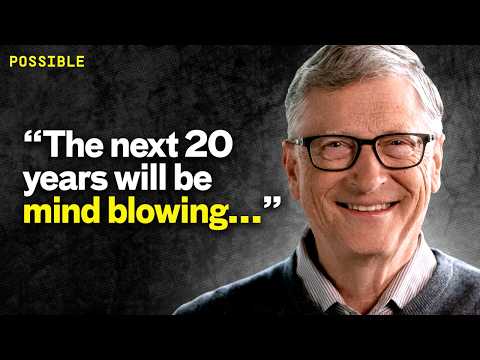
That is a very, very big deal in terms of, uh, the uplift that comes out of that. You know, on the energy side, things like either getting fission or fusion to provide both very cheap and constant, reliable electricity. You know, that's a longer time frame in, in the, the fusion case. So, but, you know, there's a ton of companies I'm invested in in five. So, deep understandings of complex science things, including all these diseases. This next 20 years is going to be mind-blowing. And actually knowing a little bit about the malnutrition, go the next level.
Depth on the bouillons and make it a little bit more tangible so people could say, oh my god, we're there now. Yeah, well, with malnutrition, if you don't get the right vitamins during pregnancy or in your first several years, you can never catch up. You know, so it's a sad fact, you don't get to go back and say, okay, eat your Wheaties, uh, and you get the IQ points and the, the physical capabilities. And it's weird that you're just missing small amounts of things like vitamin A and vitamin D. And so, how do you solve that? Well, you could fortify a food like US breakfast cereals are, are—
Fortified. But, you have to find some food that even the poorest households who are the most likely to be malnourished 'cause they're not getting eggs and, and milk and meat. Uh, and it turns out these bouillon cubes are preferably bought by low-income households because it gives them something tasty. And it's very cheap relative to how tasty it is. So, now we're going to put a lot of vitamins, particularly vitamin A, into that bouillon cube. It raises the price about 3% to do that. Something I love about what you do is you identify the problem, you bring data to it, you test it, figure out like, especially because you're working with populations who are low-income in Africa, the poorest of the—
Poor. Like, even if you're raising the price 3%, you have to build that into everything that's happening. And so, now we want to get into all of the different areas that you're focused on. And so, let's start with climate. Uh, I was lucky enough to have dinner with you and Reid and a few others a few weeks ago. And one of the interesting things you were talking about is you were saying how one of the interventions that we need to do is around cows. I feel like everyone sort of knows that maybe cows contribute to climate, but you were giving me very specific interventions that could move the needle. Could you talk more about those? Yeah, so there's basically two ways to help with cows. Cows are about 5% of global emissions, which is pretty unbelievable. Wild.
Uh, and if your goal is to get to zero, you, you don't get to skip the cows or the steel or the cement or, you know, any of, of those big areas. So, there's a whole class of solutions of making meat without cows. Uh, today, it doesn't taste as good and it costs too much. It's going through a little bit of a lull, but, you know, those companies, Impossible, Beyond, Memphis, and others, uh, are pursuing that. In terms of the cows, we actually have, we pursued many solutions. So, one is to vaccinate the cows in a way that their gut bi- bacteria that emit the methane,
Which is also called natural gas or CH4, which is the second most important greenhouse gas. You can vaccinate them and that species of bacteria isn't there. Their stomachs are very special because they can eat grass, you know, it's a three-stage, uh, fermentation process, basically. There's another way you can change what they eat and you could put either put that in their water or their feed. There is a drug to change the microbiome, not a vaccine, but a drug. That looks very promising. And then there's a solution where you stick a sort of a metal thing into the skin of the cow and it actually burns the—
Methane. And all of these look to be quite cheap and implementable even in Africa. And so I'm, you know, this is one where I wasn't hopeful when I got started a decade ago and now it's just a question which solution for which country ends up being the, the best. Yeah, it's some of the, it's similar amazing to like what you did with the toilet and all the rest is like doesn't look like it's possible, now it is and it makes a huge difference. One of the other funny things when we were talking about the discovery of the work around cows over the dinner table is once you focus on it, it's not just the systemic climate change, but it's also the questions about like, for example, what this can do for quality of life in Africa. Right, so say a little bit of
More about like milk production and cow breeds and other things, 'cause it's like I never thought Bill as the cow expert, but here we are. Well, I didn't grow up knowing much about cows. Uh, so, protein is a very important part of a good diet and foods with proteins tend to be very expensive. So, if you can make chickens and cows live longer and be more productive then that's super beneficial. So, the West has taken these cows, these Holsteins, and driven them up so they make 30 L of milk a day, whereas the normal cows, uh, make less than 3 L a day. So, you
Have this factor of 10 productivity through the genetics of that cow. Now, you can't just fly a Holstein down to Africa because the heat and the diseases, it's not adapted, but if you do the crossbreeding properly, only giving up a little bit of the productivity, say down to 20 L, still, still a factor of six better, you can improve those cows. You also take the idea of grazing where the cows are going out into areas that are now being fenced off and you can change it so the cows largely stationary and the food, which they call fodders, brought to the cows. So, you avoid these incredible conflicts between the, the grazers and the, the other farmers. And so it's one of the
Most exciting foundation things, and once we do the R&D and get those good cows in, it's private market sustainable. We're further along with chickens, you know. So I was in Ethiopia a few weeks ago, seen that we've cut the price of chickens in half. Women are the ones who do this, you know. They make extra money. They give some of the extra eggs to their kids as well as selling them. So, it's taking, but it's leveraged off of the West, you know, that's spent the last 100 years doing selective breeding of both chickens and cows. So, obviously when we're thinking about chickens and cows, it's climate change, it's malnutrition, it's potentially war
and conflict. If we zoom out on climate change, what is the sort of statistic that for you sort of represents the gravity of the situation or what are you working towards to decrease when you think about, you know, climate in general? Well, the size of the emissions, which is over 50 billion tons CO2 equivalent per year, and the pie chart of, okay, you know, what are the big five areas? You know, like transport is one of the big five, but then, you know, cars, planes, boats, trains underneath that, you know, electricity, which is coal, natural gas, industry, buildings, agriculture.
You know, I want everybody to have that pie chart in their head and, you know, the theory of change, which is that we need to make all those things without them costing more. You know, I always say there's two numbers: 50 billion and zero. Zero is what we want emissions to be, and zero is what we want the extra cost of green cement, green beef, green rice, you know, green car. We want it even at the low end where you park on the street because even if the world should pay a lot for green things, they won't because it's a global problem. The real problem is for
future generations. The negative impacts have been somewhat overstated for the current generation actually, but because it accumulates and gets worse over time, it causes us to help those future generations that, you know, it's not a terrible thing. The damage is mostly in poor countries. It's almost like people didn't realize weather's always been a problem, and they like, "Oh, every bad weather thing, that's climate." No, there was bad weather before, and it's slightly getting worse, but it's near the equator where your absolute temperatures defeat outdoor work and the current crops that we have. That's where you're getting into conditions that humans have
never thrived in. Well, on the electricity side, and we'll get to nuclear in a minute because you and I share a passion in that being a great source, and there's all kinds of things. One, the need for electricity. Second, you have good scalable clean cost-effective power, you can solve all kinds of ills. What are the other energy sources of renewables and green energy that are capturing your attention outside of nuclear? Well, of course, we want to keep driving solar to be cheaper. You know, that's gone way better than was expected, and there's some new things you've seen—perovskites that'll drive the efficiency up of that.
You know, we want to drive wind cost down including offshore wind, which is still quite a bit at a premium. We want to improve energy storage, but it's not realistic to think we'll completely solve that problem, which is why you need nuclear in the mix as well. Geothermal actually looks like it might play a role. You know, the western half of the United States actually has pretty good hot rocks, and then there's geothermal companies that want to dig really deep holes. That's more early stage, but Fervo and one other company are showing that they can actually get reasonably good
pricing and now they're scaling up. Google just did a purchase agreement at a premium to help them scale up, which is, you know, all the tech companies are very oriented towards not raising their emissions, which will take advantage of that to get these products onto a learning curve. You know, eventually we want to have a zero green premium, but somebody has to help get us there, which solar was very subsidized, and then under certain definitions has now gotten to a zero green premium. There's a few things like tidal that are probably pretty limited. You know, solar panels in space,
maybe, you know, some people have even talked about, "Okay, put the whole data center up there." It's just bits. Actually, moving bits from space to ground is easier than moving energy from space to ground. So, in particular, because launch costs are down, you can at least dream of those things. That's kind of a far-out thing, but, you know, should be in the portfolio of innovation. One of the things that I think that it's useful to highlight for most people is they like, for example, the current discussion of AI is always going to be all this electricity, but the investment that all the hyperscaler companies are putting into the kind of how we make clean data centers, how we have clean power and all the rest is like that subsidy for the
R&D, and these advanced purchase agreements are exactly the kind of thing where you kind of like different ways of conceptualizing public-private good. Yeah, I mean, I say that rich countries, rich companies, and rich individuals should bootstrap the market for these green products. You know, we should buy clean aviation fuels. Some nations may mandate that for private aviation, which that would definitely be a good thing because it would get the volume to go up so that eventually we can get something with either a zero or very low green premium into commercial aviation, which is another 6% of the emissions we have to get all the way to zero. So,
Yeah, the, the, and it's important to remember that all that data center demand, it's big numbers and it's coming quickly over the next six or seven years, but it's not as much as electric cars or electric heat pumps. So, we've, our climate solution, because you can't avoid using the energy somehow, the only non-hydrocarbon way we really know how to make energy is in a portable form is electricity. So, we get rid of coal and natural gas, but you have to make a lot more electricity to replace the either heating or industrial capacity that those direct hydrocarbons provided. And can you tell us a little more about solar? You were telling me actually
about the amazing increase in ability of solar panels and like what percentage of the sun they capture for energy, which was fascinating. But you also said that you don't think, you know, batteries aren't going to be here in time. Is it we just need more time to get to batteries where they are? The cost is too high? And I feel like not having the batteries we need is what is inhibiting solar from being the energy source that can save us all. Most places we should be adding solar as fast as we can. And we're actually, you know, limited by the grid capacity. So, I love solar. You know, the efficiency started out at like 10%. It's in the 20s now. It could get as high as 40 with new approaches over the particularly
perovskite over the next decade or so. But it's not just a 24-hour storage problem. Lithium-ion batteries are now sodium and others will solve your 24-hour problem. But you have periods of time like the Midwest gets a cold front where you get 10 or 12 days. All the batteries ever made in history for every car, every computer wouldn't store a day of electricity. And if you're only using a battery once a year, that is you charge it and it's sitting there for this unusual thing, that's super expensive electricity instead of getting the capital value out 365 times a year, you get it out once.
So, various seasonal and bad things where you don't want to shut off power, particularly if it's being used to heat homes, it's way more complicated than people think. Electricity doesn't move long distances today. It's mostly coal or natural gas plants that are fairly near to the usage. And yes, there's innovation in transmission, actually fairly exciting stuff. But we're going to have to have a mix, you know, and particularly if you look at a country like Japan where there's essentially almost no solar potential there. And even the wind has periods where you have too much or too little. The U.S. happens to be very
blessed. We have incredible wind and solar resources. And these open-source models that are now we're modeling out, okay, what does that energy system look like, are part of seeing, okay, when can we get there? And there's a lot of these goals that are not well thought through. It's going to be harder than we wished it would be. Well, one of the things that you already mentioned, gestured at before, is that part of the reason why we need nuclear fission and fusion is because of the fact that all these awesome renewables, solar, wind, hydro, etc. Well, hydro can do a little bit more
24, but yes, but they have limitations on when they generate and when they don't. And so, and then battery storage is a challenge. And so, you and I have invested in some fusion things together. Say a little bit about what's the hope and the possibilities for fusion. Fusion is where you take the big atoms like uranium, and as they split, you get energy. And fusion is where you take the small atoms, primarily hydrogen, as you put them together, you release energy. The middle of the periodic table is the most stable. And so, you're getting relativistic energy through that mass decrease.
Fusion is very difficult. It involves, you know, temperatures that are like the center of the sun, you know, millions of degrees. And so, that's plasma physics, which we know a lot more about. You know, we're using AI tools to study those things. And now there's a variety of techniques. Tokamak, which Commonwealth Fusion Systems is using, being the one with the most credible schedule for say 10 years from now. Most of the others are probably more like 15 years away. But at some point, fusion energy will be extremely cheap. And it doesn't have the same waste
problems that fission does. You know, I think those are solvable problems and I'm investing in that because that's more like a six-year time frame if everything went perfectly. So, we society as a whole, even though a lot more money's coming into it, we're still underinvesting in fusion. And fusion, given that the value of cheap electricity specifically is so fundamental to society. I mean, if, you know, somebody says, "You know, we have a water shortage." No, there's a lot of water. It just takes energy to move that water and desalinate it. So, if energy is cheap, you have infinite wonderful water everywhere in the world. But the
energy is too expensive right now to do that at scale. Even recycling things, you know, why can't we, you know, atoms don't leave the planet, tiny bit of hydrogen, but it's all there. And the reason we don't is that the energetic costs of restoring things to their original state is too high. Well, one of the, for our listeners, TerraPower, super awesome way of kind of actually using nuclear fission waste as fuel. And so, getting a compounding effect. It's one of the things that you guys have been working on for a number of years, maybe even 10. Is when the fission company TerraPower got started. Yeah, exactly. Now, one of the things
That always bemuses me about some of the current public dialogue around AI is like, "Oh, is this going to accelerate climate change because of the electricity cost?" And I think what, you know, most of these people are not realizing how we can also use AI to help us with climate. So, because it, it like if we can get a lot more intelligence applied to various problems, that can help us with climate. Say, say a little bit about how you're thinking in that arena. You know, the extra electricity load is, you know, it's there. But it's like a 10% add-on. You know, it'll challenge the way that we do green accounting a little bit. And I wish fission and fusion were sooner because this sort of gold rush.
For AI back-end capacity is kind of the next eight years. And even fusion will only be able to make a modest contribution in the 2030 time frame to that, uh, electricity supply. So, the value of AI in solving the scientific problems of, okay, how do you grow? How do you make plants more productive? Okay, you model photosynthesis and you model how you change the plant genetics in order to double the productivity. That's a very profound advance in improving photosynthetic efficiency. In fact, you know, because it's kind of a far-out.
Thing, the foundation is the primary funder of that. As we show that it can work, okay, other, other people will come into that. But anyway, AI for material science, uh, biology, it is a gigantic accelerator. So, take whatever green product you think's going to be the hardest to get to zero green premium, rethink how hard that's going to be because the AI tools are so phenomenal at accelerating all of these paths of innovation. Yeah, and actually one of the things I've been thinking about is like, while it's a big electricity cost for training these scale learning machines.
Once you have that intelligence, like, like that's how we've made everything. It's through intelligence. Once you have that intelligence that amplifies across the board, like applying that to climate change has got to be a, like there's got to be some multiplier effect of we get this much actual savings in carbon and other kinds of things through the application of this electricity. I, I don't know what the multiplier will end up being, but I'm certain it's there. No, it's absolutely there. There are some goals like not going to bubble 1.5°, that even with AI being a net positive contributor, because of the difficulty of scaling in all the areas and all the countries, uh, you know, some of those goals we will.
Miss. But we will avoid the level of heating that would be disastrous. And we will need to do some adaptation, particularly in poor countries. So, I want to switch gears. Another area where I think you're probably best known is global health. And I think it's an area where AI can do so much. And my husband is a public health data scientist, so he's particularly excited about this area of the interview. You have focused on the eradication of disease. And I think, but fact-check me, in 1980, the WHO declared that smallpox was eradicated. And that's the first and only disease that we have eradicated. You've said, "Let's tackle polio. Let's.
Tackle malaria." How do you pick what is the next disease you're going to tackle? Like, what an amazing ambition. And then, how do you go after it? Yeah, so most diseases we're going for a burden reduction. Only very few diseases should you try to go for eradication 'cause it's very, very hard to get to zero. And right now with polio, you know, we're in Afghanistan, we're in Gaza, we're in Somalia, we're in DRC. And, you know, we're having to execute high coverage vaccination campaigns against misinformation and violence in the toughest places in the.
World. So, it's very, very hard. Polio's close. There's one called guinea worm, which is confined to Africa, where, you know, President Carter just got to 100. He's been a champion of that. Uh, so, we're hoping he'll be alive not only, uh, to vote in the election, but also to come to the guinea worm celebration party. He's going to. It's going to take a couple of years. So, uh, he's going to have to hang on a little longer. So, the magic thing that happened at the turn of the century was people got serious about global health, about really measuring, okay, kids die of diarrhea, but what caused that diarrhea? They die of pneumonia, malaria. Okay, it's more clear what that.
Is. But, let's even though there's no market, the people who die of malaria happen in kids here. They, it's not like you can make a business case of, "Hey, go to Silicon Valley and do a malaria startup." And, you know, look at that spreadsheet. Uh, the line that says life saved will look good, but the line that says, uh, profit will have a lot of red numbers 'cause, uh, they can't afford these tools. So, medical science is very distorted towards rich world conditions. And even amongst rich world conditions towards cancer and, uh, a few other things. So, the incentive system is, you know, potential could be improved. But, the Gates Foundation, that's our place we come to fill in is that the things.
That aren't market driven, like getting diarrheal vaccines cheap enough for all the kids of the world, not just the rich kids who don't die of diarrhea, but the, that also used to be a half million, now down to 100,000. So, as we went from 10 million under five deaths per year in that at the turn of the century to 5 million, diarrhea was one of our best. Pneumonia, got a vaccine out for that, which was a very expensive vaccine that we worked with all the vaccine companies, Western and Asian to get those prices down. And so, we're kind of, we're basically driven by the inequity, where we say, "Why do mothers die in.
Childbirth 20 times as much in Africa? Why do kids die 50 times as much in their first 5 years in import countries, particularly Africa, but also Southeast Asia? And so, we're, you know, taking all of those and saying, "Okay, let's find the best scientists. Let's understand the field conditions. You know, is this stuff deliverable? Uh, will it be accepted?" You know, we have crazy ways of killing mosquitoes that that loan doesn't get rid of malaria, but if you treat a lot of humans and the re-infection rate has been massively reduced, then you can get to the point the US got to 'cause we had malaria, where you've
cleared during the low season, that's the, uh, winter here and the dry season there, you've actually cleared the parasites, so there's no humans, so there's no re-infection, uh, taking place. And, you know, in the next, hopefully well less than than 20 years, we have 5 years now we need to do the tools. So, our goal is to finish polio during this 5 years, and then with new tools get the credibility to get the world to fund, uh, a malaria eradication starting in 2030. Yeah, totally awesome. One of the other projects we work on together is AI in drug discovery. And so, this is one of the ones I think, uh, we may actually even begin to see, you know, some of the
earliest, you know, kind of global benefit from. So, where in what areas of AI drug discovery are you kind of most focused on and think can make a kind of a global health difference? Understanding protein and molecular shape space is a perfect AI problem because we have databases, the protein database that, you know, we have, uh, 150,000 molecules we know the shapes. And so, as we've trained AIs on those, their ability to predict the shapes and therefore the druggable sites in these proteins, uh, you know, that is accelerating medical discovery. There was actually a company called
Schrödinger that was doing it pre-AI, but now there might be 20 times as many people, uh, and, uh, progressing much faster because AI is, is very, very well suited to this. And eventually, AI won't just model the low level what the shape is, but it'll model the cell and the organ and the organism. And so, even complex disease dynamics, you know, it's beyond human understanding to map out all the different things that go on. The AI models, as you gather the data, which will be the limiting factor, will help you understand, you know, overnutrition,
malnutrition, uh, way better than we do today. So, you know, most things, put aside neurological, in the next 10 to 20 years, I would say the likelihood of dramatic, uh, medical advances, even in neurological, one thing, Alzheimer's, uh, I'd say those would be solved. And I love talking to these companies about, "Okay, which part of the problem they're solving?" I mean, one of the things that strikes me is I feel like it's super fashionable today to be, "Oh, the world is terrible. The world's a dumpster fire. It's getting worse. The past 30 years have been horrible. The next 20 are horrible." And yet, talking to you, I'm like, "No, stop." If we actually look at the data, things have been
getting better, especially in global health over the last 30 years. And often because of AI, the future's bright. There's so much that can happen. And you just sort of touched on not just sort of the technological progress, but also some of the sort of bureaucratic, some of the some of the other things that perhaps AI or or else can unlock. Are there things that AI can unlock that are just boring, administrative, or helping healthcare workers that aren't sort of about cutting-edge technology, but are other ways that AI can help in the public health field? You know, in the same way that the microcomputer revolution allowed me at a young age to think, "Okay, computing will be free. Therefore, what would an individual do
with free computing?" Uh, and, you know, Paul Allen and I kind of saw that and said, "Okay, software's the only thing that will hold that back." Whereas older people kind of thought, "Ooh, computers are expensive." And so, the idea of, "Oh, it'll be doing spreadsheets or word processor." They'd be like, "Are you kidding me?" Uh, that's just too expensive. Here, it's even more mind-blowing that you could say white-collar worker capability. And eventually, although robotics is still, uh, very specialized, eventually horizontal blue-collar productivity will be very inexpensive. So, you know, I take an MRI diagnosis that a friend has, and, you know,
ChatGPT does such a good job of explaining it, uh, you know, and showing, you know, where it got that material. The creativity, the fluency is kind of mind-blowing. And so, all of us should have this crutch of Yes, if you just want to know what fertilizer is, Wikipedia was good. But, if you want to know what a trip with a 16-year-old for 4 days with a budget of $4,000 to Italy in August looks like, nobody wrote that thing. But, the, the AI, uh, if it's connected up properly, it is mind-blowingly good at those things. So, we're already
all, you know, in our life of, uh, you know, writing poems or, uh, speeches or, uh, understanding or having complex material summarized, you know, we're already getting a, uh, a huge benefit. And you know, that, you know, a lot of white-collar work, uh, you know, should already be either more productive or, you know, drive towards, towards higher quality. So, actually, one of the things that this conversation's reminding me of that I haven't actually ever asked you is, you know, there was this decade or so of a lot of focus on personalized medicine. Where are we at currently on that? Is that improving? Is that Is the Is the
Promise of that turning out at all? I always am put off by people's fascination with n equals one medicines. Uh, you know, a half million kids die of malaria. You know, millions of people are diagnosed every year with Alzheimer's. So, I'm just the impersonalized medicine guy. I'm like, uh, you know, the world does not have the resources to do n equals one solutions. If some super rich person, you know, funds that, maybe it helps the scientific discovery path, but, you know, I couldn't bring myself to be involved with that because it's so
unjust to take finite resources. Eventually, yes. Understanding everyone's genetics and saying, "Okay, your drug dose is different because of this." Uh, and so, you know, I'm kind of taking a provocative position uh on this. The science that goes under that name is very good science. The people who work on that are very well-intended. It's just, you know, we have rare diseases. We've created such an incentive for them versus widespread conditions. We're not really, uh, allocating that effectively. Particularly, I mean, the insane stuff is the diseases of the poor countries.
So, can you actually say more about—You've traveled recently, Africa, Asia, all over—about the conditions of, with healthcare workers on the ground? What have you seen there and how can we help improve them? Well, people should understand that most people in sub-Saharan Africa never meet a doctor. Not when they're born, not when they're sick, not when they die. And so, this is not a doctor's thing. So, your image of healthcare—for most people in those countries—is primary healthcare. A modestly trained person who can give you some antibiotics, bed net, vaccines, very, very importantly, to give a, uh, pregnant women their prenatal
checks. You know, now we'll get an ultrasound evaluation and we'll see, "Okay, which 10% of pregnancies might be complicated?" And then the woman does need to get to somewhere where there's trained personnel who could do a C-section. So, we can see with this AI-trained ultrasound, is it going to be a complicated pregnancy? And the predictions are stunningly accurate. And go to all that trouble which you couldn't afford to do for all pregnancies. And, you know, so the greatest shortage of doctors in the world is there. And so, the idea that in native language through your smartphone—which, okay, not everybody has—but time's on our side
uh, even in the poor countries on this, you will get health advice. And a lot of the diagnostic tools will be available at a point of care where individuals, you know, can take. A lot of people experience this with lateral flow COVID tests. You know, now we're trying to convert those to be, uh, point of care, but, uh, molecular tests and still super cheap, but also more, more sensitive, more, uh, accurate. And so, healthcare is, you know, it's in a—we only have $100 per person per year versus in the U.S. where we spend $15,000 per person per
year. So, it's, you know, it's a 150 times difference. And, you know, in fact, there is triage involved in, "Okay, which thing should you treat?" Now, even things like blood pressure, cholesterol, obesity, my hope is that not only are the cost of those treatments going down, we're also going to put them into forms where it's like yearly dosing. And so, the cost and the delivery system of getting GLP-1 to all Africans, you know, 10, 15 years from now, you know, we'll be able to do that. So, in addition to the elevation
of humanity through all forms of kind of global medicine and what is actually, in fact, healthcare, uh, education is another area that you and the, and the, um, foundation work on intensely. And, you know, obviously, people have encountered AI a lot with this. You know, it's kind of like, you know, what is what does it mean? Um, what are some of the, the kind of maybe more surprising or other kinds of use of AI in education, whether it's, you know, kind of globally available tutors or other kinds of—What are some of the AI for education for the world that's kind of captured some of your attention? Well, I think the first thing to admit is that
tech lovers like myself have talked about the benefit of technology being used in education for our whole career. And the actual benefit for the average student has been very, very modest. If you're a motivated student who can get on Khan Academy 2 hours a night or watch YouTube videos about photosynthesis, wow, you know, people like ourselves, we are able to learn in a way that's unprecedented. You know, there's a company called The Great Courses where I, when I'm on the treadmill, I love watching uh those things. Just so much great stuff out there. But the current math achievement
of a high school graduate in the U.S. is not better than 100 years ago. It's not like medicine, uh, where there's new tools, new understanding. If I said, "Oh, in 1900, the best math teacher was then," you couldn't contradict me because it may be true. And so, we've done a lot and, you know, I'm a believer. But AI, because of the fluency and personalization, I think we we can have very high aspirations of how we mix social experience in the classroom, experiences with the teacher, and working on your own that correcting your pronunciation as you read things,
immediately telling you, "No, you didn't get this math problem right." You know, not turning in homework so 2 days later after the poor teacher spent all this time, you're like, "Well, was that a manipulation error? Or was that a conceptual understanding error?" The AI, uh, Khan Amigo is on the cutting edge of this, but there's others like CK-12 Mini that it'll say, "Yes, you—those two minuses, you didn't cancel those uh properly as opposed to, no, you set the problem up wrong because, you know, these two trains, you didn't get the—when they pass each other algebraic equation properly." And, you know, so the idea that it will
Learn how a tutor keeps students motivated, you know, using the domain like sports or health or construction that the student can relate to. The promise of having fantastic personal tutors in the inner-city US and in poor countries is super exciting. And you know, talk about an area that's underfunded, you know, global education is. And the magic formula for countries uplifting themselves is to have good health and good education, and then their economy grows, their tax collection grows, and they're very self-sufficient. And that's, you know, why we want to help countries get out of the poverty trap.
Not because it's an endless guilt thing, but if we help them get there, not only morally, but economically, stability, many good things flow from those countries being well off. Global education is a very underdeveloped field, but particularly now with AI, you know, I'm encouraging philanthropists to get in and showing that there are things like structured pedagogy, where the teachers are given a very clear way of teaching that we are seeing some very good results. You know, I really appreciate. I think some people are like, "Oh, the boy who cried wolf." It's like, "You told me 20 years ago that MOOCs were
going to do it or that whatever." And so, you know, people are skeptical. It's like, are we, you know, are we finally there? Can you tell us more about the First Avenue Elementary School in Newark? And obviously, you're super concerned about equity. Is this something that is replicable that could scale? Well, so I love Khan Academy, but it was mostly used by motivated students. And so, for the last, I think it's like eight years, they've been saying, "Okay, how do we get into the classroom? How do we work with the teachers, explain the stuff?" You know, yes, the computers, the internet stuff is getting more pervasive. The pandemic actually helped a bit with that. So, Sal and I were among the first two people who OpenAI was nice enough to
let us mess around with early ChatGPT-4. And a lot of the cool things like having it write songs and poems. Actually, Sal taught me that stuff. I was like, I wouldn't have known to ask. It can write like Shakespeare? Wow. And so, he has put a lot of Khan resources in. He gets support from the Gates Foundation and many others. Has created this Khan Amigo. And he last school year had it in a small number of schools, but including this New Jersey, Newark, New Jersey school. And so, I went there to meet the teachers, to meet the students, and see, you know, so you
meet a kid who clearly is ahead of his class. And sort of the factory-based model of, you know, 30 kids in a classroom, you definitely have a problem where you need to do remediation and catch kids up. But it also, you're also pained by that kid who's ahead, you know, and maybe checking out or being disruptive. And yet, you know, you think, "Wow, we want to drive that." So, the personal tutor aspect allows that student to sometimes be off on his own, sometimes helping the other students, and this, you know, Khan dashboard along with the Khan Amigo, which is seen, you know, so when you walk in and you're teaching the
morning, instead of people handing in homework you have to deal with that, you just go to your dashboard and say, okay, who connected in last night? How many hints did they need? How far did they get in the progression? And, you know, you're giving feedback, you know, you can have the parents connected up to that. Even the thing where a paper gets turned in, you don't turn in the paper, you turn in the AI session. So, you can just say to the AI, okay, how much did the student do? What's your suggestion on how we get them to either help with the first draft or help with the grammar or the logic? So, it's great to see it being there and
seeing it in person reminded me of embedding it in and always with teachers, whenever you have some new thing, there's maybe 10% of the teachers that latch onto it and you get these great results, and then when you tell the other 90% you must use this, those results almost always just disappear. And so, okay, how do we make this one that scales, you know, so that humility of how far we haven't come is even with AI, we will have to do that. But what I saw made me even more optimistic. So, one of the things that people sometimes miss about the approach that you and the foundation bring to these problems is, you know,
not just quantification of like, okay, cost per life saved, etc., but also the systems thinking. And so, what are some of the kind of non-tech-related levers for change in education? Like, what are some policy things that either we as Americans or, you know, the world should be thinking about to improve education? And there's a lot of very good data about not having cell phones in the school and, you know, some great work going on there. There's very good data about boys should probably start later than they do. School day should start later. There's all the learning out of the charter school movement, which it's hard
stop because it shows that long school day, long school year are incredibly beneficial, engaging the parents in a, you know, here's where your kid's having challenge and communicating with them, although these digital tools are going to make that far easier for the parents who want to engage in that. You know, we're seeing now in communities where there are charters, though most of the kids are in the public schools, those public schools essentially compete. They either adopt those practices or find their own ways. So, we're, you know, there are places like New Orleans or DC or Austin where school performance is up. You know, so we ought to make sure that even as we
Try to put AI into this. Some of those learnings are incorporated. I mean, amen. As a mother of three boys, I'm like, how are they going to compete with the girls? What is happening? So, to switch gears from education, I think I'm going to steal one of your own questions, which is, if you had the opportunity to meet with someone from the year 2100, what would your questions be for them? Wow, how did you deal with the AI challenge opportunity? You know, did... You know, you said earlier that I have this view that life is improving, which is objectively true. There's always footnotes like nuclear weapons, bioterrorism, and now AI needs to be
added to that list, but, you know, the past 50 years life in general, if you're a woman, if you're gay, I mean, it's kind of sad, in a way, that because we're so problem-oriented, we're not very reflective about, hey, 5 million kids a year aren't dying. You know, like you meet with climate people and they say, "Oh no, climate's going to ruin the world." Do you think you're going to go back to 10 million a year dying? No way. You're not going to go back. It is a super big headwind because of the impacts on agriculture. So, you know, I bring my "hey, the world is pretty good," but that 2100 person, I hope to hear how they avoided... I'll
call it the four footnotes: AI, nuclear weapons, bioterror weapons, and polarization. You know, people being able to get along and cooperate, including in how governance adapts. You know, which AI will force governance to come up with different ways of taxing people and regulating things. And it's a little scary that it's happening at a time when the broad trust in government is at a very low point, both relatively and absolutely. What are some of the things that you think people should anticipate coming with AI in the next three to five years? Well,
it's so mind-blowing, you know, sometimes it's hard to get your head around it. No one expected the white-collar thing to come before the blue-collar thing. You know, so in Life 3.0, they have these hills where the computers are doing the easy things and, you know, warehouse work, which we can't yet do, was down there in the lowlands and helping diagnose, you know, was way up the hill or writing legal briefs or code. Uh, and so, we're surprised at that order, but, you know, the so-called blue-collar horse on a robot that can be told, you know, "Go to this construction site and help, go to this restaurant, go to this hotel and clean the rooms," you know, even if the price is such that in
the home it only drops by for an hour, uh, doesn't live there at first. You know, those things are, I believe, within—within easily within the next decade. Huh. Well, and actually going back to your original vision of a PC on every desk with software that would help people do their work and lives and so forth. What do you think is going to come now? I—I think a lot of people haven't realized that part of what's happening with current AI is essentially the largest programming language will be natural language, e.g., English, and everyone will have a coding assistant, not just a PC, but a coding assistant. What do you think going back to those kind of earliest—what do you—how do you think that will
transform the world? Well, the ability to navigate data, you know, which a long time ago you had to have some IT guy write a thing and, you know, "Okay, what's the header and footer?" and, you know, report. There's a thing called RPG—report generation language, you know, and COBOL, you have this section in the picture. Anyway, you know, a lot of that stuff is so obse—obsolete, it—it just makes you laugh. The idea you can sit down and engage in a dialogue about data in a very rich way means that, you know, our ability to run businesses better, you know, understand bottlenecks, adapt to changing things
will be so incredible, and it won't require custom software. And in fact, the whole complexion of the software market—how many applications will there be? You know, at first what we have is everybody adding AI to every application and saying, "Okay, pay me extra 'cause now I got a little AI." But, in fact, the number of applications you need, you know, think of a college which has a scheduling app, a finance app, a support-the-student app, you know, that should all be one thing that every encounter with the student to the college is all, uh, maintained in a rich way. So, the software—software applications will be very different, and I'm,
you know, trying to figure out, okay, how quickly does that happen? It's incredibly beneficial that this software is more adapting to you, including creating user interfaces dynamically, than you going, "Okay, I use this software package for this," and then I go to this website and do this. You're a low-level clerk, you know, even looking at your email, the email is so stupid that you have to figure it out. It only can time-sort the order. It doesn't know what's important. And then you have your messages and you have to go back and forth, and you're the one who puts it in little folders and things. I mean, the—I thought the semantic level of interaction with the computer would be higher by now, even without AI. But now, with AI,
the idea that the very high-level tasks that I'm doing, you know, "I'm working on my budget, I'm considering buying a new home," that it will be working with you, not at the spreadsheet cell level, but at the, "Oh, you know, let's break this task down in a high-level form. Here's what I can automatically go and and do for you." It's, you know, super revolutionary. You know, we'll all have an agent that is a utilitarian, helps you get things done. You know, it reads everything you read, but the things you meant to read, uh, it reads, uh, and then, you know, your agent can figure out, okay, which parts of
That are important enough to take your time to understand. We are now switching to rapid fire. I'll let Reid ask the first question. Is there a movie, song, or book that fills you with optimism for the future? Well, The Better Angels of Our Nature, Steven Pinker, sort of documents how violent death in a lifespan, education have gone. And, you know, there's some lessons of why we've done well. Doesn't guarantee, and he doesn't say that's the future, but you know, if you have one book which
should get you back into the mindset of, okay, how far have we come, what should we feel good about, I, I'd recommend that one. Fabulous. And what is a question that you wish people asked you more often? How does malnutrition work? Uh, yeah. And I, I a lot of things I think about are boring and we should solve without most people having to ever figure out toilets and nuclear reactors and, um, you know, understanding disease, I'm surprised people aren't more curious, you know? When I first said, "What do kids die of?" I had a hard time finding out and I would have thought, "Well, isn't shouldn't we all be asking that
kind of thing? Uh, it's more important than GDP." Exactly. I love it. Um, so, where do you see progress or momentum outside of your industry? Of course, that's very broad that inspires you. Well, when India's an example of a country where although there's plenty of things that are difficult there, the health, nutrition, education is improving and they're stable enough and generating their own government revenue enough that it's very likely that 20 years from now people will be dramatically better off. And it's kind of a laboratory to try things that then once you prove them out in India, you can take to other places. And so,
our biggest non-US office for the foundation is in is in India and the most number of pilot rollout things we're doing anywhere in the world are with partners in India. You know, if you go there and you've never been, you might think, "Well, this is a chaotic place." Uh, and, you know, you're not used to so many levels of income all being on the street at the same time, but you, you will get a sense of the vibrancy. Mhm. All right, last question. Can you leave us with a final thought about what is possible to achieve if everything breaks our way in the next 15 years and what's the first step to get there? The potential positive path is so good that it will force us to rethink
how should we use our time? You know, you can almost call it a new religion or a new philosophy of, okay, how do we stay connected with each other, not addicted to these things that will make video games look like, uh, nothing in terms of the attractiveness of, uh, spending time on them. So, it's fascinating that we will the issues of, you know, disease and enough food, of climate if things go well those will largely become solved problems. And, you know, so the next generation does get to say, "Okay, given that some things that were massively in shortage are now not,
how do, how do we take advantage of that? You know, do we ban AI being used in certain endeavors so that humans get, uh, some, you know, you know, like you don't want robots playing baseball, probably. Uh, 'cause they'll be too good. Uh, so, we'll, we'll keep them off, yeah, the field. Okay, how broadly would you go with that? I mean, we are so used to this shortage world that, you know, I, I, I hope I get to see how we start to rethink these deep meaning questions. Bill, a tour de force. Thank you. Yeah, great talking to you. Possible is produced by Wonder Media
Network. It's hosted by Ari Finger and me, Reid Hoffman. Our showrunner is Shawn Young. Possible is produced by Katie Sanders, Edie Allard, Sarah Schleed, Adrian Bain, and Paloma Moreno Jimenez. Jenny Kaplan is our executive producer and editor. Special thanks to Surya Yalamanchili, Saida Sapieva, Ian Ellis, Greg Biato, Parth Patel, and Ben Relles. And a big thanks to Aubrey Bogdanovich, Ian Saunders, Christie Anthony, Alex Reed, Jen Krajicek, David Sanger, Larry Cohen, Alicia Sammond, Shawn Simmons, Denali Wieraman, Andrea Draymer, John Rider, the whole team at Gates Ventures,
and Little Monster Media Company.
From YouTube captions, lightly punctuated for readability. Timestamps link to the video above. Errors are possible.
Cite this recording
Reid Hoffman, “Possible podcast interview (2024)”, 2024. Transcript and video: Thinkers Archive, https://thinkersarchive.com/reid-hoffman/ai-climate-global-health-possible-2024/
Quoting a passage? Link to its exact moment: every timestamp above has its own anchor (for example https://thinkersarchive.com/reid-hoffman/ai-climate-global-health-possible-2024/#t-133).