Reid Hoffman on Future Of Work
Reid Hoffman sees the future of work as a long transition from fixed jobs to AI-amplified, networked work where people gain leverage by using copilots, building judgment, and doubling down on human skills.
- AI is mainly an amplification technology, not just a replacement machine.
- Work will shift toward people directing AI systems rather than working alone.
- Emotional, contextual, and human-centered skills should hold up better than formulaic work.
- Careers will depend even more on networks, identity, and continuous learning.
- The goal is not to freeze change but to steer it toward more opportunity and better futures.

“I don't think we'll have individual human contributors anymore.”Bernard Marr podcast interview, 2024 · 28:37
AI changes work by amplifying people first
Hoffman’s starting point is that AI should be understood as a tool that expands what people can do, not only as a machine that substitutes for labor. He describes it as human amplification and even as a general-purpose layer that can sit on top of many kinds of tasks, from research to scheduling to spreadsheet work.13
That leads him to frame the current moment less as a single automation shock and more as a long cognitive industrial revolution. The important question is not the exact date of AGI, but how society and institutions adapt over the next decade or two as these tools spread into everyday work.456
The job does not disappear; the shape of the job changes
Hoffman expects many professions to be reconfigured around AI assistance. In knowledge work, the near-term pattern is not one model doing everything, but people working with agents, copilots, and mixes of models that help with analysis, drafting, checking, and escalation.78
He repeatedly points to software, law, medicine, and other expert fields as places where AI will serve as a second opinion and cross-checking system. His practical stance is that these tools will keep improving quickly, so the real advantage goes to workers and firms that learn how to use them now rather than waiting for some final version.101112
This is why he argues for strategic optimism. Better outcomes come from aiming at useful applications and redesigning workflows around them, not from trying to avoid all change.135
“I don't think we'll have individual human contributors anymore.”Bernard Marr podcast interview, 2024 · full transcript →
Human advantage moves toward emotion, context, and judgment
Hoffman thinks work rooted in emotion, relationships, and human presence will be more resilient than work that is mainly factual, symbolic, or formulaic. That does not mean those fields are untouched, but it does mean the comparative advantage of humans shifts toward interpretation, trust, motivation, and lived interaction.1415
His advice follows directly from that view: develop emotional skills. If he were preparing a child for this future, he would put extra emphasis there, because those capacities are less easily reduced to pattern completion and more central to many valuable roles.16
He also warns that judgment itself can atrophy if people hand over too many decisions. AI can provide valuable navigational advice, but overreliance is a real risk, so strong workers will need to combine AI assistance with independent evaluation.1718
The winning worker learns continuously and uses AI directly
Hoffman’s practical advice is not to stand back from AI, but to use it for real work and learning. He favors teaching people to become competent with these systems early, because using AI to learn and produce is itself becoming a core professional skill.319
This matters because the tools are improving rapidly. If the systems available today are the weakest people will ever use, then waiting for stability is the wrong strategy; adaptation and experimentation become part of career resilience.1011
He also sees AI as a meta-tool that helps across many interfaces of work rather than in one narrow task. That implies the future worker is not just a specialist in one tool, but someone who can orchestrate AI across communication, research, analysis, and execution.
Careers become more networked, participatory, and self-directed
Hoffman’s older career view fits neatly with his AI view: the traditional escalator is weaker, and opportunity increasingly comes through networks. He urges people to act like the intrapreneur of their own life, because work is less about fitting into one static ladder and more about navigating changing opportunities through relationships and reputation.202122
He also thinks better labor-market navigation depends on rich data from real participation. When skills, relationships, and work histories are semantically rich, people can better understand what to learn, what jobs need, and where they may fit next.2324
That means future-of-work success is not only about raw technical skill. It also depends on being legible to networks, learning in public enough to create opportunity, and using trusted connections to make better decisions than search alone can provide.2125

“…be the intrapreneur of your own life…”TED talk, 2015 · full transcript →
The social challenge is creating opportunity fast enough
Hoffman does not think the answer to labor disruption is simply slowing technology down. He argues that social strain grows when people do not see new opportunities, which is why he links healthy politics and social stability to the creation of jobs, mobility, and visible futures.2627
That is why he focuses on steering toward good futures instead of obsessing over a single timeline question. The issue is how to organize society so AI expands access to help in education, legal support, health, government services, and other domains, while preserving trust and discernment.13528
In his view, the future of work is therefore a design problem as much as a technology problem: build tools people can trust, spread the gains broadly, and create more pathways into meaningful, higher-leverage work.29273
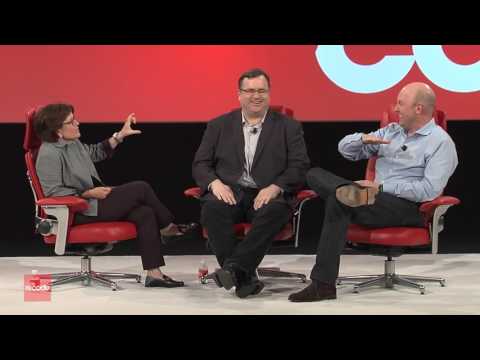
“We don't have enough change. We don't have enough change. We don't have enough creation of new jobs. We don't have the creation of new opportunities, which is what, in my view, goes right back to the politics. It's what leads to zero-sum politics. The reason our politics is going sideways is not because there's too much change, because there's not enough change. Because people don't see a future. Because they don't see anything changing. And I think you see the zero-sum politics. You see that sense on both the left, right, with you on the Bernie lap and on the Trump right. I think that's the problem. The way through that is not to slow down. The way through that is to speed up, right? The way through that is more change, more growth, more opportunity, right? That's the path forward.”Code Conference panel interview, 2016 · full transcript →
Hoffman on future of work, in his own words
“I don't think we'll have individual human contributors anymore.”
“…everybody wants to be lazier and richer…”
“…be the intrapreneur of your own life…”
Where to watch
 Reid Hoffman on AI and Work: Superagency, Jobs, and the Future2024 · 48 min · full transcriptBest single overview of how Hoffman thinks AI will reshape jobs, agents, and everyday professional work.
 Reid Hoffman on Human Amplification: AI as a Cognitive Industrial Revolution2023 · 78 min · full transcriptBest for his core framework that AI is human amplification and a cognitive industrial revolution.
 Reid Hoffman on AI and Human Flourishing: What Comes Next2024 · 59 min · full transcriptBest for which kinds of work look more resilient, especially emotional and human-centered roles.
 Reid Hoffman on AI Future: Superagency, Trust, and Safety2024 · 69 min · full transcriptBest for his practical case that people should use AI now for learning, coding, research, and work.
 Reid Hoffman on Network Literacy: How to Live in the Networked Age2015 · 21 min · full transcriptBest for understanding how careers become networked and why opportunity increasingly flows through relationships.
 Reid Hoffman on Data and Web 3: Why Participation Matters2017 · 30 min · full transcriptBest for how skills data and participation can help people navigate learning and job transitions.
Questions people ask
- What did Reid Hoffman say about AI as a meta-tool?
- What did Reid Hoffman say about how students should use AI in school?
- What did Reid Hoffman say about people overrelying on AI?
- What did Reid Hoffman say is the deeper problem with social media and fake news?
- What did Reid Hoffman say is the real problem with jobs and politics?
- What did Reid Hoffman say about technology, opportunity, and the social responsibility of tech companies?
Sources
Every quote above, word for word from the transcripts. Numbers match the text.
“…one of the things that is too often not described of what's going on with artificial intelligence is human amplification…”
“I think AI is one of the most amazing tools I think ever created in this sector.”
“…the steam engine of the mind…”
“Well, I'm not sure if whether AGI comes in 18 [snorts and clears throat] months or 6 years, it really isn't going to make much difference. So, I think we should just sort of say, you know, it's coming fast and how do we want society to be? What do we imagine in 10 or 20 years, you know? Sort of get over the idea of like the the the intensity of of how fast it's happening to it's here. And what will we do and how does it work…”
“But I think that it's a cognitive industrial revolution. You do have time to it out and figure this stuff out, but expect dynamic change. All right. Well, thank you, Reid. It's amazing what you shared with us. Thank you so much for taking your time and [INAUDIBLE]. (applause)”
“I don't think we'll have individual human contributors anymore.”
“And so, what I think you're going to see is networks of models and like kind of traffic control and escalation and all the rest. And agents are not going to be one model. They're going to be blends of models. And that's one of the reasons why you say, well, there's actually in fact a lot of lot of room for startups because it's not like we say, well, we take GPD seven and we just serve it for everything. It's going to be super expensive and there's a whole bunch of things about like serving it more cheaply and like for example, one of the really great technical papers that I love from Microsoft is, you know, all you need is textbooks. It's like you can you can train very specific models on kind of like high quality data along with by the way the larger model helping train it that all of a sudden you have a functional smaller model. And you know, the question will be a blends of these things. So I think the multi model model approach is I think gonna be you know, quickly universal.”
“…the worst AI you're ever going to use is the AI you're using today…”
“…the worst AI you're ever going to use is the AI you're using today.”
“The future is already here. It's unevenly distributed.”
“You don't get to the good futures by steering away from the bad bad ones.”
“Anything that lives in the emotional realm will be impacted not as much by AI…”
“I think we'll not watch robots playing basketball…”
“If I had a three-year-old today, I would be like doubling down on the emotional skills.”
“And for example, we already see that on a bunch of stuff on the internet. I found this on the internet. It must be true. You're like, well, I hate to break it to you. And so similarly, the question will be as it produces more and more valuable, reliable navigational advice, you'll tend to say, well, that's just the thing I should do. And that will be a challenge, is overreliance will be a challenge that we'll have to navigate. I mean, can you imagine. Is this a net bad thing, a net good thing if people start delegating a lot of their decisions to an AI for them. Does that free them up to spend the remaining brainpower on more important things? Or do they become like robots? Well, I think the important thing-- and this is part of why the dialogue is important-- the important thing is, what's the way that we should be training these agents so that they're helping human beings get to their better lives, their better selves?”
“…science is the belief in the ignorance of experts…”
“You do probably. Only with AI. That's right. And go, oh, I can, I can, I can now learn it much better. And that helps me understand quantum computing and other kinds of things. And, and that kind of thing is that, using the tools to be learning and to be producing is, I think, what's really key. And so like about, you know, if I were a parent with a kid in school and the and the score like we're banning, you know, ChatGPT, I'd be like, no, no, no, use it, teach it. Trick competence in it, create learning in it. That's what's really important.”
“…be the intrapreneur of your own life…”
“Your network is what connects you to different opportunities.”
“The startup of you is both singular and plural of the word you.”
“…everyone's going to be online, everyone's going to have the real identity, everyone's going to have the real relationships…”
“…it's not just big data, it's semantically rich…”
“You are who you know shapes who you are.”
“We don't have enough change. We don't have enough change. We don't have enough creation of new jobs. We don't have the creation of new opportunities, which is what, in my view, goes right back to the politics. It's what leads to zero-sum politics. The reason our politics is going sideways is not because there's too much change, because there's not enough change. Because people don't see a future. Because they don't see anything changing. And I think you see the zero-sum politics. You see that sense on both the left, right, with you on the Bernie lap and on the Trump right. I think that's the problem. The way through that is not to slow down. The way through that is to speed up, right? The way through that is more change, more growth, more opportunity, right? That's the path forward.”
“So I think there is, I think there is responsibility, I think it's a growing sense of it, and I think people are trying to figure out what it means and how to operationalize it the right way. And then personally, you know, it's everything from obviously part of the question that, that, that led to the election of Donald Trump, is there's a lot of people in a number of states that are feeling in pain. They worry that their children have less good features than they had. There is, you know, kind of serious opioid epidemics in a number of different states and regions, and they say, look, these need to be fixed. Don't tell us more of the same. Tell us how we have opportunity. Tell us how we make that happen. And I think, you know, part of the thing about being inventive, being problem solvers, you know, because that's part of what we try to do with technology and businesses. And so it is, we should do more of that now, I think.”
“And obviously, I am less focused at the moment on questions around autoplay or kind of equivalent, and I'm more focused on questions about like how do we get to discernment of truths and how do we get, like, you know, truth in the media, and what is this whole fake news and all, you know, facts and all that kind of stuff. And that is, I think, a much more deep issue that I'm focused on at the moment.”
“I don't think there is any such thing as an alternative fact.”
How this guide was made: drafted with AI from the full transcripts of the recordings cited, then checked: every quotation must match a transcript word for word and be the speaker's own words, and an independent review gates accuracy. Methodology and corrections.

