Oprah Winfrey on Media & Television
Oprah Winfrey sees television as a platform for truth, human connection, and self-ownership—one that should help people feel seen, less alone, and more able to change their lives.
- Television was not the goal; it became the instrument she chose to use with purpose.
- Great media starts with truth, empathy, and the humanity of the people in the story.
- She built her show by betting on herself and owning the platform, not just appearing on it.
- Her standard for television was practical impact: viewers should feel less alone and more able to change their lives.
- Media has a civic duty to resist falsehood and become a trustworthy gatekeeper in a noisy environment.

Television was her tool, not her identity
Oprah describes her path into media as something she grew into rather than something she plotted from the start. She began by following what felt true and by recognizing where her natural way of connecting with people actually worked. That is why her view of television is deeply practical: the medium matters because of what it lets you do for people.123
Over time, she came to see that her real work was larger than the job title of host. The platform looked like a talk show, films, and a network, but she says the deeper purpose was to connect people to themselves and elevate consciousness. In her view, television is valuable when it serves that larger human purpose.456
She built lasting media power by owning the platform
A major part of Oprah’s media philosophy is that creators should not only perform inside a system; they should also understand who controls the system. She credits early belief from others as foundational, but she also emphasizes the turning point when she chose to take the show national and own it. That decision was unusual at the time and became central to how she shaped her work.789
What stands out is that ownership, for her, was not mainly about status. It was a form of self-trust and responsibility. She frames the leap as betting on herself, which fits her broader belief that preparation must meet opportunity and that people should keep asking for the next right move.7102
Her best television starts with everyday people and real feeling
Oprah’s programming instincts lean toward stories that help ordinary people recognize themselves. She recalls choosing a show with everyday people and treating that as the right call, and she ties the success of her work to a consistent thread: viewers should leave understanding they are not alone. This is a clear standard for what she thinks television should do at its best.1112
That same instinct explains why conversation works so well in her hands. She is trying to create recognition, not distance—to make private struggles discussable and to turn public storytelling into personal permission for change. Television, in this sense, becomes a bridge between one person’s experience and millions of viewers who need language for their own lives.124
Truth is the moral center of media
Oprah treats truth-telling as the highest responsibility in media. She says speaking your truth is the most powerful tool people have, and she extends that belief to the press more broadly. For her, media is not just a business of attention; it is a public trust.1314
That is why she speaks so strongly about journalism and communication in an era of misinformation. She urges communicators to become new editorial gatekeepers and insists that truth both clears and confronts: it can protect, expose, and move people to act. Her standard is not neutrality as passivity, but credibility built through courage and factual integrity.1516
Good interviewing gets beneath headlines to motive, structure, and humanity
Oprah’s approach to interviewing is visible in how she frames major public conversations. She looks for the question beneath the spectacle—the one that reveals motive and meaning rather than just reaction. In the royal family interview, she identifies the central question as why they left, which shows her preference for root causes over gossip.17
She also tries to separate personal relationships from larger systems and to make conflict understandable in human terms. Her comments about the difference between family and institution, about long preparation before public action, and about the pain of false narratives all show a method: clarify structure, test the public story, and translate the situation into terms ordinary people can recognize from their own lives.181920
That method matches her broader belief that storytellers should capture humanity. The point of media is not simply to extract revelations but to help audiences understand what it feels like to live inside a story.21
Representation matters because someone is always watching
Oprah sees television as a place where possibility becomes visible. She remembers what it meant to see Black excellence recognized on screen, and she connects that experience to the girls watching her now. Media, in her view, does not just reflect culture; it expands what people believe is possible for themselves.2223
This is one reason she links storytelling with responsibility. When television tells the truth about how people live, suffer, hope, and overcome, it gives viewers both recognition and direction. That combination of visibility and honesty is part of how media can change a culture.242521
Oprah on media & television, in her own words
“I am going to use television…”
“If you can capture the humanity of people, if you can just capture the humanity of the people of the stories that you're telling, you then get that much closer to your own humanity…”
Where to watch
 Oprah Winfrey on Gratitude and Self-Belief: The road to national TV2010 · 40 min · full transcriptBest for understanding how she built national television power by betting on herself, choosing ownership, and defining the show's purpose.
 Oprah Winfrey on Truth and Purpose: USC Annenberg Commencement Advice2018 · 23 min · full transcriptBest for her clearest statement of media’s duty: truth-seeking, credible storytelling, and humane editorial judgment.
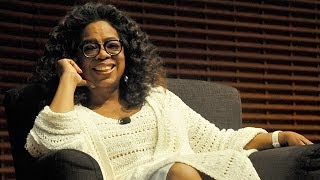 Oprah Winfrey on Purpose & Calling: Listen to Your Inner Voice2014 · 64 min · full transcriptBest for seeing how she reframed television from a career outcome into a purpose-driven instrument.
 Oprah Winfrey on the Royal Family Interview: Why They Spoke Out2021 · 85 min · full transcriptBest for watching her interviewing method: identify the real question, challenge false narratives, and separate people from institutions.
 Oprah Winfrey on Speaking Your Truth: "A new day is on the horizon"2018 · 9 min · full transcriptBest for her view that media should amplify truth, representation, and the courage to speak publicly.
Questions people ask
- What did Oprah Winfrey say about betting on herself and owning her show?
- What did Oprah Winfrey say about saying me too?
- What did Oprah Winfrey say about speaking your truth?
- What did Oprah Winfrey say her real purpose is?
- What did Oprah Winfrey say was the purpose of The Oprah Winfrey Show?
- Why did Oprah Winfrey decide to do a show about everyday people?
Sources
Every quote above, word for word from the transcripts. Numbers match the text.
“I am going to use television…”
“…what is the next right move…”
“Mine would be, actually. Mine wouldn't be lean in. It would be, step up and into yourself, because, this is the truth. There is no real doing in the world, without being first. For me, being. Your presence, your connection to yourself, and that which is greater than yourself, is far more important than what you do. But also, is the thing that fuels what you do.”
“And what I realized my contributions to the planet could be. And what my real contribution is, it looks like I'm a, I was a talk show host. It looks like, you know, I'm in the movies. It looks like, you know, I have a network. But my real contribution, the reason why I'm here, is to help connect people to themselves. And the higher ideas of consciousness. I'm here to help raise consciousness. So my television platform, was to help raise consciousness. At the beginning I didn't realize that. I thought, oh my God, I got a show!”
“…you have to know what sparks the light in you so that you, in your own way, can illuminate the world…”
“Everybody wants to fulfill the highest, truest expression of yourself as a human being…”
“His belief in me gave me the foundation that would become The Oprah Winfrey Show. And I, I have to say, I didn't take one minute of it for granted. I live in just, yeah, deep gratitude for the privilege and opportunity that he gave me. That was a privilege of a lifetime beyond anything I could have dreamed of for myself. But I have to say, when I had the opportunity to take the show national and own it, I bet on myself. This was almost unheard of at the time, to be able to take the leap and bet on yourself. I had an attorney, Jeffrey Jacobs, who said,…”
“I live in just, yeah, deep gratitude for the privilege and opportunity that he gave me.”
“This was almost unheard of at the time.”
“…my definition of luck, is preparation meeting the moment of opportunity…”
“We decided to do what we do best, and that is a show about and with everyday people. So, in the end, Don Johnson turned us down. And you know what? Doing a show about everyday people was the right call and it's still what we do 25 years later. >> AND THANK YOU, AMERICA. (cheering and applause) >> At the time, I GOTTA TELL YOU, at the time those rhinestone sunglasses were all the rage and they cost a fortune. That's why I wanted mine back.”
“I've been doing talk shows now for years, and one thing I've learned is that no matter how far down you go—and I tell you I have been down on my knees with the best of you—no matter how low you feel, this show, this show always allows people hopefully to understand the power they have to change their own lives. If there's one thread running through each show we do, it is the message that you, you are not alone. And if you feel you are alone, today's show may change all of that. Now, I don't have a lot of problems in my life. I have to tell you, things are going pretty good for me right now. But two things have bugged me for years. The first, my thighs. The second (laughter)”
“…what I know for sure is that speaking your truth is the most powerful tool we all have.”
“I want to say that I value the press more than ever before as we try to navigate these complicated times. Which brings me to this: what I know for sure is that speaking your truth is the most powerful tool we all have. And I'm especially proud and inspired by all the women who have felt strong enough and empowered enough to speak up and share.”
“…you will become the new editorial gatekeepers…”
“The truth exonerates and it convicts. It disinfects and it galvanizes.”
“…the most important question to be answered here at the end of this show will be: why did they leave?”
“I think anybody—you can understand this if in your own office or in your own family somebody is saying things about you that are not true…”
“…there's the family and then there's the institution.”
“I took away from that that there are, as Harry just indicated, there are people surrounding the family who are advisors to the family who have been there for a long time, and that's a part of the hierarchical structure. And those people have a lot of influence and also input.”
“If you can capture the humanity of people, if you can just capture the humanity of the people of the stories that you're telling, you then get that much closer to your own humanity…”
“So I want all the girls watching here now to know that a new day is on the horizon…”
“I just wanted to say to you that when you first came on the show, I said, "Mrs. Duncan, you have no idea what you've done for me." I now think you might have an idea. Well, thank you. But I am truly amazed that I, who started out in rural Mississippi in 1954 when the vision for a black girl was limited to being either a maid or a teacher in a segregated school, could end up here. It is no…”
“Taylor died knowing that her truth, like the truth of so many other women who were tormented in those years and even now tormented, goes marching on. It was somewhere in Rosa Parks's heart almost eleven years later when she made the decision to stay seated on that bus in Montgomery. And it's here with every woman who chooses to say "me too," and every man, every man who chooses to listen. In my career, what I've always tried my best to do, whether on television or through film, is to say something about how men and women really…”
“Their personal stories. Each of us in this room are celebrated because of the stories that we tell, and this year, we became the story. But it's not just a story affecting the entertainment industry; it's one that transcends any culture, geography, race, religion, politics, or workplace. So I want tonight to express gratitude to all the women who have endured years of abuse and assault because they, like my mother, had children to feed and to pay, and dreams to pursue.”
How this guide was made: drafted with AI from the full transcripts of the recordings cited, then checked: every quotation must match a transcript word for word and be the speaker's own words, and an independent review gates accuracy. Methodology and corrections.
