Marc Andreessen on Techno-Optimism
Marc Andreessen’s techno-optimism is the view that technology, entrepreneurship, energy abundance, and freer building can create a new era of growth and solve many human problems if society chooses ambition over fear.
- He sees technology as a net force for solving problems through more intelligence, information, and productive capacity.
- He thinks the U.S. still has the ingredients for a new golden age: talent, resources, energy, security, and AI leadership.
- He argues progress is often mocked early and blocked by regulation, incumbents, and moral panic before its benefits become obvious.
- He believes AI is an unusually large leap, with costs falling fast and products still in a very early form.
- He also thinks techno-optimism needs a political and cultural environment that protects truth, freedom to build, and healthy values in AI systems.
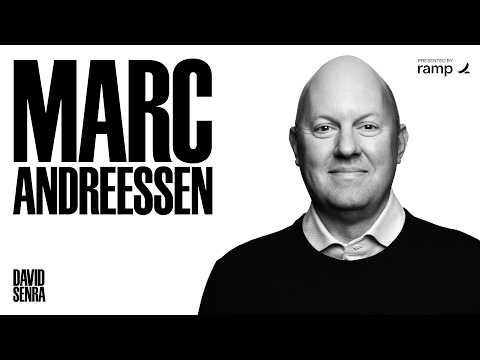
“We just have this like fundamental view that technology is, on balance, an enormously powerful force in the world, and basically that the big problem with the world is that there's not enough technology, there's not enough information, there's not enough intelligence. And we have this opportunity, we have these special sets of technologies that let us fundamentally improve things. And then there's this very special kind of personality type of the entrepreneur, who's able to build the product, and then able to build the company, and build a phenomenon, and really make an impact on things. And so when I look at the world, I'm just like, okay, this is just like... The world we live in is just a very primitive and crude place as compared to what it should be, and what it could be.”David Senra interview, 2024 · 7:16
Techno-optimism means choosing abundance over scarcity
Andreessen’s basic view is that many of the world’s problems persist not because technology has failed, but because there is too little of it. He argues that more intelligence, more information, and more capable tools expand what people can do, and that entrepreneurs are the people who turn those possibilities into real products and institutions1.
That makes his optimism practical, not just emotional. He is not saying progress happens automatically; he is saying societies can get better when they allow builders to create more energy, better software, stronger industries, and cheaper capabilities at scale12.
“We just have this like fundamental view that technology is, on balance, an enormously powerful force in the world, and basically that the big problem with the world is that there's not enough technology, there's not enough information, there's not enough intelligence. And we have this opportunity, we have these special sets of technologies that let us fundamentally improve things. And then there's this very special kind of personality type of the entrepreneur, who's able to build the product, and then able to build the company, and build a phenomenon, and really make an impact on things. And so when I look at the world, I'm just like, okay, this is just like... The world we live in is just a very primitive and crude place as compared to what it should be, and what it could be.”David Senra interview, 2024 · full transcript →
He thinks America still has the ingredients for a golden age
Andreessen ties techno-optimism to national capacity. He argues that the United States still has the preconditions for a major upswing in growth: resources, talent, security, advanced technology leadership, and the ability to produce abundant energy34.
This is why he often describes the upside in civilizational terms rather than as a narrow startup story. He sees the best-case path as something like a new roaring twenties: a broad expansion in growth, confidence, and building power, not just a few isolated breakthroughs5.
His optimism is also cultural. He believes a confident society should see itself as capable of shaping events rather than as helpless before them, which is why his language about progress is often tied to agency and ambition2.

“We have all the preconditions for a golden age.”Hoover Institution interview, 2024 · full transcript →
Progress is real even when it looks unimpressive at first
A core part of Andreessen’s argument is that people often underrate major innovations because they compare early products to some grand science-fiction ideal. His well-known contrast between flying cars and short online messages is meant to show how easy it is to dismiss a new tool before understanding what it actually changes.
He argues that software and networks are not trivial because communication is foundational to civilization. On that view, tools like global messaging, smartphones, navigation, ride-sharing, telepresence, and networked services matter because they change coordination, access, and economic possibility for millions of people67.
He also thinks many sectors look stagnant not because invention is impossible, but because regulation and subsidy structures protect incumbents and distort experimentation. That is why he points to regulatory competition across countries as one route to unlocking more innovation in areas like biotech, drones, and other frontier industries8.

“The whole basis of our civilization, in my view, is communication.”The Economist debate, 2012 · full transcript →
AI is the strongest current case for techno-optimism
Andreessen sees AI as the biggest technological revolution of his lifetime, larger than the internet in its likely economic and social effects9. His optimism here comes from both capability and economics: the systems are improving rapidly, and the cost of using them is dropping very quickly, which he expects to widen adoption and make new products viable10.
He also stresses how early everything still is. He does not think today’s interfaces, product categories, or business models are the final form, which means most of the important applications may still lie ahead1112.
That early stage creates opportunity for founders. He says AI is producing an unusually large gap between what early adopters think is possible and what incumbents understand, which means smaller teams may be able to build much more ambitious companies than established firms expect131415.
The main obstacles are fear, control, and bad governance
Andreessen does not think the biggest barrier to progress is a lack of ideas. He thinks the bigger barriers are cultural demoralization, status defense, censorship, overregulation, and institutional pressures that make people afraid to speak or build17.
He is especially concerned with concentrations of power that suppress truth rather than enable experimentation. His warning that power corrupts helps explain why his techno-optimism is tied to decentralization, open contestation, and suspicion of systems that decide what can be said or built from the top down18.
This is also why he frames politics as relevant to innovation. For him, whether a society gets more abundance depends on whether its institutions work with builders or against them, especially in strategic technologies and national capacity.
Techno-optimism still needs moral and political direction
Andreessen is not a simple determinist who thinks technology automatically leads to liberation. He argues that advanced tools can support either freedom or oppression depending on the values and institutions around them20.
That concern becomes most concrete in AI. He says the defining conflict is not just how smart the systems become, but what values they express and enforce, because AI is likely to become the interface layer for many parts of life2122.
So his techno-optimism has a condition: build aggressively, but also fight over the moral and civic framework in which the tools are deployed. On his account, the future gets better not merely from more capability, but from pairing capability with a culture that values truth, human agency, and open society212018.
Andreessen on techno-optimism, in his own words
“We have all the preconditions for a golden age.”
“We are not victims, we are conquerors.”
“The whole basis of our civilization, in my view, is communication.”
Where to watch
 Marc Andreessen on Techno-Optimism: America Can Have a Golden Age2024 · 74 min · full transcriptBest single overview of his techno-optimist case for a new American golden age built on growth, energy, entrepreneurship, and AI.
 Marc Andreessen on AI Timelines: Markets, Policy, and Open Source2024 · 81 min · full transcriptBest for understanding why he sees AI as the biggest current engine of techno-optimism.
 Marc Andreessen on Innovation and Technological Progress: Markets, Energy, Transport2012 · 57 min · full transcriptBest for his older, durable argument that progress is underestimated and often blocked by regulation and incumbents.
 Marc Andreessen on American Spirit: Growth, Power, and Optimism2025 · 226 min · full transcriptBest for the broader national and cultural frame behind his optimism about growth and American renewal.
 Marc Andreessen on AI Alignment: The Values of the AIs2024 · 107 min · full transcriptBest for the limits of techno-optimism: technology needs the right values and political environment.
 Marc Andreessen on AI Gap: Early Adopters vs. Incumbents2024 · 61 min · full transcriptBest for the startup-level implication: AI expands what small teams and ambitious founders can build.
Questions people ask
- What did Marc Andreessen say about China and American drone manufacturing?
- What did Marc Andreessen say about philanthropy and the role of government?
- What did Marc Andreessen say about regulatory competition and innovation between countries?
- What did Marc Andreessen say was the old Silicon Valley bargain?
- What does Marc Andreessen say about how early AI products are?
- What did Marc Andreessen say about Donald Trump and technology policy?
Sources
Every quote above, word for word from the transcripts. Numbers match the text.
“We just have this like fundamental view that technology is, on balance, an enormously powerful force in the world, and basically that the big problem with the world is that there's not enough technology, there's not enough information, there's not enough intelligence. And we have this opportunity, we have these special sets of technologies that let us fundamentally improve things. And then there's this very special kind of personality type of the entrepreneur, who's able to build the product, and then able to build the company, and build a phenomenon, and really make an impact on things. And so when I look at the world, I'm just like, okay, this is just like... The world we live in is just a very primitive and crude place as compared to what it should be, and what it could be.”
“We are not victims, we are conquerors.”
“We have all the preconditions for a golden age.”
“We can be energy independent anytime we want.”
“The roaring twenties. The roaring twenties. The roaring twenties. I mean, look, couple things. It is remarkable over the last several years with all of the issues, including, you know, every... Not just everything in politics, but also COVID and every other thing that's happened. It's really amazing. The United States just kept growing. If you just look at economic growth charts, The US just kept growing. And very significantly, many other countries stopped growing. So Canada stopped growing. The UK has stopped growing. Germany has stopped growing. And, you know, some of those countries may be actually going backwards at this point. And there's a very long discussion to be had about what's wrong with those countries, and there's, of course, plenty of things that are wrong with our country. But The US is just flat out primed for growth, and I think that's a consequence of many factors, you know, some of which were lucky and some of which through hard work. And so the lucky part is just, know, number one, you know, we just have like incredible physical security by being our own continent. You know, we have incredible natural resources.”
“Twitter is instant global public messaging for free.”
“The whole basis of our civilization, in my view, is communication.”
“For innovation internationally, that goes right back to the regulation, uh, topic, which is regulatory competition. Um, so various countries choosing to specialize where they want to have innovation, econ, what kind of innovation they want to have in their economy by the regulatory regimes. South Korea, embryonic stem cell research. Japan has liberalized drug development, big surge of drug R&D. Israel has commercial drone flights, which we, which are not allowed in the US. The UK, uh, online gambling, uh, is allowed, which means prediction markets work, which they can't in the US because they're illegal. Um, and so there's actually an opportunity for countries, I think, to differentiate through the regulatory structures and to have new kinds of centers of innovation as a result. I actually—I agree. I agree with this.”
“This is the biggest technological revolution of my life.”
“The price of AI is falling much faster than Moore's law.”
“I'm very skeptical that the form and shape of the products that people are using today is what they're going to be using in five or 10 years.”
“From all that, it kind of feels like it has to be early. Like, it's kind of hard to imagine that we've, like, we topped out in any way. It feels like everything is still developing. I mean, quite frankly, it feels like the products—to me, it feels like the products are still super early. Like, I'm, I'm very skeptical that the form and shape of the products that people are using today is what they're going to be using in five or 10 years. I think things are going to get much more sophisticated from here. Um, and so I think we probably have a long way to go.”
“…this is the biggest delta between what the early adopters understand as possible…”
“…we used to ask the question, is this idea too ambitious?”
“I'm full-time, I'm basically drowning in the pace of development right now…”
“…the deal was somebody like me basically could start a company…”
“The ring of power is inherently corrupting.”
“…technology is also completely perfectly compatible with the constrained vision…”
“…the single biggest fight is going to be over what are the values of the AIs…”
“AI will end up being the front end on all those things…”
How this guide was made: drafted with AI from the full transcripts of the recordings cited, then checked: every quotation must match a transcript word for word and be the speaker's own words, and an independent review gates accuracy. Methodology and corrections.
