Marc Andreessen on Software Eating World
Marc Andreessen’s “software eats the world” thesis says software stops being a support tool and becomes the core operating system of major industries, then keeps expanding as costs fall and capabilities rise.
- Software no longer just serves industries; it enters and reshapes them directly.
- He sees this as part of a larger, long technology deployment cycle, not a temporary bubble.
- Communication and information are foundational, so software that improves them has economy-wide effects.
- AI looks like the next acceleration of the thesis because intelligence itself is becoming cheaper and more widely usable.
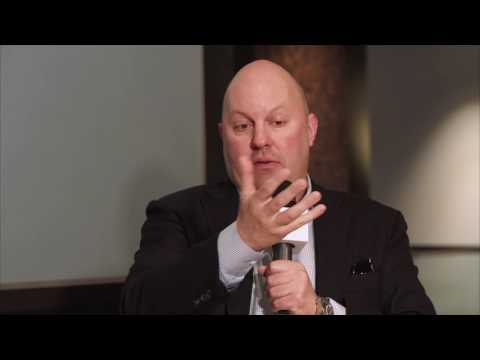
“…our thesis we call software eats the world…”StrictlyVC / Recode Decode interview, 2016 · 5:52
Software becomes the industry, not just a tool for it
Andreessen’s core idea is that the most important technology companies increasingly do not just sell software to existing sectors. They move into those sectors themselves and rebuild the product, the customer experience, and often the business model around software1.
That is why his thesis matters beyond Silicon Valley. If software can directly reorganize transportation, hospitality, finance, media, cars, and other large categories, then the center of economic power shifts toward whoever can best turn code into the service itself1.
“…our thesis we call software eats the world…”StrictlyVC / Recode Decode interview, 2016 · full transcript →
He sees this as a long historical deployment, not a fad
Andreessen places software inside a broader pattern of technological revolutions. He points to Carlotta Perez’s framework to argue that big technology waves go through bubbles and crashes, then enter a longer deployment phase where the technology spreads through the whole economy2.
That framing helps explain why he is structurally optimistic. The important question is not whether early excitement overshot in some moments, but whether the underlying technologies keep getting adopted into real institutions and daily life. His answer is yes, and he ties that to the opportunity to make modern technology work for far more people around the world234.
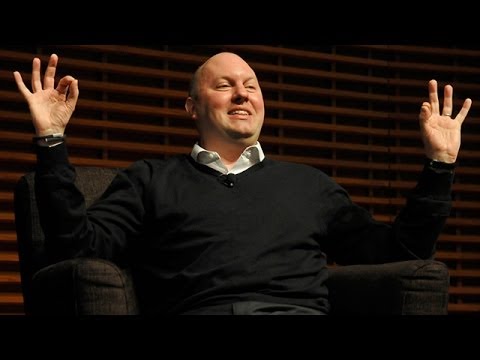
“…the best thinker on this topic is an, is an economist named Carlotta Perez…”Stanford GSB talk, 2012 · full transcript →
Why software spreads so widely: communication and information change everything
A key reason Andreessen thinks software can transform so many industries is that he treats communication and information as civilization-level infrastructure. If software dramatically improves how people communicate, coordinate, discover prices, learn, transact, and make decisions, then it can alter the economics of almost any field564.
That is also why he rejects the idea that digital products are trivial compared with physical inventions. He argues that global, instant, low-cost communication is a major breakthrough in its own right, even when critics dismiss it as less tangible than older industrial technologies56.
The main obstacles are incumbents, politics, and regulation
Andreessen does not argue that software wins automatically. He repeatedly points to politics and regulation as forces that protect incumbents and slow adoption, especially in sectors like energy and transportation where change looks slower than in internet markets78.
In his view, this is one reason some industries appear technologically stagnant: not because better approaches are impossible, but because the environment often blocks experimentation and scaling. He also thinks societies often move from ignoring a new technology to attacking it morally once it becomes too important to dismiss, which is another way resistance shows up when status and power are threatened9.
“…the whole environment in the US is just so, so politicized…”StrictlyVC / Recode Decode interview, 2016 · full transcript →
AI is the next phase of software eating the world
Andreessen’s newer view is that AI pushes the thesis much further because software is no longer only automating workflows or organizing information. It is starting to provide a form of usable intelligence, which expands what software can do inside products and companies1011.
He describes AI as the biggest technological revolution of his life and emphasizes that costs are falling extremely fast. That combination matters because when intelligence gets cheaper, software can move into more tasks, more products, and more industries at higher speed1213.
He also thinks we are still early. Product forms are unsettled, the gap between early adopters and incumbents is widening, and ambitious startups may be able to build much more with much smaller teams than established firms expect1415161718.
Andreessen on software eating world, in his own words
“…our thesis we call software eats the world…”
Where to watch
 Marc Andreessen on Software Eating the World: VC, public markets, and power laws2016 · 52 min · full transcriptBest direct explanation of what he means by software eating the world and why software companies move into whole industries.
 Marc Andreessen on Innovation and Technological Progress: Markets, Energy, Transport2012 · 57 min · full transcriptShows why he thinks software-driven communication, transport, and energy advances are real progress, not trivial distractions.
 Marc Andreessen on Big Breakthrough Ideas: Tech, founders, and VC2012 · 55 min · full transcriptGives the historical frame for why he sees this as a long deployment cycle rather than a passing boom.
 Marc Andreessen on AI Timelines: Markets, Policy, and Open Source2024 · 81 min · full transcriptExplains why he thinks AI is the next major acceleration of software’s reach across the economy.
 Marc Andreessen on AI Gap: Early Adopters vs. Incumbents2024 · 61 min · full transcriptBest for understanding how quickly AI may widen the gap between startups and incumbents.
Questions people ask
- What did Marc Andreessen say about regulatory competition and innovation between countries?
- What did Marc Andreessen say about the developing world and technology?
- What does Marc Andreessen say about how early AI products are?
- What does Marc Andreessen think technology is for?
- Why did Marc Andreessen say new technologies trigger moral panic?
- What did Marc Andreessen say about smartphones in the developing world?
Sources
Every quote above, word for word from the transcripts. Numbers match the text.
“…our thesis we call software eats the world…”
“…the best thinker on this topic is an, is an economist named Carlotta Perez…”
“We consider that the basically the, the, the amazing opening of the developing world or whatever terms you wanna use. The, the billions of people around the world who have not had access to what we would consider to be modern education, modern information, modern communication, modern politics access to markets. You know, most of the world has not, has not had access to those things historically. Most of the world is in the process of getting access to those things. And so we think the biggest thing happening in our time is the just tremendous flowering of, of basically the en-, the entire developing world. And it's all over the planet. And it's happening at different paces but it, it's really all over the planet. There's extraordinary stories now in almost every country on the planet of just amazing things happening. And we think it's a twin story, it's you know, it's a political and economic development story and a, and a markets development story, but then it's also a technology story.”
“And so we think a world in which everybody on the planet has a smartphone with internet access is a completely different world. Not just because they can play floppy birds but because they can, you know, very fundamental things. They can get up to date market information on pricing. Which is very important if your a farmer and you've never had that information before. Or they can get up to date health information, or they can educated, kids can get educated in ways, you know. A lot of countries around the world like they don't have textbooks much less like modern education systems so there's just an enormous ability to upgrade modern education across the entire world.”
“Twitter is instant global public messaging for free.”
“The whole basis of our civilization, in my view, is communication.”
“…the whole environment in the US is just so, so politicized…”
“For innovation internationally, that goes right back to the regulation, uh, topic, which is regulatory competition. Um, so various countries choosing to specialize where they want to have innovation, econ, what kind of innovation they want to have in their economy by the regulatory regimes. South Korea, embryonic stem cell research. Japan has liberalized drug development, big surge of drug R&D. Israel has commercial drone flights, which we, which are not allowed in the US. The UK, uh, online gambling, uh, is allowed, which means prediction markets work, which they can't in the US because they're illegal. Um, and so there's actually an opportunity for countries, I think, to differentiate through the regulatory structures and to have new kinds of centers of innovation as a result. I actually—I agree. I agree with this.”
“So he says stage three is like... Right. So when they failed to ignore it and they failed to argue society out of it I love it. They moved to the name calling. Right? And what's the name calling? The name calling is this is evil. This is moral panic. This is evil. This is terrible. This is awful. This is gonna destroy everything. Like, don't you understand, like, you know, all this, you know, it's just it's just like this is horrifying. You, you know, the person working on it are being reckless and evil and, you know, all this stuff and you must be stopped. And he said the reason for that is because basically fundamentally what these things are is they're a war over status. It's a war over status and therefore a war over power and then of course, ultimately money, but but status... Human status is the thing.”
“What we're dealing with here is intelligence.”
“AI is the latest in a long series of basically augmentation methods…”
“This is the biggest technological revolution of my life.”
“The price of AI is falling much faster than Moore's law.”
“I'm very skeptical that the form and shape of the products that people are using today is what they're going to be using in five or 10 years.”
“…this is the biggest delta between what the early adopters understand as possible…”
“…we used to ask the question, is this idea too ambitious?”
“I'm full-time, I'm basically drowning in the pace of development right now…”
“From all that, it kind of feels like it has to be early. Like, it's kind of hard to imagine that we've, like, we topped out in any way. It feels like everything is still developing. I mean, quite frankly, it feels like the products—to me, it feels like the products are still super early. Like, I'm, I'm very skeptical that the form and shape of the products that people are using today is what they're going to be using in five or 10 years. I think things are going to get much more sophisticated from here. Um, and so I think we probably have a long way to go.”
How this guide was made: drafted with AI from the full transcripts of the recordings cited, then checked: every quotation must match a transcript word for word and be the speaker's own words, and an independent review gates accuracy. Methodology and corrections.

