Make Life Multiplanetary
Mars is not an escape fantasy; it is a cost-reduction and reusability challenge.
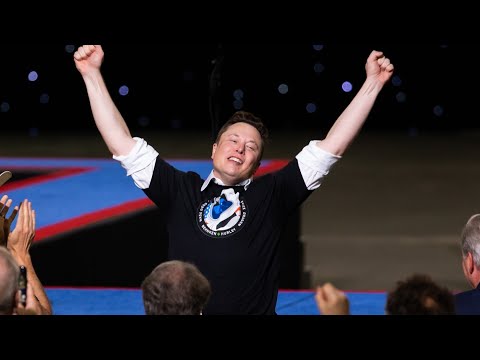
“…we need to bring them back safely, and we need to repeat these missions and have this be a regular occurrence…”NASA / SpaceX Demo-2 post-launch press conference, Kennedy Space Center, 2020 · 4:55
The lesson
Musk’s case for Mars starts with purpose, not tourism. He frames the goal as making life sustainably multiplanetary so civilization is not confined to one planet, while also giving people an ambitious future worth building toward123. In that framing, Mars is not a luxury project or an escape plan for a few people; it is the practical route toward a self-sustaining second branch of civilization, which is why he keeps returning to the need for a real city rather than a handful of visits45.
From there, he reduces the problem to economics and engineering. The main barrier is not desire but the cost of reaching space, so the breakthrough that matters most is a rocket system that is not only reusable, but rapidly and completely reusable6789. His analogy is implicit in the architecture: if rockets can be used more like aircraft, then access to orbit can become routine enough to support much larger ambitions beyond one-off missions10.
That is why Starship and its booster matter in his system of thinking. In the near term, Mars is about building the ship and booster first, proving they work, and then using that capability as the foundation for larger goals. Falcon Heavy and Crew Dragon fit this same pattern: milestones are valuable because they increase confidence, but they are only meaningful if they lead to repeatable operations and a transportation system that can keep improving12.
A Mars city, in Musk’s argument, only becomes plausible when multiple cost-reduction steps work together. Full reusability is the biggest lever, but it is followed by orbital refilling and making propellant on Mars, because a self-sustaining settlement cannot depend forever on Earth for every return trip and every ton of fuel. That is why he talks about infrastructure, not just vehicles: power, propellant production, and protected food production are basic requirements for a settlement that can survive and grow.
The practical takeaway is that Musk treats a civilization-scale vision as a sequence of concrete bottlenecks. He pairs a long-term reason to act with a short-term technical constraint: lower launch cost, achieve rapid reuse, master orbital refilling, then build the local systems a city would need on Mars1374. His operating style here is to make the inspiring goal useful by translating it into specific engineering problems that can be solved in order.
5 principles from Elon Musk
Start with a civilization-scale reason
Musk argues that Mars matters because it extends the future of consciousness and creates an inspiring frontier, not because it is an indulgence. Apply this by linking hard technical work to a reason big enough to justify years of effort and repeated setbacks.
“We must make life sustainably multi-planetary…”
Treat the real constraint as cost of access
He repeatedly reduces the Mars problem to the cost of getting to orbit and beyond. In your own work, identify the bottleneck that makes everything else expensive or slow, and attack that first instead of optimizing around it.
“…the fundamental issue is actually the cost of access to space…”
Build for rapid full reusability
For Musk, reusability is not a nice-to-have; it is the economic turning point that makes a spacefaring future possible. When a system must scale, design it to be used again quickly and cheaply rather than rebuilt each time.
“…the essential technology, the the holy grail breakthrough that's needed is a a rapid and completely reusable rocket system.”
Aim for a self-sustaining system, not a demo
A few missions do not achieve the goal; the target is a city that can continue and grow with local infrastructure. Apply this by asking whether your project can operate independently and repeatedly, not just succeed once under special conditions.
“…the fastest path to a self-sustaining city on Mars…”
Translate vision into the next engineering step
Musk connects the distant aim of Mars to immediate build tasks like the ship, booster, refilling, and local resource production. Use the same move: define the long-term outcome, then name the next physical or operational capability that must exist first.
“We need to seize the opportunity and do it as quickly as possible.”
Moments to watch
In his own words
The quotes behind the lesson, word for word from the transcripts. Numbers match the lesson above.
“We must make life sustainably multi-planetary…”
“…become a spacefaring civilization and a multi-planet species…”
“…life can't just be about solving problems.”
“…the fastest path to a self-sustaining city on Mars…”
“Well, I think the thing about Mars is that I think it's important for us to take the set of actions that are most likely to continue consciousness into the future? What increases the probability of consciousness of of of continuing into the future? I think we should not take it for granted that consciousness will continue because we have not encountered any aliens. Where are the aliens? This is the Fermi Paradox. This is one of the most important questions. How come we've not found any aliens? There's people out there who think we've found aliens. Trust me. I would know. We have not. Okay. People ask me, you've to Area 51. Okay. Please. SpaceX actually has Area 59. It's even better. Eight better than 51. Among So the set of actions we can take that are likely to increase the scope and scale of consciousness such that we are better able to understand the nature of the universe, one of those actions is to become a multi planet species or ensure that life is multi planetary.”
“…the fundamental issue is actually the cost of access to space…”
“…the essential technology, the the holy grail breakthrough that's needed is a a rapid and completely reusable rocket system.”
“…the critical breakthrough that's necessary is a rapidly reusable orbital rocket…”
“…reusability, I think, is absolutely fundamental to a breakthrough in access to orbit and beyond…”
“…make space travel like air travel…”
“…we need to bring them back safely, and we need to repeat these missions and have this be a regular occurrence…”
“We need to seize the opportunity and do it as quickly as possible.”
Reflect
- What is one goal in your work that feels visionary but is actually blocked by a specific cost or infrastructure problem? Name that bottleneck clearly.
- Where are you accepting one-off success when you should be designing for repeatable, reusable operation?
- If you had to make your project self-sustaining rather than dependent on constant outside rescue, what local capabilities would you need to build?
Check your understanding
Go deeper
 Elon Musk on Mars Colonization: Making Humans Multiplanetary2016 · 96 min · full transcript
 Elon Musk on SpaceX Reusability and Mars: Making Space Accessible2017 · 56 min · full transcript
 Elon Musk on Mars and SpaceX: Building the Interplanetary Future2018 · 72 min · full transcript
 Elon Musk on Starship and Mars: Making Space Travel Reusable2019 · 122 min · full transcript
 Elon Musk on Starship and Mars: Making Life Multiplanetary2022 · 123 min · full transcript
 Elon Musk on Crew Dragon Launch: We’ve Made History Again2020 · 56 min · full transcript
 Elon Musk on Falcon Heavy and Reusability: "Crazy Things Can Come True"2018 · 45 min · full transcript