Software Eats Industries
Software stops being a tool category and becomes the way whole industries are rebuilt.
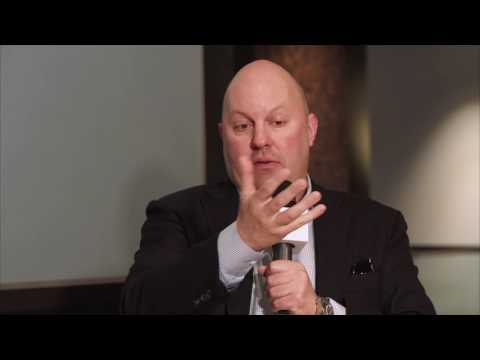
“…our thesis we call software eats the world…”StrictlyVC / Recode Decode interview, 2016 · 5:52
The lesson
Andreessen’s core claim is that software is no longer just a tool sold to existing industries. His view is that the most important new companies increasingly enter sectors like transportation, hospitality, finance, and other real-world markets and rebuild how those sectors operate from the inside1. To understand this, start with a simple shift: software stops being a support function and becomes the operating logic of the business itself1.
He ties that expansion to a broader optimism about technology’s role in the world. He argues that technology is a powerful force because many problems come from too little information, intelligence, and capability, not too much, which means software can improve real systems rather than merely entertain people2. That is why he pushes back on dismissive views of internet products: communication tools matter because communication is foundational to how civilization works, and new digital systems can be genuinely transformative even when critics treat them as trivial34.
This is also why he frames the moment as deployment rather than bubble. In his view, the right historical lens is the long rollout of a technological revolution into the wider economy, a framework he associates with Carlotta Perez5. On that view, the key question is not whether technology exists, but whether it is now being applied deeply enough across industries and across populations to change how the economy actually works56.
His examples point in the same direction: when software reaches energy, transport, and global communications, it changes access, coordination, and decision-making in the physical world, not just on screens37. He sees smartphones and internet access as especially important because they bring education, market information, and health information to billions of people who historically lacked those tools67. So software eating industries is not only about startups attacking incumbents; it is also about widening the set of people and sectors that can participate in modern systems67.
That does not mean every company in a hot category will win. Andreessen is explicit that you should not back a company just because it sits in a fashionable sector; the company still needs a real product and a meaningful leap in value, such as being far better, cheaper, or faster89. So the thesis is not that software automatically wins, but that software creates the conditions for exceptional companies when it is applied to large markets with a real product advantage910.
4 principles from Marc Andreessen
See software as an industry builder, not just a tool
Look for cases where software changes the core workflow, economics, or customer experience of an industry. The biggest opportunity is often not selling software to incumbents, but building a new company that operates the industry differently.
“…our thesis we call software eats the world…”
Treat communication products as fundamental infrastructure
Do not dismiss a product because it looks lightweight on the surface. If it changes how people share information and coordinate at scale, it can have deep economic and social effects.
“Twitter is instant global public messaging for free.”
Read the moment as deployment, not hype
When a technology wave matures, the next step is broad application across the economy. Ask where the technology is being put to work in real sectors and for real users, rather than focusing only on market excitement.
“…the best thinker on this topic is an, is an economist named Carlotta Perez…”
Demand a step-change in value
A software company entering an industry still needs a sharp advantage for customers. Use a simple test: is it dramatically better, cheaper, or faster than the old way?
“10x faster or 10x cheaper or 10x better…”
In his own words
The quotes behind the lesson, word for word from the transcripts. Numbers match the lesson above.
“…our thesis we call software eats the world…”
“We just have this like fundamental view that technology is, on balance, an enormously powerful force in the world, and basically that the big problem with the world is that there's not enough technology, there's not enough information, there's not enough intelligence. And we have this opportunity, we have these special sets of technologies that let us fundamentally improve things. And then there's this very special kind of personality type of the entrepreneur, who's able to build the product, and then able to build the company, and build a phenomenon, and really make an impact on things. And so when I look at the world, I'm just like, okay, this is just like... The world we live in is just a very primitive and crude place as compared to what it should be, and what it could be.”
“Twitter is instant global public messaging for free.”
“The whole basis of our civilization, in my view, is communication.”
“…the best thinker on this topic is an, is an economist named Carlotta Perez…”
“We consider that the basically the, the, the amazing opening of the developing world or whatever terms you wanna use. The, the billions of people around the world who have not had access to what we would consider to be modern education, modern information, modern communication, modern politics access to markets. You know, most of the world has not, has not had access to those things historically. Most of the world is in the process of getting access to those things. And so we think the biggest thing happening in our time is the just tremendous flowering of, of basically the en-, the entire developing world. And it's all over the planet. And it's happening at different paces but it, it's really all over the planet. There's extraordinary stories now in almost every country on the planet of just amazing things happening. And we think it's a twin story, it's you know, it's a political and economic development story and a, and a markets development story, but then it's also a technology story.”
“And so we think a world in which everybody on the planet has a smartphone with internet access is a completely different world. Not just because they can play floppy birds but because they can, you know, very fundamental things. They can get up to date market information on pricing. Which is very important if your a farmer and you've never had that information before. Or they can get up to date health information, or they can educated, kids can get educated in ways, you know. A lot of countries around the world like they don't have textbooks much less like modern education systems so there's just an enormous ability to upgrade modern education across the entire world.”
“…we wouldn't invest in an app company because it's an app company…”
“10x faster or 10x cheaper or 10x better…”
“The product that becomes a company is a really good template…”
Reflect
- What industry you know well still uses software as a layer on top rather than as the core operating model, and what would it look like to rebuild that industry around software?
- Have you dismissed any product as superficial because it looked like a consumer app? What would change if you evaluated it instead by how it improves communication, coordination, or access to information?
- In your own work, where could a 10x improvement in speed, cost, or quality unlock adoption in a large existing market?
Check your understanding
Go deeper
 Marc Andreessen on Software Eating the World: VC, public markets, and power laws2016 · 52 min · full transcript
 Marc Andreessen on Big Breakthrough Ideas: Tech, founders, and VC2012 · 55 min · full transcript
 Marc Andreessen on Innovation and Technological Progress: Markets, Energy, Transport2012 · 57 min · full transcript
 Marc Andreessen on Venture Capital: How Startups Win2013 · 61 min · full transcript