Build With AI
Andreessen’s public program: end stagnation, build competence, and use AI for abundance.
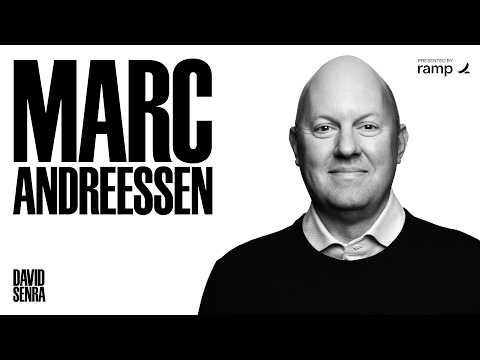
“We just have this like fundamental view that technology is, on balance, an enormously powerful force in the world, and basically that the big problem with the world is that there's not enough technology, there's not enough information, there's not enough intelligence. And we have this opportunity, we have these special sets of technologies that let us fundamentally improve things. And then there's this very special kind of personality type of the entrepreneur, who's able to build the product, and then able to build the company, and build a phenomenon, and really make an impact on things. And so when I look at the world, I'm just like, okay, this is just like... The world we live in is just a very primitive and crude place as compared to what it should be, and what it could be.”David Senra interview, 2024 · 7:16
The lesson
Andreessen’s basic program starts with growth. He argues that the United States still has the ingredients for a new expansionary era, especially if it chooses to build around energy, technology, and productive ambition instead of settling for stagnation12. His broader worldview is that the world’s main shortage is not desire or need, but capability: more technology, more information, and more intelligence let people solve more problems3.
From that perspective, AI matters because it is not just another software feature. Andreessen treats it as a foundational technological shift, larger than the internet, with rapidly falling costs and wide downstream effects on products, industries, and everyday work45. He also thinks it is still early, which means learners should focus less on today’s interfaces and more on the deeper pattern: intelligence is getting cheaper and easier to apply67.
In practical terms, he expects AI to change jobs mainly by changing tasks. His emphasis is that roles may persist while routine or mediocre work gets absorbed by systems, pushing people toward higher judgment, broader range, and stronger taste89. That is why he stresses skill stacking: becoming good across multiple areas creates outsized value, and AI increases the leverage of people who can combine specialties instead of staying narrowly single-threaded10.
Education is where this becomes personal. Andreessen sees AI as a deeply useful tool for self-improvement: something like a personalized tutor, coach, and thought partner that can help ambitious people learn faster and develop unusual competence over time111213. His advice follows naturally: use AI actively, not passively; bring it your questions, drafts, confusion, and ambitions so it can amplify deliberate practice rather than replace it1214.
He is also clear that the main question is not whether AI becomes magically autonomous, but what social and institutional values shape it. He downplays dramatic fantasies about machines suddenly becoming independent agents, and instead points to human choices about control, constraints, and alignment151617. That connects AI back to his wider political view: societies flourish when they reward competence and problem-solving, and they decay when systems become more important than the people trying to do real work1819.
5 principles from Marc Andreessen
Choose growth over stagnation
Start from the assumption that problems can be solved by building more capacity, not just redistributing scarcity. In your own work, ask what productive bottleneck could be removed with more energy, better tools, or better information.
“We just have this like fundamental view that technology is, on balance, an enormously powerful force in the world, and basically that the big problem with the world is that there's not enough technology, there's not enough information, there's not enough intelligence. And we have this opportunity, we have these special sets of technologies that let us fundamentally improve things. And then there's this very special kind of personality type of the entrepreneur, who's able to build the product, and then able to build the company, and build a phenomenon, and really make an impact on things. And so when I look at the world, I'm just like, okay, this is just like... The world we live in is just a very primitive and crude place as compared to what it should be, and what it could be.”
Treat AI as a general-purpose amplifier
Use AI as a broad capability that can improve many kinds of work, not as a novelty tied to one app. Because costs are falling quickly and product forms are still changing, build habits around experimentation rather than attachment to today’s interface.
“This is the biggest technological revolution of my life.”
Optimize for task transformation, not job panic
Look at which parts of your job are repetitive, average, or easily specified, because those are the first to shift. Then redesign your role around judgment, synthesis, communication, and ownership of outcomes.
“If the goal is to be a mediocre coder, then just let the AI do it.”
Stack skills to multiply your value
Combine two or three useful competencies so you can do work that a single specialist cannot easily match. AI makes this strategy stronger by helping you get functional in adjacent areas faster.
“…people who really want to improve themselves and develop their careers should be spending every spare hour, in my view at this point, talking to AI…”
Fight over values, not science fiction
The important governance question is what norms and constraints AI systems embody in the real world. When evaluating policy or products, focus on alignment, control, and institutional incentives rather than cinematic fears.
“…the single biggest fight is going to be over what are the values of the AIs…”
In his own words
The quotes behind the lesson, word for word from the transcripts. Numbers match the lesson above.
“We have all the preconditions for a golden age.”
“We can be energy independent anytime we want.”
“We just have this like fundamental view that technology is, on balance, an enormously powerful force in the world, and basically that the big problem with the world is that there's not enough technology, there's not enough information, there's not enough intelligence. And we have this opportunity, we have these special sets of technologies that let us fundamentally improve things. And then there's this very special kind of personality type of the entrepreneur, who's able to build the product, and then able to build the company, and build a phenomenon, and really make an impact on things. And so when I look at the world, I'm just like, okay, this is just like... The world we live in is just a very primitive and crude place as compared to what it should be, and what it could be.”
“This is the biggest technological revolution of my life.”
“The price of AI is falling much faster than Moore's law.”
“I'm very skeptical that the form and shape of the products that people are using today is what they're going to be using in five or 10 years.”
“From all that, it kind of feels like it has to be early. Like, it's kind of hard to imagine that we've, like, we topped out in any way. It feels like everything is still developing. I mean, quite frankly, it feels like the products—to me, it feels like the products are still super early. Like, I'm, I'm very skeptical that the form and shape of the products that people are using today is what they're going to be using in five or 10 years. I think things are going to get much more sophisticated from here. Um, and so I think we probably have a long way to go.”
“Everybody wants to talk about job loss but really what you want to look at is task loss.”
“If the goal is to be a mediocre coder, then just let the AI do it.”
“The additive effect of being good at two things is more than double.”
“AI is the philosopher's stone.”
“…people who really want to improve themselves and develop their careers should be spending every spare hour, in my view at this point, talking to AI…”
“Maybe the picture I'd leave you with... You you you mentioned the 20 year, you know, the 20 year old who has grown up having had this technology the whole time and having had all their Yeah. Questions answered. I think there's actually something even deeper. The AI... Like, the AI that my eight year old's gonna have by the time he's 20, it's gonna have had twelve years of experience with him. So it will have grown up with him. Be a good life coach. Yes. It will know everything he's ever done. It will know everything he ever did well. It will know everything he did that took real effort. It will know what he's good at. It will know what he's not good at. It'll know how to teach him. It'll know how to correct for his, you know, whatever limitations he has. It'll know it'll know how to maximize his strengths. It'll it'll it'll know what he wants.”
“We're used to being in this mass media kind of culture in which basically everything is mediated, right? Everything got filtered through TV interviews or newspaper interviews or magazine interviews, and, you know, obviously now more and more it's just no. You actually want smart people who are actually working on something explaining themselves, and then you have, you know, you have new kinds of intermediation like podcasts that open that up for people to make that possible. And so, yeah, like domain practitioners are, you know, really great. I mean, just to state the obvious.”
“…there's no genie in the bottle.”
“The natural course of progression is not for that to all of a sudden decide it has a mind of its own.”
“…the single biggest fight is going to be over what are the values of the AIs…”
“The people aren't running the system; the system is running the people…”
“…it doesn't win elections, it doesn't lead to a happy company, it doesn't lead to a well-functioning university…”
Reflect
- Which parts of your current work are mostly routine tasks, and which parts require judgment, taste, or trust? How could AI remove the first group so you can spend more time on the second?
- What two or three skills, if combined, would make you unusually effective in your field? How could you use AI over the next month to accelerate one of those adjacent skills?
- When you use AI, do you mostly ask it for answers or use it to improve your thinking process? What would change if you treated it more like a tutor or coach?
Check your understanding
Go deeper
 Marc Andreessen on American Spirit: Growth, Power, and Optimism2025 · 226 min · full transcript
 Marc Andreessen on Techno-Optimism: America Can Have a Golden Age2024 · 74 min · full transcript
 Marc Andreessen on Government Efficiency: Why Bureaucracy Fails2024 · 90 min · full transcript
 Marc Andreessen on AI and Education: The Super-Powered Individual2023 · 105 min · full transcript
 Marc Andreessen on AI Timelines: Markets, Policy, and Open Source2024 · 81 min · full transcript
 Marc Andreessen on Artificial Intelligence: Why the Panic Is Overblown2020 · 160 min · full transcript
 Marc Andreessen on AI Alignment: The Values of the AIs2024 · 107 min · full transcript