Geopolitical Reality
Wars, alliances, China, energy, and security shape markets more than daily price moves.

“Those tectonic plates, they're still shifting, they're still moving, they're still the most important things that are taking place in the world.”CNBC / Reagan National Economic Forum conversation, 2024 · 3:39
The lesson
Dimon’s core argument is that the biggest strategic risks are geopolitical, not the day-to-day market moves that usually get more attention. He describes the current period as unusually dangerous and points to war, nuclear risk, and shifting global power as the forces leaders should focus on first rather than obsessing over small changes in interest rates or asset prices1234. His practical message is to widen the frame: if you are only tracking quarterly data and market sentiment, you may miss the bigger forces shaping business conditions.
That leads to a risk-management mindset built on preparation rather than prediction. Dimon stresses humility about forecasting and argues that leaders should prepare for multiple plausible outcomes, including recession, inflation persistence, or geopolitical escalation, instead of assuming a smooth base case5. The point is not to panic; it is to acknowledge that serious shocks can happen and to build resilience before they do.
On national strategy, Dimon sees economic strength, military strength, and political values as connected. He argues that the U.S. cannot lead from weakness and must maintain strong defense while also preserving the economic system and democratic commitments that support long-term power6789. For business leaders, that means national security is not separate from economic planning: supply chains, investment, energy, and industrial capacity all sit inside a broader security picture.
Dimon’s view on China is tougher than simple engagement but more nuanced than total decoupling. He treats China as a serious national-security challenge while still arguing that the U.S. and China should keep talking, and that America should act with allies rather than alone10111213. The implication is that firms should distinguish between areas that truly require security-driven separation and areas where continued trade, dialogue, and coordination are still necessary.
Finally, Dimon ties geopolitical realism to a longer-term confidence in the West’s capacity to respond. He argues that alliances matter, that strengthening partners is strategically smarter than letting them drift apart, and that America’s underlying assets remain formidable if it keeps its resolve141516. So the chapter’s lesson is not fatalism. It is disciplined realism: take geopolitical threats seriously, reinforce alliances and resilience, and keep enough confidence to act decisively.
5 principles from Jamie Dimon
Treat geopolitics as the main strategic risk
Do not let daily market noise crowd out the larger forces that can reshape economies and industries. Build your plans around war, alliances, security, and political fragmentation, because these can matter more than short-term price moves.
“Those tectonic plates, they're still shifting, they're still moving, they're still the most important things that are taking place in the world.”
Prepare for scenarios instead of trusting forecasts
Use forecasting with humility and plan for several plausible outcomes, especially when inflation, rates, and conflict can interact. A resilient organization is designed to function even when the consensus view turns out wrong.
“People prepare for possibilities and probabilities, not calling one course of action since I've never seen anyone call it. I want to point out the central banks 18 months ago were 100% dead wrong. Okay? So maybe there should be humility about financial forecasting. I—I would be quite cautious about what might happen next year.”
Link economic strength to national security
Security is not just a military issue; it depends on a strong economy, functioning institutions, and the capacity to sustain allies and industry. When making business decisions, include how they affect resilience, supply, and strategic capability.
“We must maintain the strongest military in the world.”
Engage rivals without being naive
A hard problem like China does not require either blind optimism or total disengagement. Address real security concerns, but preserve dialogue and coordination where possible, especially with support from allies.
“I think China and America should engage.”
Strengthen alliances, not just your own position
Durable strength comes from keeping partners close and capable, not from acting in isolation. In practice, that means valuing cooperation across trade, defense, and economic policy rather than treating every issue as a solo contest.
“The goal should be, in my view, to strengthen Europe and get them closer, not to get them weaker and get them further.”
In his own words
The quotes behind the lesson, word for word from the transcripts. Numbers match the lesson above.
“…this may be the most dangerous time. The world has seen in decades…”
“Those tectonic plates, they're still shifting, they're still moving, they're still the most important things that are taking place in the world.”
“I don't think it makes a piece of difference whether a rate goes up 25 basis points or more.”
“I just would put on your table the most serious thing facing mankind is nuclear proliferation.”
“People prepare for possibilities and probabilities, not calling one course of action since I've never seen anyone call it. I want to point out the central banks 18 months ago were 100% dead wrong. Okay? So maybe there should be humility about financial forecasting. I—I would be quite cautious about what might happen next year.”
“We don't win from a position of weakness.”
“We better have the best military in the world Bar None.”
“We must maintain the strongest military in the world.”
“We need to keep the world free and safe for democracy.”
“I'm not afraid of China.”
“I think China and America should engage.”
“America First is OK, but not America Alone.”
“I don't think we have any engagement right now, and so - but that can start tomorrow.”
“The goal should be, in my view, to strengthen Europe and get them closer, not to get them weaker and get them further.”
“It's still a haven because of that strength, the rule of law, the strength of America's economy, innovation, the growth, the United States military, which not just protects America, it protects a good part of the western world. So it's still very strong. But yes, a lot of this uncertainty is challenging that a little bit. So you're going to be reading about this non-stop until, hopefully, these tariffs and trade wars settle down and go away, so people can say, I can rely on America. So I wrote... in my letter, I wrote America First is OK, but not America Alone. And so if you talk about... and again, I'm not worried about the markets as much as I am about keeping the western world together, free and safe for democracy. And that, to me, means you want to strengthen the economic relationships. If there's unfairness, deal with it. But yeah, we should be careful.”
“The real risk is our heart, our soul, our grit, our courage.”
Reflect
- What risks in your work do you treat as background noise even though they could reshape everything if they changed suddenly?
- Where are you relying on a single forecast or base case when you should instead prepare for several scenarios?
- How would your decisions change if you treated alliances, partnerships, or supply resilience as strategic assets rather than operational details?
Check your understanding
Go deeper
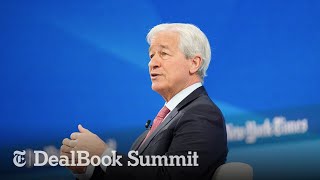 Jamie Dimon on Global Risk: War, China, and Inflation2023 · 33 min · full transcript
 Jamie Dimon on China Trade Relations: America First, Not Alone2023 · 38 min · full transcript
 Jamie Dimon on Geopolitics and Economic Security: Truth Forward2024 · 39 min · full transcript
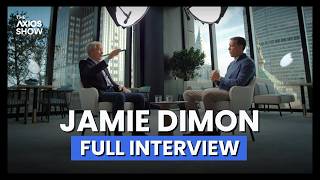 Jamie Dimon on America’s Future: AI, Risk, and Renewal2024 · 40 min · full transcript
 Jamie Dimon on Global Economy Outlook: Cautious on Rates, War, and Inflation2023 · 71 min · full transcript
 Jamie Dimon on Economy, AI & Risk: Bonds, Geopolitics and Leadership2024 · 61 min · full transcript