Elon Musk on Free Speech
Musk treats free speech as the core condition for democracy and wants X to allow lawful speech broadly while using transparency, context, and verification to fight manipulation.
- Free speech is, for Musk, a precondition of democracy.
- He bought Twitter/X because he believed censorship and narrative control were growing on the platform.
- His basic rule is broad permission for lawful speech, not speech shaped by political or advertiser pressure.
- He prefers adding context and transparency over removing posts.
- He sees bots, fake accounts, and deceptive media as threats to real speech, so verification matters.
Free speech is the safeguard that makes democracy possible
Musk’s starting point is simple: citizens cannot govern themselves if they cannot hear competing claims, test them, and decide for themselves. He ties free speech directly to informed voting and says democracy breaks down when people are denied the information needed to judge public affairs.12
He talks about this in unusually high-stakes terms. In his view, the loss of free speech is not a minor policy mistake but a civilizational danger, because once open debate is lost, it is hard to recover.345
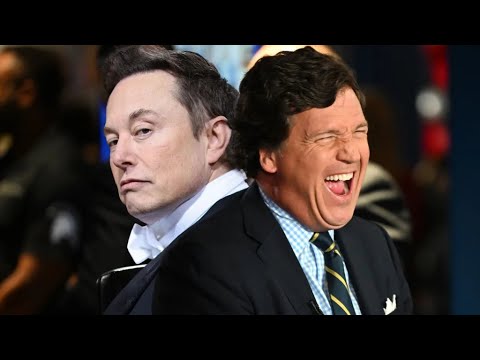
“…if we don't have free speech, we don't have democracy…”Tucker Carlson Tonight interview, 2023 · full transcript →
He bought Twitter/X because he thought the public square was being manipulated
Musk says he became increasingly uneasy with how Twitter was operating before he bought it. He describes noticing changes in the system, feeling that something was off, and seeing deplatforming decisions as a sign that the platform was suppressing speech instead of functioning as an open arena for debate.6
That is why he repeatedly describes X not just as a company, but as a digital town square. The point, as he frames it, was to preserve a place where major political and social arguments could happen in public rather than being quietly narrowed by gatekeepers.6
He also presents the acquisition less as a personal desire than as a burden he took on because he thought the platform mattered. Even earlier, he said he did not want to own Twitter, which fits his claim that the motivation was not prestige but the importance of open discourse.7
His rule is broad lawful speech, with limits coming mainly from the law
Musk’s practical standard is that speech should generally be allowed if it is legal. He argues for a platform that follows the law in each country but otherwise stays strongly committed to free expression.
This means he resists the idea that platforms should remove speech simply because it is unpopular, politically inconvenient, or commercially costly. He frames outside pressure to shape speech, especially from advertisers, as an attempt to control the platform rather than engage in open argument.8
His broader concern is that informal pressure can be just as powerful as formal censorship. A system can still become restrictive, in his view, if companies fear punishment for allowing lawful but controversial views.83
He prefers transparency and added context over takedowns
Musk’s preferred answer to falsehood is more visible correction, not less visible speech. He says his aim for X is to be the best or least inaccurate source of truth, and he points to Community Notes as a way to correct claims by adding context rather than simply deleting posts.9
That matters because it shows his theory of moderation: the platform should expose claims to scrutiny, supply explanation, and let users see both the original statement and the correction. He even says no one is exempt from this process, including himself.9
He links this to a wider preference for transparency. In his telling, people who want to spread lies dislike systems that make claims easier to inspect and challenge in public.10
Authentic speech requires fighting bots, impersonation, and misleading media
Musk does not treat free speech as a free-for-all where authenticity does not matter. He argues that bots and fake accounts distort public conversation, so reducing them improves trust and reduces misinformation.
That is why verification plays a large role in his thinking. He says it will be fundamental in the future, because users need better ways to know whether an account or a piece of media is what it claims to be.11
He applies the same idea to AI-generated content: if something could be mistaken for real, it should be clearly labeled. In his view, open speech works better when identity, provenance, and context are easier to verify.11
For Musk, the fight over speech is also a fight over power
Musk often describes speech conflicts as part of a larger struggle over who gets to shape public reality. He connects censorship, narrative management, media pressure, and political power into one issue: whether citizens will encounter reality directly or through systems designed to steer them.10
That helps explain why he speaks about elections and speech in the same breath. He sees open information as the condition for legitimate self-government, which is why he casts current choices as unusually consequential for freedom.452
Whether one agrees with his political conclusions or not, the core principle is consistent: concentrated control over speech threatens democratic judgment, while open contestation gives truth a better chance to win over time.91
Musk on free speech, in his own words
“…if we don't have free speech, we don't have democracy…”
“I think freedom is is is fundamentally at stake in the election tomorrow…”
Where to watch
 Elon Musk on Free Speech: Twitter, Elections, and Civilization2024 · 159 min · full transcriptBest for understanding why Musk sees free speech, censorship, and elections as part of the same democratic crisis.
 Elon Musk on AI Safety and Free Speech: We Need Insight, Not Nothing2023 · 96 min · full transcriptMost direct statement of his core principle that democracy depends on free speech.
 Elon Musk on Twitter Takeover: Free Speech, Bots, and X2023 · 87 min · full transcriptBest explanation of how his free-speech approach works on X in practice, including lawful speech, bots, and verification.
 Elon Musk on Trust and AI: The mind is a storm2023 · 94 min · full transcriptUseful for seeing how he thinks about advertiser pressure, trust, truth-seeking, and Community Notes.
 Elon Musk on a Future Worth Excited About: AI, robots, space2022 · 70 min · full transcriptShows the earlier version of his town-square argument and why he wanted more transparency around Twitter.
Questions people ask
Sources
Every quote above, word for word from the transcripts. Numbers match the text.
“…if we don't have free speech, we don't have democracy…”
“Uh, First Amendment, um, if we don't have free speech, we don't have democracy because people cannot make an informed vote. Those are my controversial views, and, you know, and, and look, I, I, I don't think either party, I don't think the Republicans are perfect. I don't think obviously I right now I’m more Republican than Democrat, but it's not like I think the Republican Party is perfect or, or without issues. Um, but we've got a choice between two candidates, and I think on balance it's a no-brainer, uh, to vote for Trump. And if we don't vote for Trump, I think we are at serious risk of losing our democracy and…”
“The point at which you lose free speech, it doesn't come back…”
“I think freedom is is is fundamentally at stake in the election tomorrow…”
“Vote like your life depends on it because I think it does.”
“The reason I bought it was because I... I'm pretty attuned since I I was, like, the most interacted with user on Twitter before the acquisition. So before the acquisition, I had more interactions than than... Like, there's some accounts like Obama or whatever had higher follower accounts, but, I had the most number of interactions of of any account in the system. So, I was very attuned to, like... If if they saw chain... If they changed the system, I can tell immediately. Like... And I'm like I'm like, something weird is going on here. You know? Like Yeah. So there's like... I I just got increasingly uneasy. And, obviously, when when they deplatformed the setting president, you know, not the deep deep deep platform Trump, that was that was just insane. You know? And and and the things he was posting, like, was posting things that that... Like, was posting good things.”
“I do not want to own Twitter.”
“If somebody's gonna try to blackmail me with advertising... Blackmail me with money, go fuck yourself.”
“But my aspiration for the X platform is that it is the best source of truth or the least inaccurate source of truth. And well, I don't know if you will believe me or not, but I think honesty is the best policy. And I think that the truth will win over time. And the we've got this great system, and it's getting better, called community notes, which is fantastic, I think, at correcting falsehoods, or or adding context. In fact, we we make a point of of not removing anything, but only adding context. Now that context could could include that this is completely false, and here's why. And and and no one is immune to this. I'm not immune to it.”
“…those who want to push lies obviously hate truth and transparency.”
“So yeah, I think verification is going to be extremely fundamental in the future. That's why we're so focused on it. So I mean, the reason I brought that up is, you know, as a content creator, I'd like to keep making those and I don't want to necessarily fool people, right? So would it be possible to, I don't know, add a flag to it so that content creators can say, "Hey, this is AI-generated content. Don't take it seriously. It's a parody." Well, I think in the tweet, you know, in the post, I think it would be advisable to say that this is not real, right, if it is something that can be potentially misinterpreted. It was crazy how viral that picture of the Pope with the…”
How this guide was made: drafted with AI from the full transcripts of the recordings cited, then checked: every quotation must match a transcript word for word and be the speaker's own words, and an independent review gates accuracy. Methodology and corrections.