Dopamine and Drive
Motivation is a system of wanting, pursuit, and baseline.

“People with ADHD yes, they are distractable. Yes, they are impulsive. Yes, they are easily annoyed by things happening in the room. They sometimes have a high level of emotionality as well. Not always, but often however people with ADHD can have a hyper focus and incredible ability to focus on things that they really enjoy or and are intrigued by.”Huberman Lab podcast, April 2022 · 14:38
The lesson
Dopamine is better understood as a system for wanting, pursuit, and effort than as a simple pleasure chemical. In these recordings, Huberman ties dopamine to motivation, craving, movement, focus, and the willingness to work for something, which is why it shows up in both healthy drive and addiction risk12. A useful starting idea is that dopamine pushes attention and behavior outward toward what might be gained, not just toward what already feels good.
A key correction is that motivation is not about isolated 'hits' of dopamine. Huberman emphasizes that what matters is the relationship between your baseline dopamine and any peak above that baseline; the same experience can feel very different depending on where you started and what your recent peaks have been34. This helps explain why repeated overstimulation can make ordinary rewards feel flat and why chasing ever-bigger spikes can backfire over time45.
Reward timing matters because dopamine is strongly linked to anticipation and surprise. Huberman says dopamine is more about the desire to pursue than pleasure alone, and that novelty or unexpected rewards amplify the signal, which helps explain why new cues, uncertain outcomes, and variable rewards can become especially compelling6. The downside is that the same features that energize learning and exploration can also strengthen craving and compulsive pursuit62.
Dopamine also helps explain why attention is uneven rather than simply 'good' or 'bad.' In the ADHD material, Huberman notes that some people struggle with distractibility and impulse control yet can focus intensely on what feels interesting or rewarding, which fits the broader point that dopamine shapes salience and effort allocation789. That is also why constant context switching tends to hurt focus: it fragments the sustained pursuit state that dopamine can support when directed at one target10.
The practical takeaway is not to fear dopamine but to manage it as a dynamic system. Huberman stresses that prior dopamine levels influence current motivation, and current behavior influences motivation in the coming days and weeks, so patterns matter more than single moments. In practice, that means being cautious about repeatedly chasing large spikes, using novelty deliberately rather than constantly, and building work and rewards in ways that preserve baseline motivation instead of draining it54.
5 principles from Andrew Huberman
Treat dopamine as motivation, not just pleasure
Think of dopamine as the system that energizes wanting, pursuit, and effort. This frame helps explain why the same biology supports productive ambition, focused work, craving, and addiction risk.
“There's a fundamental relationship between dopamine released in your brain and your desire to exert effort.”
Manage baseline and peaks
Your experience of reward depends on where your dopamine baseline is and how big your recent peaks have been. If you repeatedly chase large spikes, ordinary activities can feel less satisfying and motivation can drop.
“Again, how much dopamine you experience from something depends on your baseline level of dopamine when you arrive there, and your previous dopamine peaks. Okay? That's super important to understand, and it's completely neglected by the general language of dopamine hits. This is why when you repeatedly engage in something that you enjoy, your threshold for enjoyment goes up and up and up. So I want to talk about that process.”
Use novelty carefully
Surprise and novelty are powerful dopamine drivers, so they can help initiate learning and engagement. But they can also train you to depend on constant stimulation, making steady work and familiar rewards harder to appreciate.
“The one thing dopamine loves more than anything else is surprise.”
Reduce context switching to protect drive
Dopamine supports a narrowed, goal-directed state of attention. Frequent switching between tasks interrupts that state and makes it harder to sustain effort on the thing that matters most.
“…the brain does not do well with constant context switching…”
Remember that dopamine is trainable over time
Your current habits shape future motivation. Instead of asking only how to feel more motivated now, ask what today’s reward pattern will do to your motivation next week.
“Again, how much dopamine you experience from something depends on your baseline level of dopamine when you arrive there, and your previous dopamine peaks. Okay? That's super important to understand, and it's completely neglected by the general language of dopamine hits. This is why when you repeatedly engage in something that you enjoy, your threshold for enjoyment goes up and up and up. So I want to talk about that process.”
Moments to watch
In his own words
The quotes behind the lesson, word for word from the transcripts. Numbers match the lesson above.
“There's a fundamental relationship between dopamine released in your brain and your desire to exert effort.”
“…dopamine lies at the heart of addiction to all things.”
“…there's no such thing as a dopamine hit.”
“Again, how much dopamine you experience from something depends on your baseline level of dopamine when you arrive there, and your previous dopamine peaks. Okay? That's super important to understand, and it's completely neglected by the general language of dopamine hits. This is why when you repeatedly engage in something that you enjoy, your threshold for enjoyment goes up and up and up. So I want to talk about that process.”
“The real key is to not expect or chase high levels of dopamine release every time we engage in these activities.”
“The one thing dopamine loves more than anything else is surprise.”
“People with ADHD have poor attention and they have high levels of impulsivity…”
“…people with ADHD can have a hyper focus and incredible ability to focus on things that they really enjoy…”
“People with ADHD yes, they are distractable. Yes, they are impulsive. Yes, they are easily annoyed by things happening in the room. They sometimes have a high level of emotionality as well. Not always, but often however people with ADHD can have a hyper focus and incredible ability to focus on things that they really enjoy or and are intrigued by.”
“…the brain does not do well with constant context switching…”
Reflect
- Where in your life are you chasing repeated high-stimulation rewards that may be lowering your enjoyment of slower, more important work?
- Think of one project you avoid and one activity you easily hyperfocus on. How might reward, interest, or novelty be shaping the difference?
- What would it look like to structure your day so that rewards support motivation over the next week, not just the next hour?
Check your understanding
Go deeper
 Andrew Huberman on Dopamine: Motivation, Focus & Satisfaction2021 · 137 min · full transcript
 Andrew Huberman on Motivation and Dopamine: Drive, Reward, and Craving2022 · 89 min · full transcript
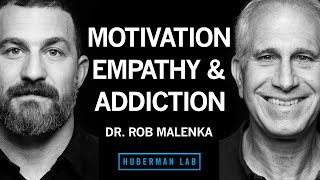 Andrew Huberman on Dopamine and Social Reward: Reward, Learning, and Context2021 · 170 min · full transcript
 Andrew Huberman on Focus and ADHD: Tools to Improve Attention2022 · 138 min · full transcript
 Andrew Huberman on Nicotine: Effects on the Brain, Body & Quitting2021 · 114 min · full transcript